
TL;DR:
- Most roof leaks originate at penetrations like vents, chimneys, or skylights rather than in the open field of the roof. Water travels horizontally for 8-12 feet before showing as interior stains, requiring careful inspection of flashing and penetrations, especially in Texas’s harsh climate. A comprehensive approach—including interior, attic, exterior inspections, and targeted testing—is essential to accurately identify and repair leaks, preventing costly future damage.
Your roof could be leaking right now, and you would have no idea. Water from a roof leak travels 8-12 feet or more horizontally before it ever shows up as a stain on your ceiling, meaning the actual entry point is rarely where the damage appears. For Texas homeowners and business owners in El Campo and Houston, the risk is especially high. Intense summer sun degrades roofing materials faster than in most other states, and heavy rainstorms during hurricane season push wind-driven rain into spots that a dry-day inspection would never catch. This guide walks you through exactly how to find a roof leak before it turns into a five-figure repair bill.
Table of Contents
- Common causes of roof leaks in Texas
- How to spot interior signs of a roof leak
- Attic and exterior inspection techniques
- Testing and confirming leak locations
- Preventative maintenance to minimize future leaks
- Why most roof leak guides miss critical steps
- Protect your property with expert roof solutions
- Frequently asked questions
Key Takeaways
| Point | Details |
|---|---|
| Penetrations are leak hotspots | Chimneys, vents, and flashing cause most Texas roof leaks. |
| Water stains mislead location | Stains often appear far from the true leak source due to water travel. |
| Multi-zone inspection is critical | Check interior, attic, and exterior to pinpoint the real leak. |
| DIY tests are effective | A hose test, done stepwise, reliably confirms leak entry points. |
| Prevent leaks through maintenance | Regular checks and timely boot/flashing replacement minimize future roof damage. |
Common causes of roof leaks in Texas
Understanding where leaks commonly start gives you the foundation for a smart inspection. You do not need to check every square inch of your roof. You just need to know the high-risk zones.
The single biggest insight experienced roofers use is this: 90% of roof leaks occur at penetrations, not in the open field of your roof. Penetrations are anywhere something pokes through the roof surface, such as chimneys, vent pipes, skylights, HVAC curbs, and valleys where two roof planes meet. The open decking between these points is where leaks are least likely.
Here are the most common culprits you will find on a Texas roof:
- Pipe boots (the rubber or lead collars around vent pipes)
- Step flashing at the junction of roof and walls
- Counter flashing around chimneys
- Valley metal where roof planes intersect
- Skylight frames and curbs
- Roof-to-wall transitions on low-slope additions
- Nail pops under shingles that lift the surface
Texas sun is brutal on rubber. Pipe boots crack after 8-15 years, especially those on south-facing slopes that absorb the most UV exposure. Step flashing at walls is another frequent failure point because it relies on caulk and metal alignment that shifts over time with thermal expansion. In Houston and El Campo, summer temperatures regularly push roof surface temperatures well above 160°F, which dramatically accelerates material breakdown.
| Leak source | Average lifespan in Texas heat | Risk level |
|---|---|---|
| Pipe boots (rubber) | 8-12 years | Very high |
| Step flashing | 15-20 years | High |
| Chimney counter flashing | 15-25 years | High |
| Skylight seals | 10-15 years | Medium-high |
| Valley metal | 20-30 years | Medium |
| Open field shingles | 25-40 years | Low |
If your home or commercial building is more than a decade old and you have not had flashing or pipe boots inspected, you already have potential leak points that deserve attention. For a deeper look at regional patterns, the Houston roof leak causes page explains how local climate factors specifically affect your roof.
How to spot interior signs of a roof leak
Once you understand what causes leaks, the next step is looking for evidence inside your home or business. The tricky part is that interior signs are often subtle and easy to dismiss as something else.
Common interior signs include water stains, peeling paint, musty odors, mold growth, and sagging drywall on ceilings and walls. Any one of these signals that water has been present long enough to cause secondary damage.
Look for these specific indicators on a room-by-room walkthrough:
- Ceiling discoloration that looks tan, brown, or yellowish, often with a ring pattern
- Bubbling or peeling paint on ceilings or upper walls, especially near exterior walls
- Soft or spongy drywall that gives slightly when pressed
- Mold or mildew spots, which can appear black, green, or white
- Musty odors in specific rooms, especially after rain
- Rust stains running from ceiling fixtures or metal brackets
- Warped or buckled wood on window frames, door frames, or trim near exterior walls
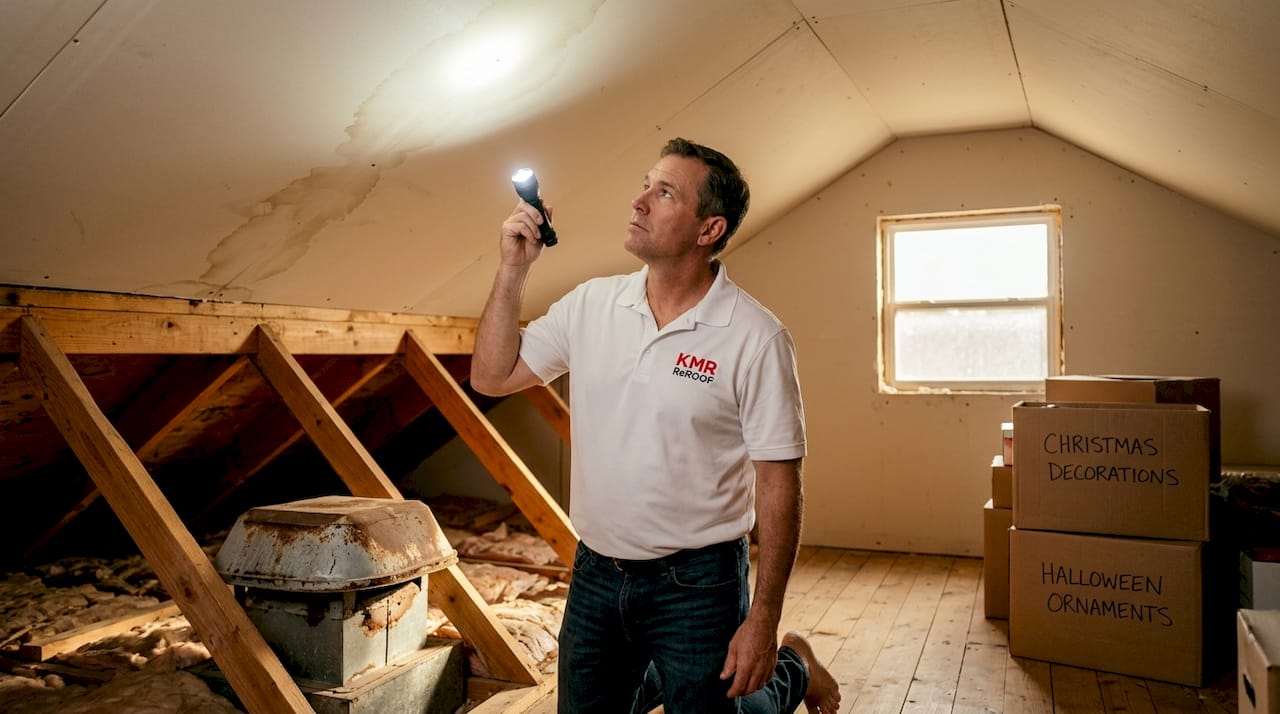
The most important thing to remember here is that the stain is not the source. Because water travels 8-12 feet or more sideways before dripping down, a stain in the center of a bedroom ceiling could be coming from a failed pipe boot six feet uphill toward the ridge. This is why so many DIY repairs fail. People patch the wrong spot.
When you find a stain, trace it uphill. On a sloped roof, water travels down the roof deck or along a rafter until gravity forces it to drip. The actual entry point is almost always higher up and closer to a penetration point than the stain suggests.
Pro Tip: After a rainstorm, do a quick interior walkthrough with your phone’s flashlight. Fresh wet stains are darker and easier to catch in the first 24 hours. Photograph every new stain with a timestamp so you can track patterns across multiple storms.
If you notice a leak actively dripping, protect your belongings and structure immediately. The emergency roof repair steps guide can help you minimize damage while waiting for professional help.
Attic and exterior inspection techniques
After identifying potential clues inside your home, it is time to investigate the attic and roof surface directly. This two-part check is where most homeowners skip a step, and that shortcut leads to repeated repairs without resolution.
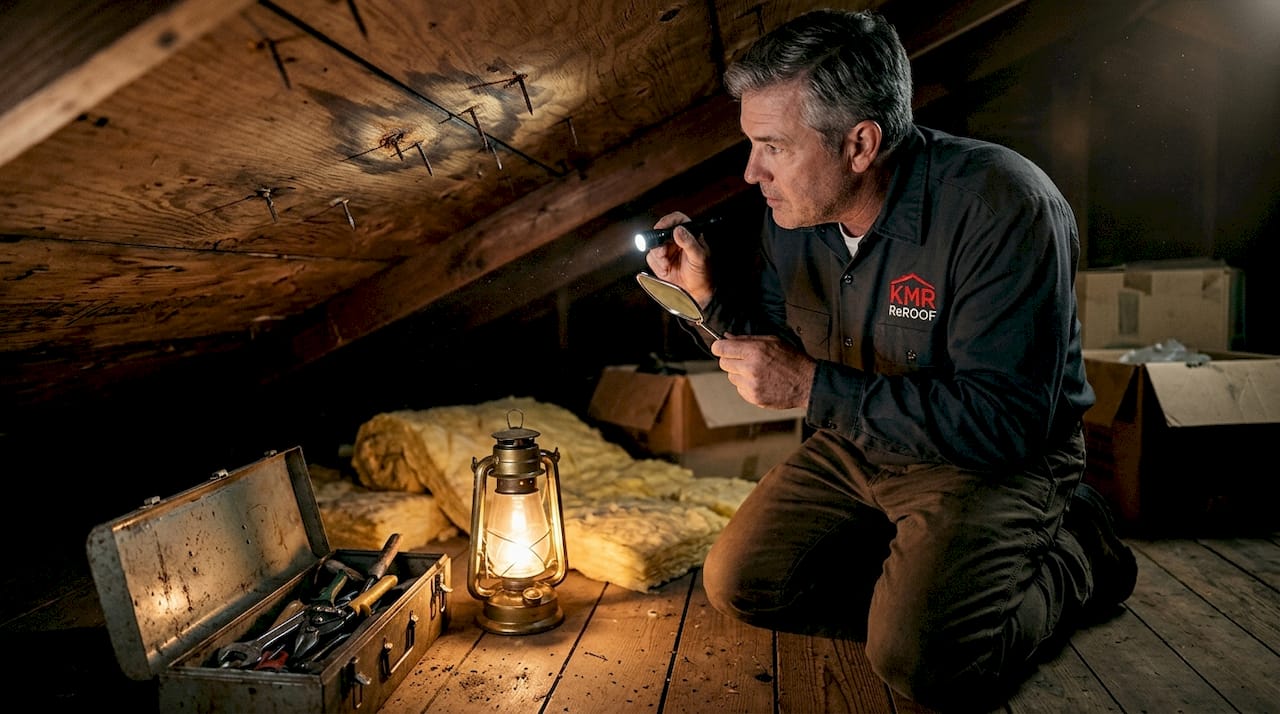
Attic inspection step-by-step:
- Wait for daylight hours and use a bright flashlight or headlamp in addition to any attic lighting.
- Enter the attic and allow your eyes to adjust before moving around.
- Look for darkened wood, wet insulation, rusted nails, mold patches, or visible daylight coming through the decking.
- Follow any stains or discoloration uphill along the rafters toward the ridge.
- Mark the suspected entry point with chalk or painter’s tape so you can find it when you get on the roof.
- Check the underside of the decking near every penetration, chimney, and valley.
Rusted nails are a reliable indicator because they rust only when exposed to moisture consistently. Mold on the underside of the decking indicates long-term water presence, not a single storm event. Daylight through holes is obvious but rarer, usually caused by storm damage or animal entry.
| What you see in the attic | What it means |
|---|---|
| Dark streaks on rafters | Water traveled this path repeatedly |
| Wet or compressed insulation | Active or recent leak nearby |
| Rusted nails | Chronic moisture exposure at that spot |
| Mold on decking underside | Leak has been present for weeks or months |
| Daylight through decking | Physical breach, likely storm-related |
| White mineral deposits | Slow evaporation leak over long period |
For the exterior inspection, walk the roof perimeter first from the ground with binoculars if needed. Look for lifted flashing, cracked pipe boots, missing shingles, or open seams. For flat or low-slope roofs common on commercial buildings, look for ponding water areas, blistering membrane, and open seams at edges.
Pro Tip: Never walk on a wet roof. Beyond the safety risk, wet shingles are slippery and you can crack brittle older shingles just by stepping on them. Schedule your exterior inspection for a dry morning when the surface is firm and visible damage stands out clearly.
For flat roofs in particular, the inspection process is different from a sloped shingle roof. The flat roof inspection guide covers those specific techniques, and the inspect roof damage safely article provides important safety guidelines before you climb up.
Testing and confirming leak locations
Visual inspection narrows the field, but testing closes the gap between suspicion and certainty. This step is especially important when leaks are intermittent, appearing only during specific wind directions or particularly heavy rain events.
The hose test: step-by-step
- Assign one person to stay inside the attic with a flashlight and a way to communicate (phone or walkie-talkie).
- Start at the lowest section of your suspected leak zone and work uphill.
- Soak each 2-foot section for 2-3 minutes before moving higher.
- Have your inside observer call out the moment water appears.
- When water is detected inside, mark the corresponding outside section and note which roof feature is nearby.
- Do not skip directly to the highest point. Rushing the test causes missed readings.
Patience is the key to this test. Most failures happen because the person on the hose moves too fast and soaks multiple sections at once. If water appears inside and you have already moved the hose to a new spot, you will misidentify the source.
For situations where visual and hose testing still leave uncertainty, thermal imaging is the next step. Infrared cameras detect temperature differences caused by wet insulation or wet decking beneath the surface. A soaked section of insulation holds heat differently than dry material, and a thermal scan makes that visible without tearing open your ceiling. Many roofing professionals use this technology for commercial flat roofs and large residential projects.
Pro Tip: Schedule any professional thermal scan in the early evening after a warm day. The temperature contrast between wet and dry material is most pronounced as the roof cools down. Midday scans are often inconclusive because surface heat masks the difference.
When to call a professional instead of continuing DIY testing:
- The leak reappears after two or more attempted repairs
- You cannot safely access the roof or attic
- The building has a flat roof or TPO membrane
- Interior damage includes mold or structural softening
- The leak only occurs during wind-driven rain at specific angles
For step-by-step professional repair guidance specific to this area, the fix roof leak El Campo resource walks through the full process.
Preventative maintenance to minimize future leaks
Once a leak is found and fixed, the goal is to make sure it does not come back. Most recurring leaks are not bad luck. They are the result of skipped maintenance and missed early warning signs.
Build these habits into your annual property routine:
- Inspect pipe boots every spring, especially south-facing ones. Look for cracks, lifted edges, or gaps where the rubber meets the pipe.
- Check step flashing and counter flashing after any significant storm. Flashing can pull away from walls or chimneys if caulk fails.
- Clear gutters twice a year in El Campo and Houston. Blocked gutters cause water to back up under shingles along the eave, a slow leak source that most people never connect to the roof.
- Trim tree branches that hang over the roof. Branches drop debris that holds moisture against shingles and scratches protective granules.
- Document your roof age and material type. When your pipe boots reach the 8-15 year mark, proactive replacement costs a fraction of a water damage repair.
Pro Tip: After any hailstorm or named tropical storm, do a full inspection within 72 hours. Insurance claims for storm damage typically require documentation that damage is directly tied to a specific event, and waiting too long can weaken your claim.
The single biggest mistake property owners make is treating leaks as isolated events rather than signs of a broader maintenance gap. A failed pipe boot today often means flashing failure is coming in 12 months. For a full maintenance schedule, the roof maintenance tips Houston page covers seasonal routines, and avoid roofing mistakes Texas covers the errors that turn small problems into expensive replacements.
Why most roof leak guides miss critical steps
Here is something most generic guides will not tell you: finding a roof leak is a multi-zone problem, not a single-point problem. Most checklists tell you to look for stains and check your flashing. That is fine as far as it goes, but it misses the core challenge, which is that water moves in every direction before becoming visible, and a single storm can create entry at multiple points simultaneously.
We see this constantly in Houston and El Campo. A homeowner gets their pipe boot replaced because it is the obvious crack, and the leak appears to stop. Then three months later it is back, because there was also failed step flashing that only leaks under specific wind conditions. The pipe boot was real. The repair was correct. But the inspection was incomplete.
Texas weather creates a specific pattern worth knowing. Wind-driven rain during Gulf Coast storms enters gaps that standard vertical rain would skip entirely. A flashing joint that is watertight in a calm downpour becomes a direct leak point when rain hits horizontally at 40 mph. If your leak only appears during storms with strong wind, do not assume the roof is fine during calm rain. You have a wind-vulnerability that a ground-level inspection will never show.
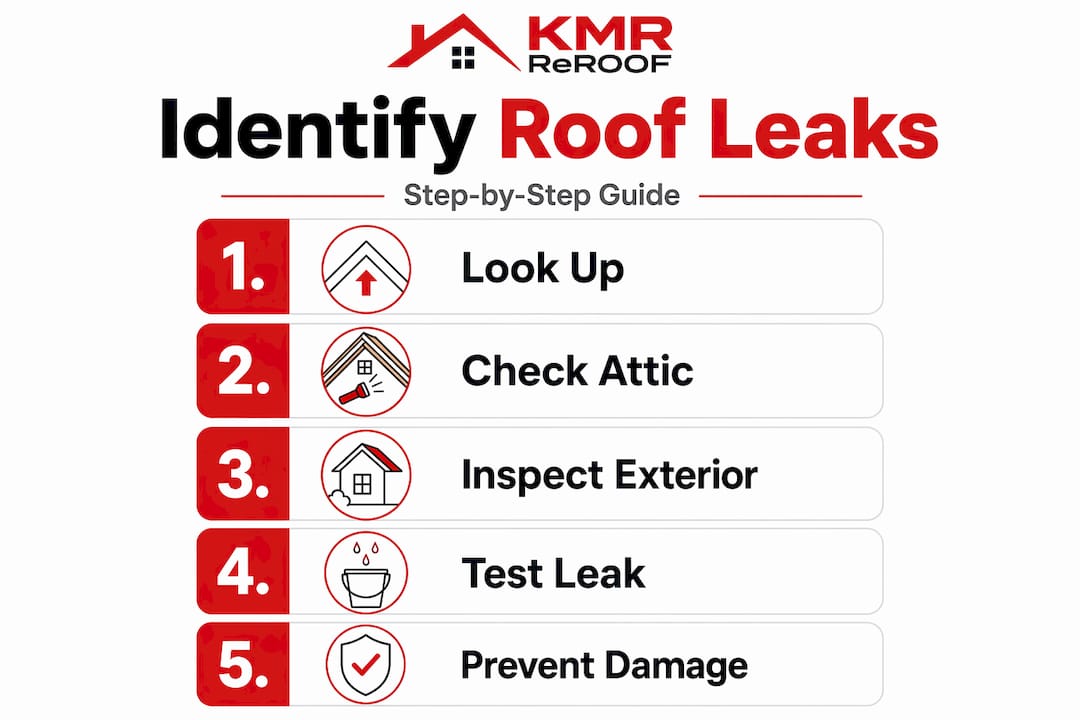
The fix is a combined inspection approach: interior first to find evidence, then attic to trace it uphill, then exterior to identify the failure point, and finally a targeted test to confirm before you call it resolved. Skipping any of these layers is how a $200 pipe boot repair turns into a $4,000 mold remediation job six months later.
For flat roof properties especially, the flat roof maintenance Houston resource addresses the particular vulnerabilities of low-slope commercial roofing that most residential guides completely ignore.
Protect your property with expert roof solutions
Identifying a leak is the first step. Knowing when it is beyond a DIY fix is just as important.

If your inspection has turned up persistent water damage, failed flashing, or a roof system that is past its service life, Mister ReRoof is ready to help. We serve homeowners and businesses across El Campo and Houston with expert installations built for Texas conditions. Whether you need a Victoria metal roof replacement for long-term durability, an El Campo shingle roof replacement that fits your home’s profile, or an El Campo TPO roof replacement for your commercial flat roof, our team delivers systems that stand up to heat, wind, and heavy rain. Contact Mister ReRoof today for a free estimate and stop chasing the same leak twice.
Frequently asked questions
How do I know if my roof leak is serious?
If you see mold, sagging drywall, or large water stains, your leak is likely serious and needs urgent attention, since these interior signs indicate water has been present long enough to cause secondary structural or health hazards.
Why don’t water stains match the leak entry point?
Roof leaks allow water to travel 8-12 feet or more sideways along decking or rafters before dripping down, so the visible stain on your ceiling is rarely directly below the actual roof breach.
What’s the most common place a roof will leak?
Penetrations such as chimneys, vents, skylights, flashing, and valleys account for 90% of leaks, making them your highest-priority inspection points.
How long do pipe boots last before leaking?
Pipe boots typically crack after 8-15 years, with south-facing installations failing faster due to concentrated UV exposure from the Texas sun.
Is a hose test safe for DIY roof leak detection?
A hose test is reliable and safe for most residential roofs when done methodically, with one person soaking 2-foot sections gradually uphill while an observer monitors the attic for the first sign of water.
