
TL;DR:
- For low slope roofs with a pitch below 3:12, membrane choice is crucial to ensure durability, drainage, and energy efficiency. TPO, EPDM, and PVC are popular, with metal panels suitable for slopes as low as 1:12, while roll roofing is only for budget projects with short lifespan expectations. Proper drainage, correct membrane specifications, and regular inspections are key to extending the roof’s service life and avoiding costly failures.
When a building has a pitch below 3:12, standard shingles are off the table. The world of low slope roofing options opens up to membranes, metal systems, and multilayer assemblies that most property owners have never compared side by side. Choosing wrong costs you not just money upfront but years of maintenance headaches and premature failure. This guide walks you through every major roofing type for low slopes, the criteria that actually matter, and how to match the right system to your building, budget, and climate.
Table of Contents
- Key takeaways
- Low slope roofing options: the criteria that matter first
- 1. TPO roofing
- 2. EPDM roofing
- 3. PVC roofing
- 4. Modified bitumen roofing
- 5. Built-up roofing (BUR)
- 6. Standing seam metal roofing
- 7. Roll roofing
- Roofing type comparison at a glance
- Matching roofing types to your building and budget
- My honest take after years of low slope projects
- Mister ReRoof knows low slope roofing in Texas
- FAQ
Key takeaways
| Point | Details |
|---|---|
| Drainage comes first | Every low slope system needs a minimum 1/4:12 slope for positive drainage or ponding water will destroy the membrane. |
| Single-ply membranes dominate | TPO, EPDM, and PVC cover most commercial buildings due to their balance of cost, durability, and ease of installation. |
| Cool roof compliance is real | Many energy codes require a Solar Reflectance Index of at least 78, which white TPO and PVC meet without added coatings. |
| Attachment method changes risk | How a membrane is fastened affects thermal performance, leak detection speed, and long-term durability. |
| Metal is viable on low slopes | Standing seam metal panels work at slopes as low as 1:12 when installed to manufacturer specs. |
Low slope roofing options: the criteria that matter first
Before picking a material, you need a clear decision framework. The wrong criteria lead to the wrong roof, and on a commercial building, that mistake is expensive.
Slope and drainage. Low slope assemblies require a minimum slope of 1/4:12 to move water off the membrane. Zero slope is not permitted under typical building codes for membrane systems. Roof drainage design coordinates membrane slope with internal drains, scuppers, and gutters. This is a multidisciplinary decision, not just a materials choice.
Lifespan and durability. Most property owners underestimate how much climate and building use stress a membrane. Texas heat, UV exposure, and heavy rain cycles age roofs faster than temperate zones. Check manufacturer warranty terms carefully.
Installation and lifecycle cost. Installed price matters, but so does the 20-year cost of maintenance and repairs. A cheap membrane that leaks every three years costs more than a premium one that doesn’t.
Energy efficiency. Cool roof compliance for low slope commercial roofs often requires a minimum Solar Reflectance Index of 78. This affects which membrane colors and coatings qualify under local energy codes.
Maintenance access and repair ease. Some systems are harder to inspect and repair than others. Ballasted membranes, for example, require moving gravel to find leaks.
Pro Tip: Specify aged solar reflectance, not just initial reflectance, when comparing membranes. Reflectance degrades over time, so a membrane that looks great on day one may fall out of compliance within a few years.
1. TPO roofing
Thermoplastic polyolefin (TPO) is currently the most widely installed single-ply membrane on commercial low slope roofs, and for good reason. White TPO reflects solar heat aggressively, and most products meet or exceed the SRI 78 threshold without any additional coating. That makes it a go-to for building owners trying to hit energy code compliance.
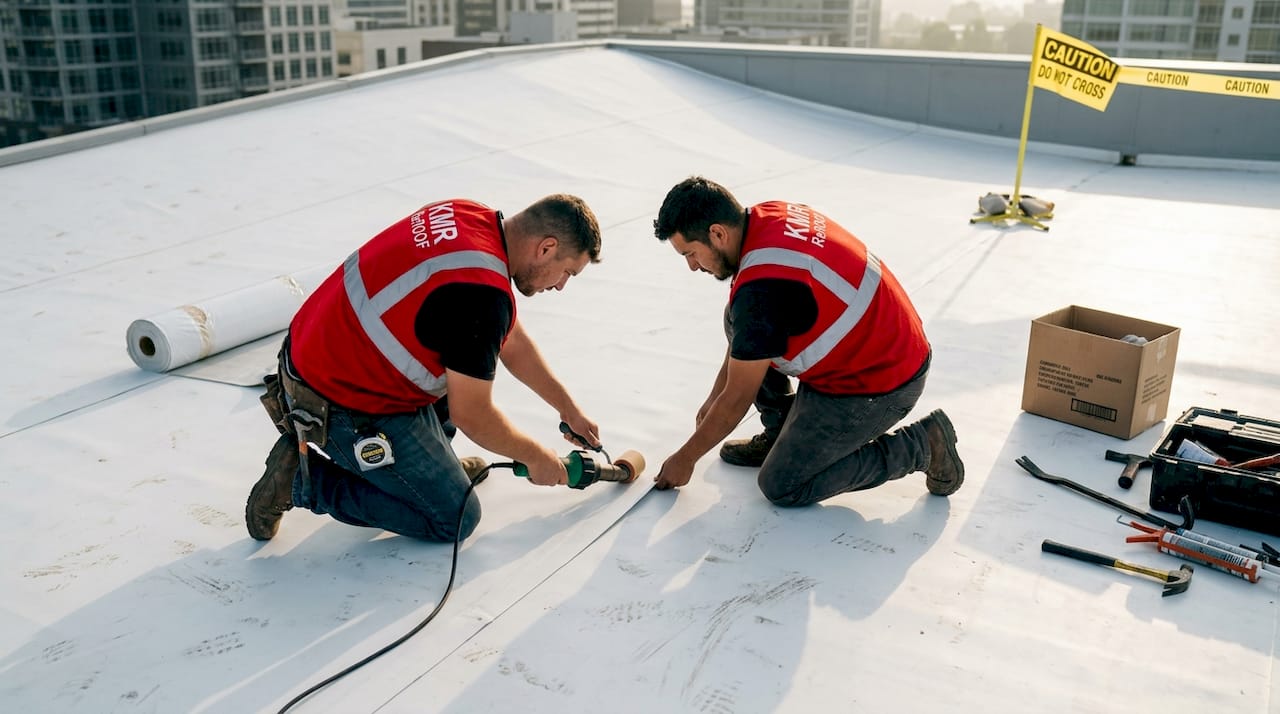
TPO is heat-welded at seams, which creates a monolithic, watertight bond stronger than adhesive joints. Installed costs typically run $5.50 to $9.00 per square foot. It performs well in climates with wide temperature swings, which covers most of Texas. The main limitation is variability in formulation quality across manufacturers. Not all TPO membranes are equal, and thinner sheets (40 mil) wear faster than 60 or 80 mil products. For TPO roof replacement, hiring a contractor who specifies membrane thickness is non-negotiable.
2. EPDM roofing
EPDM (ethylene propylene diene monomer) is a synthetic rubber membrane that has been the backbone of commercial flat roofing for decades. It is exceptionally durable in UV exposure and temperature extremes, with lifespans of 15 to 30 years depending on attachment and maintenance. EPDM installed cost runs roughly $4.50 to $7.50 per square foot.
The attachment method matters more with EPDM than with most other systems. Ballasted EPDM (held down with gravel) is the most economical to install but the hardest to maintain. Finding a leak under ballast means moving stone. Fully adhered systems make inspection and repair far simpler. EPDM attachment type is a critical risk management decision, not just an installation preference.
One trade-off to know: standard EPDM is black, which absorbs heat. White EPDM and coated versions are available but add cost. In hot climates, this is worth factoring into your energy analysis before you commit.
3. PVC roofing
PVC (polyvinyl chloride) membranes have been in commercial use since the 1960s and carry a well-earned reputation for chemical resistance. That makes PVC the go-to choice for restaurants, food processing plants, and any building where rooftop kitchen exhausts or chemical runoff could contact the membrane. EPDM and TPO degrade under grease and certain solvents. PVC does not.
PVC is heat-welded like TPO, which produces strong, consistent seams. It is also inherently flexible, which helps it perform on roofs with complex geometry. Installed costs run slightly higher than TPO, typically $6.00 to $10.00 per square foot. Lifespan is 20 to 30 years with proper maintenance. The main drawback is that PVC contains plasticizers that can migrate out of the membrane over time, causing brittleness in very cold climates.
4. Modified bitumen roofing
Modified bitumen is an asphaltic membrane reinforced with polymers, typically APP (atactic polypropylene) or SBS (styrene-butadiene-styrene). It is installed in multiple layers, making it one of the more durable flat roofing materials for high-traffic roofs like those with rooftop equipment.
SBS modified bitumen is particularly good in cold climates because it stays flexible. APP-modified is better in high-heat environments. Installation methods include torch-applied, cold-applied, and self-adhered. Torch application is common but requires a certified installer due to fire risk. Expect 15 to 25 years of service life. Installed costs are comparable to mid-range EPDM.
Pro Tip: Modified bitumen is one of the easiest systems for a facility manager to understand visually. Surface granules show wear clearly, making annual inspections straightforward even for non-roofers.
5. Built-up roofing (BUR)
Built-up roofing has been around longer than any other commercial system. A BUR assembly layers alternating plies of bitumen and reinforcing fabric, typically topped with gravel or a mineral cap sheet. The result is a thick, redundant barrier that handles foot traffic better than single-ply membranes.
Modern BUR systems are less common than they were 40 years ago, largely because single-ply installation is faster and less labor-intensive. But BUR still makes sense when you need maximum durability on a roof with heavy mechanical equipment or regular maintenance foot traffic. Expect a lifespan of 15 to 30 years. Installed costs are higher than EPDM due to the labor involved.
6. Standing seam metal roofing
Metal is not just for steep roofs. Standing seam panels can be installed on slopes as low as 1:12 when manufacturer specifications are followed. The continuous interlocking seams keep water out without relying on slope for drainage, which is what makes them viable on low pitch applications.
The advantages of metal on low slopes include exceptional longevity (40 to 70 years), low maintenance, and resistance to hail and wind. For metal roof replacement on commercial or agricultural buildings, standing seam is the right call. The limitations are cost (typically $10.00 to $16.00 per square foot installed) and the need for qualified installers who understand thermal expansion management on low slopes.
7. Roll roofing
Roll roofing is the simplest and cheapest option for low slope applications. It is essentially the same material as the base layer of a built-up roof, sold in large rolls and applied in overlapping courses. Installed cost runs as low as $1.50 to $3.00 per square foot.
The honest reality is that roll roofing is best suited for outbuildings, garages, and sheds where budget is the only concern. It carries a lifespan of 5 to 10 years under normal conditions and is prone to cracking and lifting in temperature extremes. For commercial buildings or any property where roof failure creates serious operational risk, this is not the right choice.
Roofing type comparison at a glance
| Roofing type | Lifespan | Installed cost (per sq ft) | Energy efficiency | Maintenance ease |
|---|---|---|---|---|
| TPO | 15-25 years | $5.50-$9.00 | Excellent (cool roof compliant) | Moderate |
| EPDM | 15-30 years | $4.50-$7.50 | Poor (black) / Good (white) | Varies by attachment |
| PVC | 20-30 years | $6.00-$10.00 | Excellent | Moderate |
| Modified bitumen | 15-25 years | $5.00-$8.00 | Moderate | Good |
| Built-up (BUR) | 15-30 years | $6.00-$10.00 | Moderate | Fair |
| Standing seam metal | 40-70 years | $10.00-$16.00 | Good (reflective coatings) | Excellent |
| Roll roofing | 5-10 years | $1.50-$3.00 | Poor | Poor |
Pro Tip: When comparing bids, ask every contractor to specify the membrane thickness, attachment method, and whether the system qualifies as a cool roof under your local energy code. Those three questions separate informed proposals from guesswork.
Matching roofing types to your building and budget
Not every property has the same needs, and the best low pitch roofing solution for a warehouse is not the same as for a medical office building.
- Commercial office buildings: TPO or PVC are strong choices. Both meet cool roof requirements and offer clean aesthetics. TPO is typically the more cost-effective of the two.
- Industrial or food processing facilities: PVC is the clear choice when grease, chemicals, or exhaust systems are present. Its chemical resistance is unmatched among membrane options.
- Budget-constrained properties: EPDM with fully adhered attachment gives you the best combination of low cost and manageable maintenance. Liquid-applied coatings are also worth considering if the existing substrate is structurally sound. White silicone coatings run $1.50 to $4.00 per square foot and can restore cool roof compliance at a fraction of replacement cost.
- Hard-to-access roofs: Standing seam metal or fully adhered TPO. Both minimize the need for routine maintenance visits.
- When to reroof vs. coat or repair: If your membrane is under 15 years old with localized damage, a targeted repair or coating may extend its life. If it’s brittle, showing widespread seam failures, or causing interior leaks after every rain, replacement is the right call.
My honest take after years of low slope projects
I have seen property managers make the same mistake repeatedly: they focus on installed cost per square foot and ignore everything else. On a flat or low slope roof, that thinking gets expensive fast.
The biggest overlooked factor is drainage. You can put the best membrane on the market on a roof that holds standing water, and it will fail years ahead of schedule. Drainage performance depends on the entire system geometry, not just the membrane. I always ask to see the roof’s drain layout and any past ponding complaints before I talk about materials.
The second thing I tell every client: roofing membranes are not all the same product with different brand names. Membrane thickness, reinforcement scrim quality, and seam technology vary dramatically. A 45-mil EPDM and a 60-mil EPDM are not interchangeable.
What I have found actually works over decades is this: pick a material that suits your climate and building use, pay for the correct attachment method, and do not skip the annual inspection. A $400 inspection catches a $40,000 problem before it becomes one. That is where the real return on investment lives in low slope roofing.
— Misterreroof
Mister ReRoof knows low slope roofing in Texas
Texas heat, Gulf humidity, and storm season put every low slope roof to the test. Mister ReRoof specializes in roof replacements built specifically for these conditions, including flat roof replacement for commercial and residential properties across El Campo and Houston.
Whether you need a TPO membrane for your commercial building, a standing seam metal system for a long-term investment, or honest advice on whether your current roof needs replacement or repair, Mister ReRoof delivers the workmanship and product knowledge to get it right. Get your free estimate today and find out which roofing system makes the most sense for your property and budget.
FAQ
What is the minimum slope required for a low slope roof?
Low slope roofing assemblies require a minimum positive drainage slope of 1/4:12. Zero slope is not permitted under standard building codes because standing water degrades membranes and causes leaks.
What is the best roofing material for a low slope commercial roof?
TPO and PVC single-ply membranes are the most widely used on commercial low slope buildings due to their cool roof compliance, heat-welded seams, and competitive installed costs. The right choice depends on your building use, with PVC preferred where chemical or grease exposure is a factor.
How long does a low slope roof last?
Lifespan varies by material. EPDM and TPO typically last 15 to 30 years, PVC lasts 20 to 30 years, and standing seam metal can last 40 to 70 years. Proper drainage design and annual inspections extend any system’s service life significantly.
Can metal roofing work on a low slope?
Yes. Standing seam metal panels can be installed on slopes as low as 1:12, provided the installation follows manufacturer specifications. Metal shingles require a steeper minimum slope of 3:12 because they rely on slope for water shedding rather than continuous interlocking seams.
Is a roof coating a good alternative to replacement?
Liquid-applied coatings, such as white silicone, can restore cool roof compliance and extend membrane life at $1.50 to $4.00 per square foot installed. They are a viable option when the existing membrane is structurally sound with only surface degradation. Widespread seam failures or substrate damage require full replacement.
