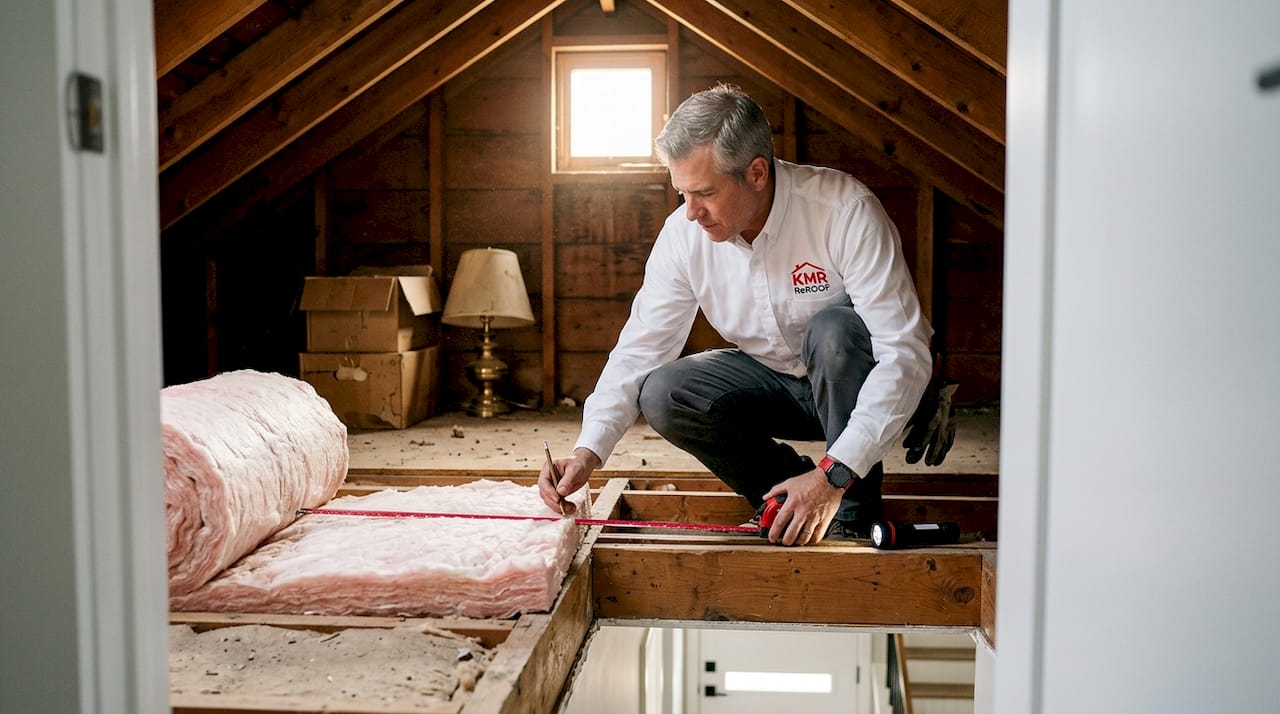
The Role of Insulation in Roofing: What Homeowners Need to Know
The Role of Insulation in Roofing: What Homeowners Need to Know
TL;DR:
- Up to 30% of home energy escapes through the roof, making insulation essential for efficiency and longevity. Proper installation of high R-value insulation prevents moisture damage, reduces thermal stress, and enhances indoor comfort while lowering utility bills. Insulation, ventilation, and roofing materials must work together to optimize performance and prevent common issues like ice dams and premature roof aging.
Your roof works harder than you think. Most homeowners focus on shingles, gutters, and flashings when they worry about roof performance. But up to 30% of energy loss in a home escapes through the roof. That single statistic reframes everything. The role of insulation in roofing goes far beyond keeping your attic warm in winter. It determines how long your roof lasts, what your monthly utility bills look like, and whether moisture quietly destroys your roof deck while you sleep. Here is what you actually need to know.
Table of Contents
- Key takeaways
- The role of insulation in roofing: how heat actually moves
- Benefits of roof insulation beyond energy savings
- Insulation types, installation basics, and what goes wrong
- How insulation, ventilation, and roofing materials work together
- My take on what homeowners consistently get wrong
- Get your roof and insulation working together in Texas
- FAQ
Key takeaways
| Point | Details |
|---|---|
| Energy loss starts at the top | Up to 30% of home energy escapes through the roof, making insulation one of the highest-impact upgrades. |
| R-value doubles the results | Upgrading from R-19 to R-38 cuts heat transfer by roughly 50%, which directly lowers cooling costs. |
| Insulation protects the roof itself | Proper insulation reduces thermal stress on roofing materials and prevents moisture damage and ice dams. |
| Compression kills performance | Compressed insulation loses R-value fast. Full thickness and no compacting are non-negotiable during installation. |
| Insulation and ventilation work together | Neither one fixes the other. Both systems must be correctly sized and balanced for the roof to perform. |
The role of insulation in roofing: how heat actually moves
Heat does not sit still. It moves through your roof in three ways: conduction, convection, and radiation. Conduction transfers heat directly through solid materials like wood framing and sheathing. Convection moves heat through air currents in your attic space. Radiation sends infrared heat from a sun-baked roof deck down into your living space. Insulation fights all three of these mechanisms at once, which is why it matters so much to energy efficiency and roofing performance as a whole.
The measurement that matters most here is R-value. R-value tells you how well an insulation material resists heat flow. The higher the R-value, the more resistant it is. What many homeowners do not realize is that the relationship between R-value and performance is not linear. Upgrading from R-19 to R-38 cuts heat transfer through the roof by approximately 50%. That is a dramatic improvement, particularly in hot climates like Texas where cooling loads dominate your energy bill for six or more months a year.
Here is a quick overview of how the most common insulation types stack up by R-value per inch:
- Fiberglass batts: R-2.9 to R-3.8 per inch, widely available and cost-effective
- Rigid foam boards: R-3.8 to R-6.5 per inch, excellent moisture resistance
- Spray foam (open-cell): R-3.5 to R-3.8 per inch, great for irregular spaces
- Spray foam (closed-cell): R-6.0 to R-7.0 per inch, highest density and air sealing
- Blown-in cellulose: R-3.2 to R-3.8 per inch, good for retrofitting existing attic floors
Pro Tip: If your attic currently has R-19 insulation and you live in a climate with hot summers, upgrading to R-38 or higher is one of the most cost-effective improvements you can make to your home. The return on investment through lower energy bills compounds every year.
Benefits of roof insulation beyond energy savings
The importance of roofing insulation is routinely undersold when conversations focus only on energy bills. The real story includes moisture control, roofing material lifespan, and the kind of indoor comfort that changes how a home feels to live in every single day.
Moisture is the quiet killer of roofs. When warm, humid air from inside your home rises and contacts a cold roof deck, condensation forms. Over time, that moisture rots wood sheathing, degrades adhesives in roofing underlayments, and creates the perfect conditions for mold. Good insulation keeps the roof deck at a more stable temperature, which reduces the chance of that condensation event happening in the first place.
In colder climates, this moisture problem takes a dramatic form: ice dams. Proper insulation prevents ice dams by keeping the roof deck uniformly cold. Without adequate insulation, heat from the living space warms the upper portion of the roof, melts snow, and sends water running toward the cold eaves where it refreezes into a dam. That backed-up water forces its way under shingles and into the structure. The cost of that damage routinely exceeds what proper insulation would have cost in the first place.
Beyond moisture and ice, insulation also buffers your roofing materials from the stress of rapid temperature swings. A metal roof or asphalt shingle system expands and contracts with every heating and cooling cycle. Insulation moderates those swings by reducing how much the roof deck temperature changes throughout the day.
Think of roof insulation as a shock absorber for your roofing system. Without it, every hot afternoon and cool evening puts your shingles and fasteners through a mechanical stress cycle that adds up over years.
The comfort benefits are real and tangible. Roof insulation stabilizes indoor temperatures and eliminates the hot and cold spots that make certain rooms unbearable in summer or winter. It also provides meaningful noise reduction, which is a benefit that owners of metal roofs especially appreciate during heavy Texas rainstorms.
Pro Tip: If certain rooms in your home are consistently hotter or colder than others, inadequate roof insulation is one of the first things to check. The fix is often simpler and cheaper than replacing your HVAC system.

Insulation types, installation basics, and what goes wrong
Choosing the right insulation is only half the battle. The other half is making sure it goes in correctly. Here is how the main options compare for residential roofing applications:
| Insulation type | Best use | R-value per inch | Key advantage |
|---|---|---|---|
| Fiberglass batts | Attic floors between joists | 2.9 to 3.8 | Low cost, easy to source |
| Rigid foam board | Roof deck above sheathing | 3.8 to 6.5 | Moisture resistant, adds continuous coverage |
| Spray foam (closed-cell) | Roof deck underside, air sealing | 6.0 to 7.0 | Highest R-value, superior air sealing |
| Blown-in cellulose | Existing attic retrofit | 3.2 to 3.8 | Fills gaps well, good for odd spaces |
| Radiant barrier | Attic rafters in hot climates | N/A (reflects heat) | Reduces radiant heat gain in summer |
One of the most common and costly mistakes during installation is compression. Compressed insulation loses a significant portion of its effective R-value because it traps less air, and trapped air is what actually does the insulating. A 6-inch fiberglass batt jammed into a 4-inch cavity does not perform at R-19. It performs at something far lower, and you often cannot see the problem from the attic floor once everything is in place.
The second major issue is thermal bridging. Your roof framing, including rafters, trusses, and blocking, conducts heat far better than insulation does. Continuous insulation over framing addresses this by covering the structural members with a layer of rigid foam that breaks the thermal bridge. Without it, heat flows straight through the wood and into your living space regardless of how much insulation surrounds it.
A few other common installation problems worth knowing:
- Gaps and voids around recessed lights, pipes, or HVAC penetrations that allow air bypass
- Insulation installed with the vapor barrier facing the wrong direction for the climate
- Insufficient depth at the eaves where insulation naturally compresses due to limited space
- Missing air sealing before insulation installation, which lets conditioned air escape freely
Pro Tip: Before adding more insulation, seal air leaks first. Air sealing is cheap and the payoff is significant. Insulation slows heat transfer, but it cannot stop air movement. A home with great insulation and poor air sealing still loses a lot of energy.
Professional roof insulation installation matters more than most homeowners expect. Spray foam in particular requires precise mixing ratios and application techniques that directly affect both R-value and off-gassing behavior. A DIY spray foam job that goes wrong can create indoor air quality problems that are expensive to remediate. For energy-saving roof upgrades, getting a professional assessment first pays off.
How insulation, ventilation, and roofing materials work together
Here is where many homeowners get into trouble. They treat insulation, ventilation, and the roof covering as three separate systems. They are not. They function as one assembly, and a problem in any one component degrades the others.
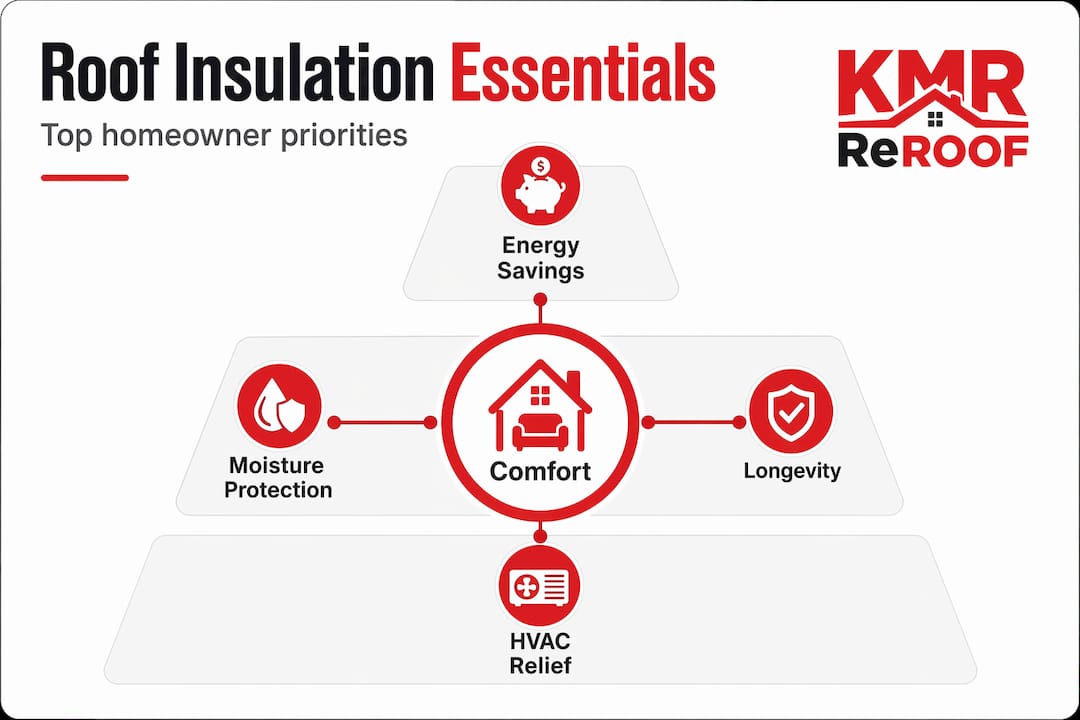
Attic ventilation serves a specific purpose: it carries out heat and moisture that would otherwise build up and damage the roof deck and framing. But ventilation only works properly when the attic floor is well-insulated and air-sealed first. Homeowners often add more ventilation when insulation depth or air sealing is the actual deficiency. More ridge vents or soffit vents cannot compensate for conditioned air leaking into the attic from the living space below.
The relationship between insulation and your actual roofing material also carries warranty implications. Most major shingle manufacturers specify minimum attic ventilation requirements that assume a particular insulation and air sealing configuration. If those conditions are not met, the warranty can be voided. When insulation and roofing work are done by different contractors at different times without coordination, this is a real risk.
Some climate-specific points worth keeping in mind:
- In hot climates like Houston and El Campo, the priority is reducing heat gain through the roof. Radiant barriers and high R-value insulation work together with cool roofing materials to cut cooling loads dramatically.
- In cold climates, the priority shifts to keeping the roof deck cold and uniform to prevent ice dams, which requires both insulation depth and careful air sealing.
- In mixed climates, vapor barrier placement becomes critical since the direction of moisture drive reverses between seasons.
Ventilation requirements also differ. Hot climate roofs often benefit from aggressive ventilation of the attic space above the insulation. Cold climate assemblies sometimes use unventilated cathedralized ceilings with spray foam, where moisture management works entirely through material selection rather than airflow. Understanding roof ventilation basics is worth the time before you make any decisions.
The bottom line is that proper insulation reduces the burden on your HVAC system. Roofing insulation boards reduce HVAC workload, which extends equipment life and reduces maintenance costs. And up to 30% savings on heating and cooling costs are achievable when insulation is specified and installed correctly.
My take on what homeowners consistently get wrong
I have seen a lot of roofing projects where insulation was treated as an afterthought. The roofing contractor focuses on the shingles. The HVAC contractor focuses on the equipment. Nobody takes ownership of the insulation, and the homeowner pays for that gap in energy bills and premature roof problems for years.
The single most common mistake I see is compression. Insulation gets stuffed into spaces to speed up installation, and nobody checks whether it maintained full thickness. The effective R-value drops, the homeowner does not notice until their bills stay high, and the contractor is long gone. This is one reason I push hard for professional installation with a documented R-value verification.
The second mistake is chasing ventilation as the fix for everything. If your attic is too hot or your roof is showing premature aging, adding vents feels logical. But if the actual problem is conditioned air leaking into the attic through gaps in the ceiling, more ventilation just makes your AC work harder. You have to fix the insulation and air sealing first. Ventilation then does its job properly.
My honest advice: when you replace your roof, treat it as an opportunity to assess and upgrade the whole system. New shingles on top of inadequate insulation is a missed chance. The incremental cost of upgrading insulation during a reroof is far lower than doing it as a standalone project later.
— Misterreroof
Get your roof and insulation working together in Texas

At Misterreroof, we see the impact of poor insulation on roofing systems every day across El Campo, Houston, Victoria, Katy, and the surrounding area. A roof replacement done right accounts for insulation, ventilation, and the specific demands of Texas weather from day one. Whether you are looking at a metal roof replacement in Victoria that maximizes thermal performance, a shingle replacement in El Campo with updated attic insulation, or a TPO roof in El Campo built for flat-roof efficiency, our team coordinates the full system so nothing gets left to chance. Contact Misterreroof today for a free estimate and a real conversation about what your roof needs to perform long-term.
FAQ
What is the role of insulation in roofing systems?
Roof insulation slows heat transfer between the interior of your home and the outside environment, reducing energy loss and protecting roofing materials from thermal stress and moisture damage. It is one of the most impactful components in a complete roofing assembly.
How does R-value affect roof insulation performance?
R-value measures how well insulation resists heat flow. Upgrading from R-19 to R-38 attic insulation can cut heat transfer through the roof by approximately 50%, which directly reduces cooling costs in hot climates.
Can roof insulation prevent ice dams?
Yes. Proper insulation keeps the roof deck at a uniform cold temperature, which prevents uneven snowmelt and the ice dam formation that forces water under shingles and into the roof structure.
What happens if insulation is compressed during installation?
Compressed insulation loses a significant portion of its rated R-value because it traps less air. The insulation appears to be in place but delivers far less thermal performance than specified, resulting in higher energy bills and reduced comfort.
Does roof insulation reduce heating and cooling costs?
Yes. Properly specified and installed roof insulation can reduce residential heating and cooling costs by up to 30% by lowering the workload on your HVAC system and reducing heat exchange through the roof.
