Roof decks explained: Texas homeowner guide to upgrades
Roof decks explained: Texas homeowner guide to upgrades
TL;DR:
- The roof deck is the structural foundation supporting all roofing materials.
- Proper inspection and maintenance of the deck are crucial in Texas’s harsh climate.
- Upgrading to moisture-resistant materials like plywood can extend roof longevity.
Most Texas homeowners spend a lot of time thinking about shingles, gutters, and attic insulation. Almost nobody thinks about the roof deck until something goes very wrong. The roof deck is the structural foundation your entire roofing system sits on, and in Texas, where summer heat bakes your home for months and hail can arrive without warning, its condition matters more than most people realize. This guide breaks down what a roof deck is, which materials work best in Texas, what the building codes require, and exactly when you need to replace yours before putting a new roof on top.
Table of Contents
- What is a roof deck? Structure and function explained
- Core materials: OSB vs plywood vs plank decking
- Texas codes, inspections, and when to replace your roof deck
- How Texas weather challenges roof decks (and how to protect yours)
- A Texas roofing pro’s take: What most articles miss about roof decks
- Ready for a roof upgrade? Trusted Texas roof replacement solutions
- Frequently asked questions
Key Takeaways
| Point | Details |
|---|---|
| Roof deck definition | The roof deck is the structural layer under your roofing materials, providing crucial support and a weather barrier. |
| Material matters | Plywood is more durable in Texas humidity, while OSB offers cost savings but is less moisture-resistant. |
| Code requirements | Texas building codes require inspection and replacement of any damaged or gapped roof decking during reroofing. |
| Weather impacts | Extreme heat, hail, and moisture in Texas make roof deck choice and maintenance even more important. |
| Professional inspection | Having your roof deck checked during roof work avoids costly surprises and extends your roof’s lifespan. |
What is a roof deck? Structure and function explained
The terms “roof deck,” “decking,” and “sheathing” all refer to the same thing: the flat, solid layer of panels or boards nailed across your roof rafters or trusses. As Texas Roof Authority explains, a roof deck is the structural layer of wooden boards or panels that forms the surface on top of your rafters, serving as the foundation for underlayment, shingles, and every other roofing material above it. Without a solid deck, nothing else on your roof performs the way it should.
Most modern Texas homes use either OSB (oriented strand board) panels at 7/16 inch thickness or plywood panels at 1/2 inch thickness. Older homes sometimes have plank decking, which is individual boards laid across the rafters. Each material behaves differently under Texas conditions, and we’ll cover that in detail in the next section.
One thing worth clearing up: a roof deck and a rooftop deck are not the same thing. A rooftop deck is an occupiable outdoor living space built on top of a roof structure, the kind you might see on a downtown condo or a high-end Houston home. Understanding why roofs fail in Texas often starts with recognizing how different these two structures are.
| Feature | Roof deck | Rooftop deck |
|---|---|---|
| Location | Under roofing materials | Above roof structure |
| Material | OSB, plywood, plank | Composite, wood, concrete |
| Function | Structural base for roofing | Outdoor living surface |
| Live load requirement | Minimal (roofing loads only) | High (people, furniture) |
| Code focus | IRC roofing sections | Structural and waterproofing codes |
Here is what a sound roof deck does for your home:
- Provides structural support across rafters and trusses
- Creates a continuous weather barrier base
- Gives roofing materials (nails, underlayment, shingles) a solid surface to attach to
- Helps your roof meet local building code requirements
- Distributes wind and hail loads across the structure
Core materials: OSB vs plywood vs plank decking
Now that you know what a roof deck is, the next question is which material makes the most sense for your Texas home. Each option has real trade-offs, and the Texas climate pushes those trade-offs in specific directions.
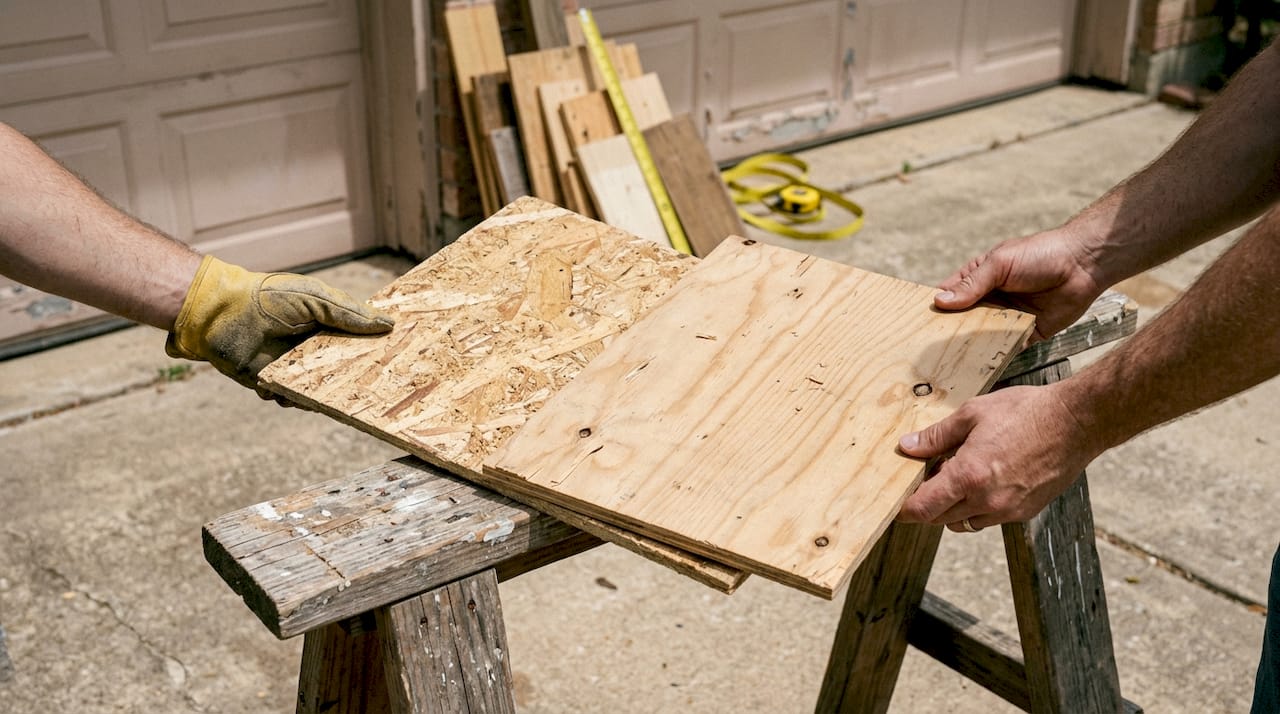
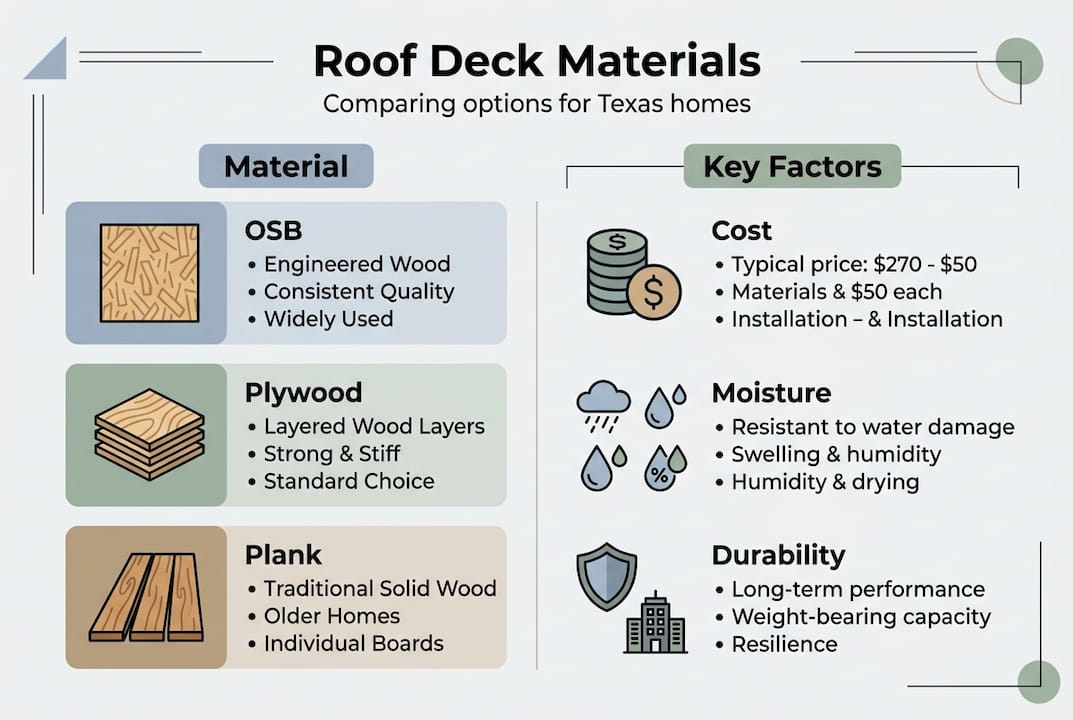
OSB (oriented strand board) is made from compressed wood strands and adhesive. It is the most common choice in new construction because it costs less. Plywood is made from thin wood veneers glued in alternating directions, which gives it more dimensional stability. Plank decking is the oldest option, solid wood boards nailed side by side, and it shows up in homes built before the 1970s.
| Material | Cost per sq ft | Heat/humidity performance | Best fit |
|---|---|---|---|
| OSB (7/16") | Lower | Swells when wet, slower to dry | Budget-focused new builds |
| Plywood (1/2") | Moderate | Better moisture recovery | Humid Texas climates |
| Plank decking | Varies | Gaps widen with heat cycles | Older homes needing update |
As Texas Roof Authority notes, OSB is more cost-effective and common, but plywood offers better durability and moisture recovery in humid Texas conditions. Both are IRC-compliant at the proper thickness. If you are upgrading your roofing system and you live in a coastal or high-humidity area like the Houston metro, plywood is worth the extra cost.
Plank decking in older homes often has gaps that have widened over decades of heat cycles. Those gaps can exceed the 1/8 inch maximum allowed by code, which means the deck must be replaced or covered before new shingles go on.
Pro Tip: If your existing deck is OSB and you’ve had any leak history, ask your contractor about upgrading to plywood during replacement. The cost difference is modest compared to the long-term moisture resilience you gain in Texas’s climate.
Texas codes, inspections, and when to replace your roof deck
Picking the right material is only part of the job. Texas follows the International Residential Code (IRC) with local amendments, and those codes have direct requirements for roof decking during any re-roofing project.
As Texas Roof Authority outlines, damaged or rotted decking must be repaired or replaced per IRC codes during roof replacement. IRC section R905.2.1 specifically requires solid sheathing under new shingles, and gaps larger than 1/8 inch in plank decking require replacement. Inspections are part of the process.
Here is how a professional inspection typically goes during a re-roofing project:
- Remove old shingles and underlayment to expose the deck surface
- Walk the deck carefully to feel for soft spots or bounce
- Visually check for discoloration, rot, mold, or water staining
- Measure gaps between plank boards with a gauge
- Mark damaged sections for repair or full panel replacement
- Confirm panel thickness meets local code before laying new underlayment
Code requirement: IRC R905.2.1 mandates solid sheathing under new shingles. Any deck with rot, structural damage, or gaps exceeding 1/8 inch must be repaired or replaced before a new roofing system is installed. Skipping this step can void your material warranty and fail inspection.
Signs your deck needs replacement before a new roof goes on:
- Soft or spongy areas when you walk the attic
- Visible water stains or dark discoloration on the underside
- Sagging sections visible from outside
- Plank gaps wider than 1/8 inch
- Active mold or rot smell in the attic
Understanding the differences between flat vs pitched roofs also matters here, because flat roofs carry water longer and put more stress on decking over time.
How Texas weather challenges roof decks (and how to protect yours)
Texas does not go easy on roofing materials. The combination of intense UV radiation, extreme heat, coastal humidity, and frequent hail events creates a uniquely demanding environment for roof decks.
As documented by Texas Roof Authority, extreme heat and UV cause expansion that requires 1/8 inch gaps during installation, hail damage is common across Texas’s Hail Alley, and humidity creates moisture risks that separate OSB and plywood performance significantly.
Here are the biggest risks Texas homeowners face with their roof decks:
- Thermal expansion: Panels expand in summer heat and contract in winter, stressing fasteners and seams over time
- Moisture intrusion: Even small leaks from hail-damaged shingles can saturate OSB quickly
- Hail impact: Repeated hail events weaken shingles and underlayment, letting moisture reach the deck
- Rot and mold: Poor attic ventilation traps heat and moisture against the deck from below
- UV degradation: Exposed deck sections (from missing shingles) degrade fast under Texas sun
According to rooftop deck construction standards, proper gap spacing and waterproofing details are critical to long-term performance in climates with wide temperature swings, which describes Texas perfectly.
The weather effects on roofing durability are real and measurable. Choosing durable roof choices in Texas starts at the deck level, not at the shingle level.
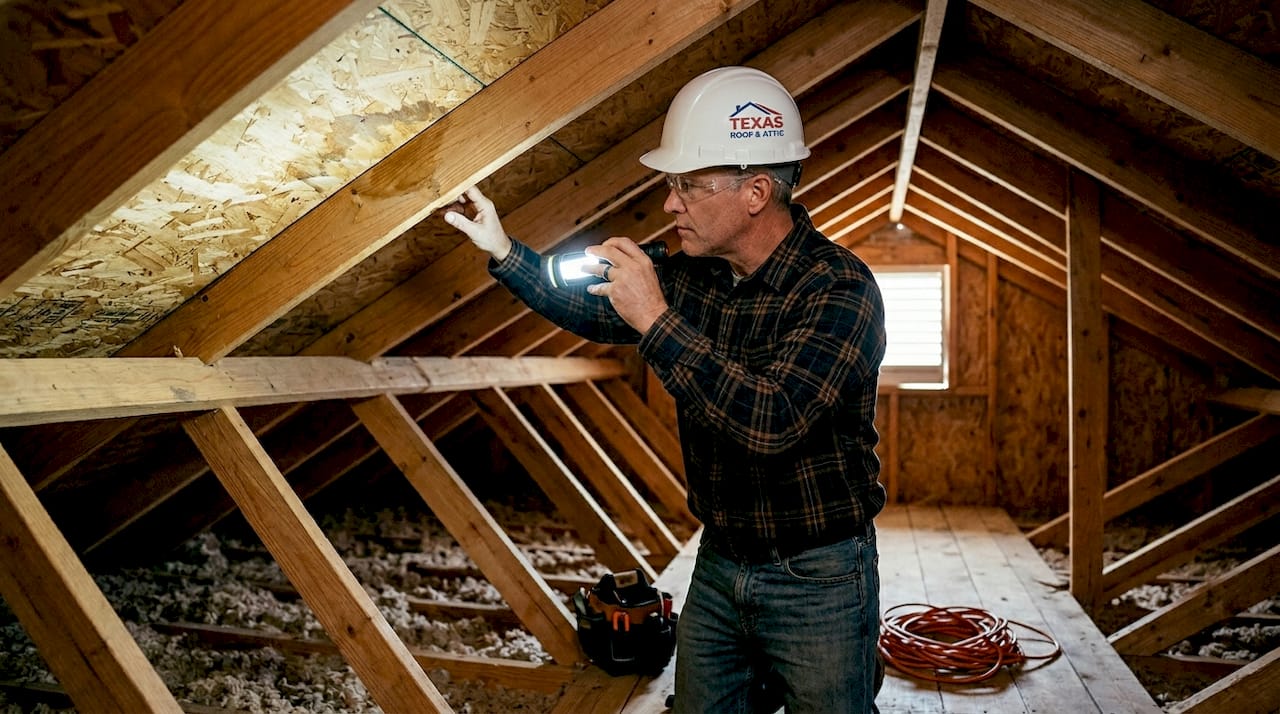
Pro Tip: Once a year, go into your attic after a heavy rain and look up. Any daylight, water staining, or soft spots on the underside of the deck are early warnings worth acting on immediately. Catching a small wet spot costs far less than replacing a full deck section. Consistent roof maintenance is the single best way to extend your deck’s life.
A Texas roofing pro’s take: What most articles miss about roof decks
Here is something most roofing articles will not tell you: the roof deck is where the real money is lost or saved during a roof replacement. Homeowners focus on shingle color and brand. Contractors who cut corners focus on speed. Neither conversation starts at the deck, and that is a problem.
We have seen homes where a brand-new roof failed within two years because the deck underneath was never properly inspected. The shingles looked fine from the street. Inside the attic, the OSB was swollen and delaminating from a slow leak that had been there for years before the new roof went on. That is an expensive mistake that a proper inspection would have caught.
The other thing experienced pros do differently is insist on correct expansion gaps. Panels butted too tight against each other will buckle in a Texas summer. That buckling shows up as waves in your shingles and can break the seal on your underlayment. It is a small installation detail with big consequences.
Investing in quality roofing and savings long-term always starts with the deck. A strong deck means your shingles last longer, your underlayment holds its seal, and your home stays protected through whatever Texas throws at it. Do not let anyone talk you into skipping the deck inspection to save a few hundred dollars.
Ready for a roof upgrade? Trusted Texas roof replacement solutions
If your roof deck is showing signs of age, damage, or code issues, the smartest move is to get a professional assessment before problems get worse.
At Mister ReRoof, we inspect and address roof decking as a standard part of every roof replacement we do in Texas. Whether your home needs a metal roof replacement in Victoria, TX or a shingle roof replacement in Hallettsville, we make sure the deck underneath is solid, code-compliant, and ready for the Texas climate before a single new shingle goes on. Contact Mister ReRoof today for a free estimate and let us help you protect your home from the foundation of your roof on up.
Frequently asked questions
What is the difference between a roof deck and a rooftop deck?
A roof deck is the structural foundation layer that supports your roofing materials, while a rooftop deck is an occupiable outdoor surface built above the roof structure, requiring extra load capacity and waterproofing.
How do I know if my roof deck needs to be replaced?
Look for soft spots, water staining, rot, or gaps larger than 1/8 inch. As IRC codes require, damaged or rotted decking must be repaired or replaced before any new roofing system is installed.
Which deck material is best for Texas weather?
Plywood handles moisture and Texas humidity better than OSB, though OSB is more cost-effective. Both meet code when installed at the correct thickness and with proper expansion gaps.
Do I need to upgrade my roof deck when replacing shingles?
Not always, but IRC R905.2.1 requires solid sheathing under new shingles. If inspectors find damage or gaps beyond 1/8 inch, repair or replacement of the deck is required before the new roofing system goes on.
