Texas local roofing codes: Compliance and protection guide
Texas local roofing codes: Compliance and protection guide
TL;DR:
- Texas roofing codes vary widely by city and county, requiring homeowners to check local regulations.
- Permits and inspections are essential steps in ensuring code compliance during roof replacement projects.
- Understanding local amendments and energy codes helps homeowners avoid costly rework and insurance issues.
Many Texas homeowners assume there’s one roofing standard that applies across the entire state. That assumption can be costly. In Texas, local roofing codes are locally adopted and amended versions of model building codes, enforced by each city or county’s own authority. What’s required in Houston may differ significantly from what Fort Worth or a rural county demands. This guide cuts through that confusion and gives you a clear, actionable path to understanding exactly what applies to your address, so your roof replacement passes inspection, stays insured, and protects your home’s value.
Table of Contents
- What are local roofing codes and who enforces them?
- Permits, inspections, and code compliance during roof replacement
- How local amendments and edge cases affect your roofing project
- Energy codes and related requirements: What most homeowners miss
- A step-by-step methodology for homeowners: Stay compliant and avoid costly mistakes
- Our take: Why verifying local roofing codes is the hidden key to a worry-free project
- Get expert, code-compliant roofing — without the stress
- Frequently asked questions
Key Takeaways
| Point | Details |
|---|---|
| Local rules override state baseline | Every Texas city or county can amend roofing codes, so always check local requirements, not just state law. |
| Permits and inspections protect you | Securing the right permit and passing inspections ensure your roof is legal, insurable, and adds value. |
| Code changes create surprises | Recent amendments or differing local rules can impact both costs and technical requirements. |
| Don’t ignore energy codes | Energy efficiency regulations may apply to your new roof, so confirm all mandates before work starts. |
| Verify, don’t assume | Get code requirements in writing directly from your local office to prevent delays and protect your investment. |
What are local roofing codes and who enforces them?
Local roofing codes aren’t invented from scratch by each city. Most Texas jurisdictions start with a model code, typically the International Residential Code (IRC), and then layer on their own amendments. Those amendments can change material requirements, ventilation standards, deck thickness rules, and more. The result is that two homes just miles apart in different jurisdictions can face very different roofing requirements.
According to the Texas State Law Library, local roofing codes are locally adopted and may differ from state-level standards, with the city or county authority having jurisdiction over enforcement. That enforcement falls to your local building department, which reviews permit applications, schedules inspections, and issues final approvals.
To show how much variation exists, here’s a simplified comparison across three Texas jurisdictions:
| Jurisdiction | Code adopted | Notable local amendments | Enforcement body |
|---|---|---|---|
| Houston | IBC/IRC with local amendments | Hurricane strapping, specific underlayment | Houston Permitting Center |
| Fort Worth | IRC 2021 with local amendments | Deck inspection requirements, layer limits | Fort Worth Development Services |
| Rural county (unincorporated) | Varies; some adopt no code | May have no formal requirements | County or none |
This table makes one thing clear: there is no single Texas roofing code. For a broader overview of how Texas structures its roofing requirements, see this Texas roofing codes overview.
If you skip the step of finding your local roofing regulations before starting work, you risk serious consequences:
- Failed inspections that halt your project mid-construction
- Insurance claim denials because the work isn’t code-compliant
- Unexpected cost overruns to correct non-compliant work
- Complications when selling your home due to unpermitted or non-compliant roofing
“Always ask your local code department which version and amendments apply before starting work.”
That one step, asking before you start, is the single most effective way to avoid expensive surprises.
Permits, inspections, and code compliance during roof replacement
Once you understand who enforces the rules, the next step is knowing how local codes surface during a real roof replacement. The permit process is usually your first point of contact with the local code system.
Most Texas cities require a permit for a full roof replacement. The typical process works like this: you or your contractor submits an application to the local building department, pays a fee (usually based on project value or square footage), receives approval, and then displays the permit on-site during work. Some jurisdictions exempt minor repairs or small patch jobs, but a full reroof almost always triggers a permit requirement.
Here are the major inspection points that code officials typically check during a roof replacement:
- Decking and sheathing — Inspectors verify that the structural deck is sound and meets thickness requirements before new materials go on.
- Underlayment — The water-resistant layer beneath shingles or metal panels must meet local material and installation specs.
- Ventilation — Attic ventilation ratios are checked to prevent moisture buildup and heat damage.
- Flashing — Around chimneys, skylights, and walls, flashing must be properly installed to prevent water intrusion.
- Final material inspection — The finished roof surface is checked for correct installation, proper fastening, and code-compliant materials.
Here’s how permit and inspection requirements break down across major Texas cities:
| City | Permit needed | Key inspection stages | Notable local amendment |
|---|---|---|---|
| Houston | Yes | Decking, final | Hurricane tie-down requirements |
| Fort Worth | Yes | Decking, underlayment, final | Limits on layering over existing shingles |
| San Antonio | Yes | Underlayment, final | Specific fire-rating requirements |
| Austin | Yes | Multiple stages | Energy code alignment required |
As Fort Worth’s roofing guidelines confirm, local enforcement typically shows up as permitting and inspections for reroofing and roof repairs, with outcomes affecting code compliance, insurance, and future home sales.
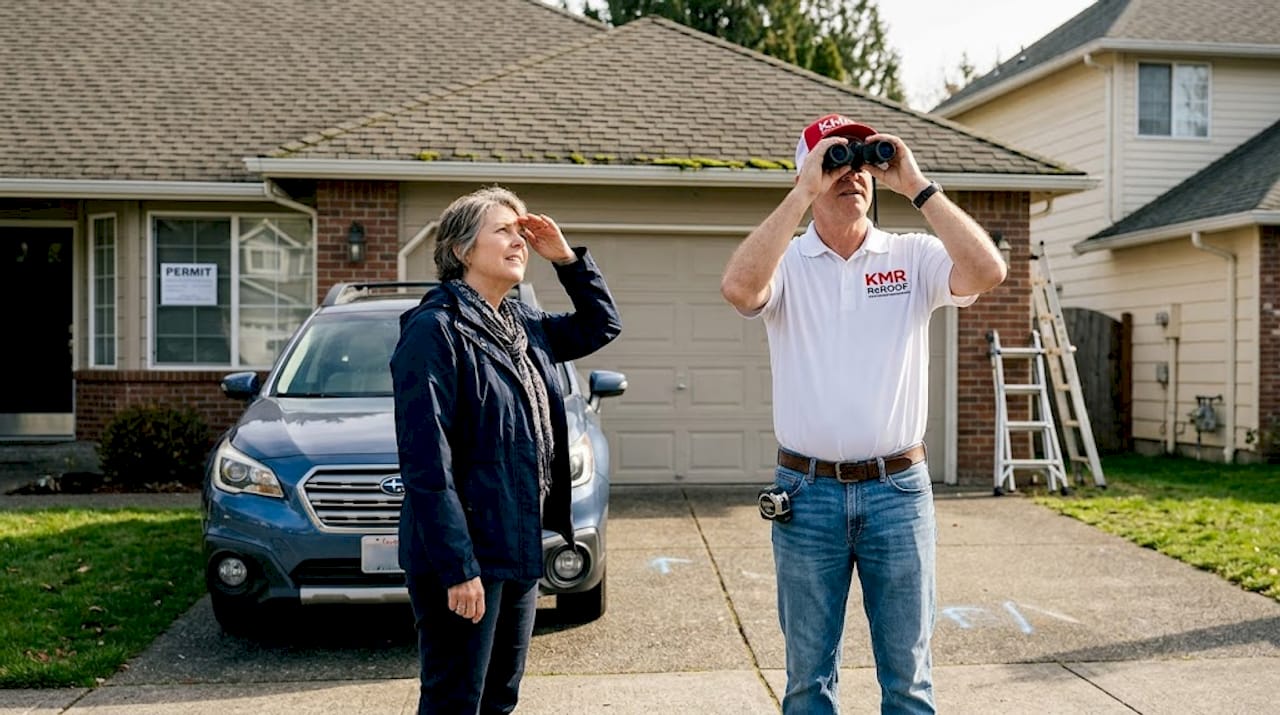
Pro Tip: A qualified contractor can help you correctly schedule inspections so every code-critical detail is checked at the right time. Missing an inspection stage can mean tearing out completed work for reinspection.
Passing inspection matters beyond just getting a certificate. Insurers increasingly check whether roofing work was permitted and inspected before paying claims. And when you sell your home, buyers and their lenders often request proof that major work was done with permits. Understanding roofing safety requirements and the importance of roof inspections can help you see why these steps protect far more than just your roof. In fact, knowing how inspections save money over the long term is one of the most underappreciated benefits of staying compliant.
How local amendments and edge cases affect your roofing project
Beyond the standard process, some project details change significantly due to local amendments or when code updates hit older homes. This is where many homeowners get caught off guard.
Local amendments to the base IRC can include a wide range of specific requirements. Common examples include:
- Deck thickness rules — Some jurisdictions require a minimum plywood thickness (often 7/16 inch or 15/32 inch) that may be stricter than the base IRC.
- Extra underlayment layers — Certain coastal or high-wind areas require a secondary underlayment or specific synthetic products.
- Ventilation ratios — Local amendments may set tighter attic ventilation ratios than the model code baseline.
- Shingle layer limits — Many Texas cities prohibit installing new shingles over existing layers, requiring a full tear-off.
- Wind resistance ratings — Especially in South Texas and along the Gulf Coast, local amendments often require higher wind-rated materials.
Regional variation is real. The NCTCOG 2024 IRC Amendments show that the North Central Texas Council of Governments provides a compiled set of recommended amendments to a given IRC edition for the region, giving municipalities a starting point that still varies by individual city adoption.
Fort Worth’s own documentation confirms that local edge cases can change the technical scope of work during replacement, including bringing decking or sheathing to a newer standard, required underlayment upgrades, or whether a new deck layer is even allowed.
Consider a real scenario: a homeowner in a North Texas suburb plans a shingle reroof and budgets for a simple overlay. The local amendment prohibits overlays and requires full tear-off. That single amendment can add $1,500 to $3,000 or more to the project cost. Another homeowner in a coastal county discovers that the local amendment requires a secondary water barrier under the shingles, adding both material and labor costs they hadn’t anticipated.
Pro Tip: If your home’s code version and the current one differ, ask if any “existing building” leniency or stricter requirements apply, especially for decking and sheathing. Some jurisdictions allow older homes to meet the code in effect when the home was built, while others require full compliance with the current code on any permitted work.
Understanding how amendments change roofing rules and hiring a local-compliant contractor are two of the most important steps you can take before signing any contract. A contractor who doesn’t know your local amendments isn’t just uninformed. They’re a liability. For more on navigating local code variations, it pays to do your homework before work begins.
Energy codes and related requirements: What most homeowners miss
Local amendments aren’t the only thing that can change your project. Let’s look at a crucial but often overlooked area: energy codes.
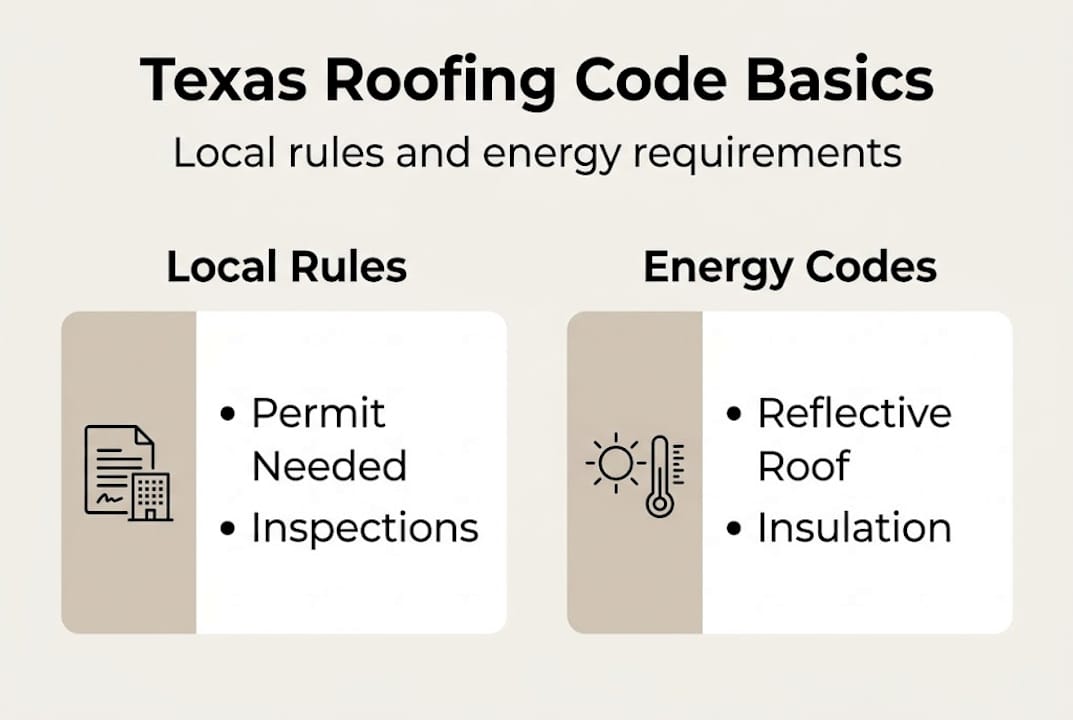
Most Texas cities enforce energy efficiency codes separately from roofing codes. These are typically based on the International Energy Conservation Code (IECC) or ASHRAE standards. Your roof replacement can meet every roofing code requirement and still fail an energy code inspection if you haven’t addressed these separately.
Common energy-related requirements that affect roofing include:
- Insulation R-value — Attic insulation must meet minimum R-value thresholds, and a reroof is often the trigger that requires an upgrade.
- Cool or reflective roofing — Some jurisdictions require roofing materials that meet specific solar reflectance standards to reduce heat gain.
- Material certifications — Products may need to carry Energy Star ratings or meet specific IECC-referenced standards.
- Air sealing — Penetrations through the roof deck must be properly sealed to meet energy code air barrier requirements.
As noted in ASHRAE 90.1 energy code guidance, local codes intersect with energy-related requirements via IECC and ASHRAE references, and the need to align designs with the jurisdiction’s adopted energy code path is a real compliance obligation.
“IECC is the enforceable legal document for energy efficiency, and local adoptions can vary — always confirm with your local office.”
Missing energy code requirements is a common source of project delays. A homeowner in Austin, for example, might complete a full shingle replacement only to learn that the local energy code required upgraded attic insulation as part of the permitted scope. That means opening up the job again and adding insulation before the final inspection passes. Explore how energy efficiency in Texas roofing connects to your overall project plan. The energy code impacts on projects are real and worth understanding before you finalize your scope of work.
A step-by-step methodology for homeowners: Stay compliant and avoid costly mistakes
Now that you know the layers involved, here’s a simple checklist to make sure you get it right from the start.
- Confirm whether your project requires a permit. Contact your city or county building department and describe the scope of work. Ask specifically whether a full replacement, partial repair, or overlay triggers a permit in your jurisdiction.
- Request the current code version and amendments in writing. Ask which IRC edition your city has adopted and whether any local amendments apply. Get this in writing or print it directly from the city’s website.
- Check energy code requirements separately. Ask the same department which IECC edition is enforced and whether your reroof triggers any energy-related upgrades such as insulation or reflective roofing.
- Share all code documents with your contractor before signing a contract. Your contractor should review the local amendments and confirm that their scope of work addresses every requirement.
- Confirm inspection stages and scheduling before work begins. Know exactly which stages require an inspector on-site and when. Missing a required inspection can mean tearing out completed work.
- Keep copies of all permits, inspection reports, and approvals. These documents protect you during insurance claims and home sales for years to come.
As Fort Worth’s roofing permit process illustrates, the practical homeowner methodology comes down to confirming permit triggers, getting code version and amendments from your city, and having your contractor sequence inspections properly.
Pro Tip: Never rely on your contractor’s word alone. Get all code requirements directly from your local department. Even the best contractors can be unaware of recent amendments or jurisdiction-specific rules.
Choosing a qualified Texas roofing contractor who actively works with local building departments is one of the strongest protections you have. Staying compliant protects your insurance coverage, supports your home’s resale value, and eliminates the risk of mid-project rework that can double your costs.
Our take: Why verifying local roofing codes is the hidden key to a worry-free project
You’ve seen the process. Now here’s what years in Texas roofing have taught our team about code compliance and project peace of mind.
Most roofing problems we see, cost overruns, inspection failures, insurance disputes, don’t trace back to poor craftsmanship. They trace back to a communication breakdown with the city over code details. A contractor who installs a beautiful roof using the wrong underlayment for that jurisdiction, or who skips the deck inspection stage, creates a problem that no amount of skilled labor can fix after the fact.
We tell every homeowner the same thing: treat verifying local code and amendments as your number one risk management step. It matters as much as picking the right materials or the right contractor. In fact, we’d argue it matters more, because a code violation can make even the best materials irrelevant if the installation isn’t approved.
Homeowners who stay proactive, who get the code in writing, keep records of every inspection, and loop their contractor into all communications with local officials, almost never face the nightmare scenarios we described in this guide. They close out their projects cleanly, their insurance stays intact, and their home’s value reflects the investment they made.
Review the roof certification requirements that often follow a compliant replacement. These certifications can be powerful tools when it comes time to sell or refinance.
“Cutting corners on code research never pays off. Getting local code answers up front is your real protection.”
Get expert, code-compliant roofing — without the stress
Ready to make your roofing project worry-free and fully compliant? Here’s how our local experts can help.
At Mister ReRoof, we stay current with local code changes across Texas so you never have to guess what your city requires. Whether you need metal roof replacement in Victoria, quality roofing in Hallettsville, or dependable shingle roofing in El Campo, our team handles permits, inspections, and local amendment compliance from start to finish.
We’ve built our reputation on projects that pass inspection the first time, protect your insurance coverage, and hold up against Texas weather for decades. Contact Mister ReRoof today to schedule your roof replacement and get a free estimate backed by real local expertise.
Frequently asked questions
How do I find the local roofing code for my Texas address?
Contact your city or county code enforcement department and ask for the current roofing code version and amendments, since code versions vary by jurisdiction and may differ significantly from neighboring areas.
Do all roof replacements in Texas require a permit?
Most cities require a permit for full roof replacements, but permit exemptions depend on the scope of work, so always verify with your local building department before starting.
What happens if my roofer ignores a local code amendment?
Unaddressed amendments can lead to failed inspections, denied insurance claims, or costly rework, since code compliance outcomes directly affect whether the work is recognized by insurers or future buyers.
How do energy codes impact my roof replacement?
Local energy efficiency codes may require reflective roofing materials or insulation upgrades, and these are enforced alongside standard roofing code since IECC adoptions vary by jurisdiction.
Can a contractor handle code compliance for me?
A good contractor helps navigate the process, but you should confirm requirements directly with your local office in writing to fully protect your investment and avoid disputes later.
