
The Role of Gutters in Roofing: What Homeowners Must Know
The Role of Gutters in Roofing: What Homeowners Must Know
TL;DR:
- Properly functioning gutters protect a home’s foundation, fascia, landscaping, and roof from water damage. Sizing, slope, and maintenance are crucial to prevent overflow, clogging, and costly repairs. Regular cleaning, correct installation, and proper downspout placement ensure long-term water management and home stability.
Most homeowners spend thousands on their roof and then ignore the gutters holding the whole water management system together. The role of gutters in roofing goes far beyond catching rainwater. Without a functioning gutter system, that same water attacks your fascia, saturates your soil, erodes your foundation, and quietly shortens your roof’s lifespan by years. The costs are real and add up fast. This article covers everything from how gutters actually protect your home to how sizing, slope, and material choices determine whether your system holds up or fails under pressure.
Table of Contents
- Key takeaways
- The role of gutters in roofing and water management
- Gutter sizing, slope, and material choices
- Gutter maintenance and roof health
- Downspout placement and foundation protection
- My take on gutters as the unsung heroes of roofing
- Protect your home with the right roofing system
- FAQ
Key takeaways
| Point | Details |
|---|---|
| Gutters protect more than the roof | A functional gutter system shields foundations, fascia, landscaping, and interior walls from water damage. |
| Sizing and slope are non-negotiable | Improperly sized or poorly sloped gutters overflow during rainfall, defeating the entire system. |
| Clogged gutters accelerate roof damage | Debris buildup causes water backup, fascia rot, and ice dam conditions that shorten roof lifespan. |
| Downspouts need distance | Discharge must extend at least 4 to 6 feet from the foundation to prevent basement moisture and structural cracking. |
| Maintenance prevents expensive repairs | Skipping gutter cleaning and inspection leads to restoration costs that can exceed $5,000 or more. |
The role of gutters in roofing and water management
Your roof sheds thousands of gallons of water every year. Where that water goes after it leaves the shingles determines whether your home stays healthy or starts deteriorating from the outside in. Gutters collect that runoff at the roofline and channel it through downspouts to discharge points safely away from the structure. That one job, done well, prevents a cascade of problems. Done poorly, it causes them.
When gutters are absent, damaged, or clogged, water falls directly off the roof edge and pools against the foundation. That pooling creates hydrostatic pressure that pushes against basement walls, causing cracks and moisture infiltration. The fascia boards behind the gutters absorb standing water and rot within a few seasons. Landscaping beds directly below the roofline erode from the constant force of uncontrolled water sheeting off the edge.
The financial exposure here is serious. Water damage restoration costs between $1,200 and $5,300 on average, and foundation repairs average around $5,000. Those two line items alone can exceed $10,000 for a single incident. And they are almost entirely preventable with a properly installed and maintained gutter system.
The importance of gutters also extends to pest control. Standing water in clogged gutters and saturated soil near the foundation creates pest breeding grounds, attracting mosquitoes, termites, and carpenter ants. These problems compound over time, and by the time you notice them, the damage is already done.
Key consequences of failing gutter systems include:
- Fascia and soffit rot from prolonged water contact
- Basement flooding from saturated soil and hydrostatic pressure
- Foundation cracks from freeze-thaw cycles in waterlogged soil
- Shingle deterioration from water backing up under the roof edge
- Driveway and walkway cracking from misdirected runoff
Gutter sizing, slope, and material choices
Getting the size and slope right is where gutter system benefits actually get realized in practice. A gutter that is too small for the roof area it serves will overflow during a moderate rainstorm. A gutter with the wrong slope either drains too slowly and traps debris or pitches so steeply that water shoots past the downspout during heavy rain.
Sizing to match your roof and rainfall
Gutter capacity depends on gutter size, slope, local rainfall intensity, and the roof area draining into each section. A 5-inch K-style gutter handles approximately 2,500 square feet at one inch of rainfall per hour, and that capacity drops sharply as rainfall intensity increases. In high-rain areas like Houston, undersizing is a common and costly mistake. Miscalculations in gutter sizing lead directly to roof edge damage and foundation exposure over time.
For most residential roofs, K-style gutters in 5-inch or 6-inch widths are standard. Complex rooflines with steep pitches, large surface areas, or multiple valleys need more capacity at each collection point, often requiring 6-inch gutters and additional downspouts.
Getting the slope right
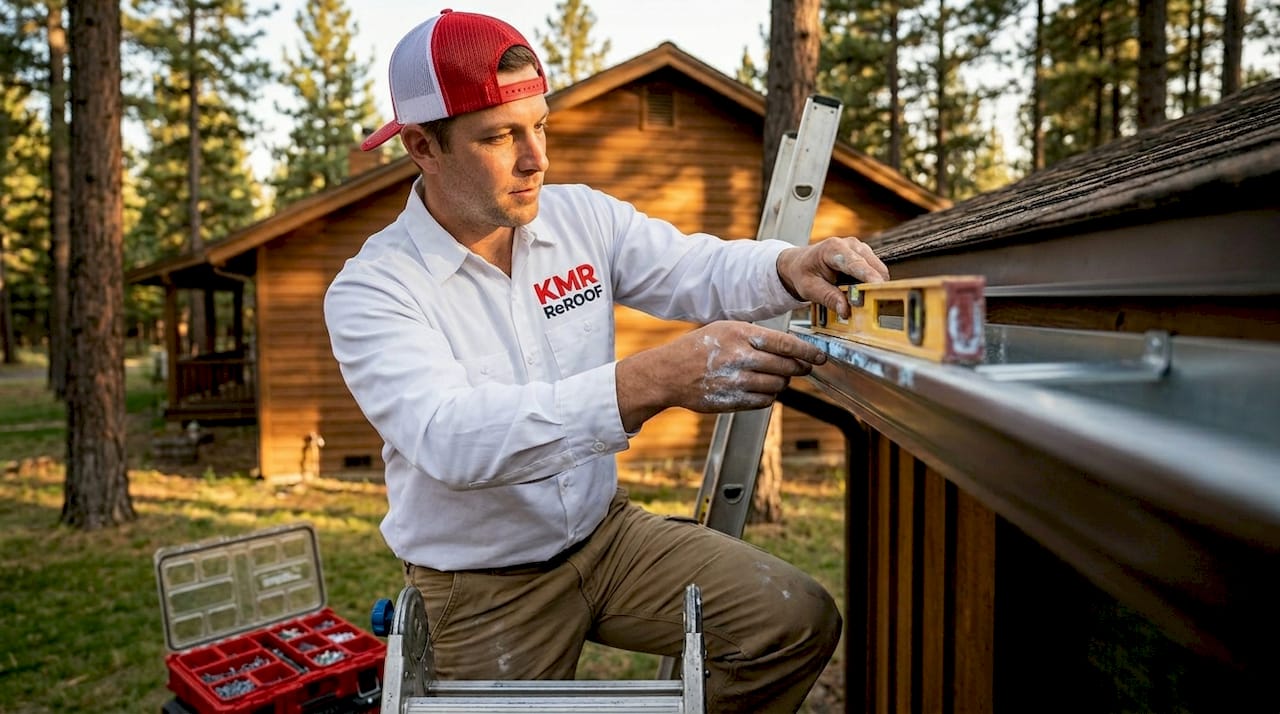
The industry standard slope is a quarter-inch drop per 10 feet of gutter run. That gradient moves water toward the downspout efficiently without creating the overshoot problem that occurs with excessive pitch. Proper gutter slope balances drainage speed with controlled flow during heavy rain events. It sounds like a small detail, but incorrect slope is one of the most common installation errors.
Choosing the right material
| Material | Lifespan | Cost Range | Key Consideration |
|---|---|---|---|
| Aluminum | 20-30 years | Affordable | Lightweight, prone to denting; needs expansion joints |
| Steel (galvanized) | 20-40 years | Moderate | Heavier and stronger; can rust without proper coating |
| Copper | 50+ years | Premium | Extremely durable; develops patina; used in high-end homes |
One overlooked detail with aluminum gutters: thermal expansion. Aluminum expands and contracts with temperature swings, and without proper expansion joints, aluminum gutters can buckle or pull away from the fascia over time. This is especially relevant in Texas, where temperature differences between summer and winter can be dramatic.
Seamless gutters minimize leaks and corrosion by reducing the number of joints along the run. Traditional sectional gutters have seams every few feet, and each one is a potential leak point as sealant ages. Seamless gutters are custom-fabricated on-site and represent a meaningful upgrade in long-term performance, particularly for homeowners who want to reduce maintenance frequency.
Pro Tip: If you are choosing roofing materials with a steeper pitch or metal roofing panels, account for faster and more forceful water runoff when sizing your gutters. A roof that sheds water faster needs a gutter system that can keep up.
Gutter maintenance and roof health
How gutters protect roofs is not just about their presence. It is about their condition. A clogged gutter is nearly as damaging as no gutter at all. When gutters fill with leaves, twigs, and debris, water backs up behind the dam and sits against the fascia. In colder months, that backed-up water freezes and causes ice dams that force water beneath shingles, causing interior leaks and structural damage.
Ice dams are worth understanding clearly. They form when heat escaping through the attic warms the roof deck, melting snow above. That meltwater runs down to the cold eave, where it refreezes. A clogged gutter accelerates this process by trapping water at exactly the wrong point. However, ice dams are primarily caused by attic heat loss and ventilation problems. Gutters alone cannot solve the problem, but clean gutters combined with proper attic insulation and ventilation eliminate 92% of ice dam formation risk. That combination is the real solution.
Pro Tip: Schedule gutter cleaning twice a year: once in late fall after leaves drop and once in early spring before storm season. For homes under heavy tree cover, a third cleaning in midsummer is worth the time.
Gutter guards: worth the investment?
Gutter guards are screens or covers that block debris from entering the gutter while allowing water to flow through. Gutter guards reduce cleaning frequency by up to 70%, which is a significant benefit for homes surrounded by mature trees. However, no guard system is fully maintenance-free. Fine debris like pine needles and shingle granules can still accumulate over time, and guards need periodic inspection to confirm they are seated correctly and not directing water over the edge.
Micro-mesh guards are generally the most effective at filtering out fine debris. Foam and brush-style inserts trap organic material inside the gutter and can create more maintenance work than they eliminate. If you are investing in guards, the micro-mesh variety from a reputable installer is the only version that consistently delivers on the reduced-maintenance promise.
As part of routine roof maintenance, check your gutter system at least twice a year for sagging, separated joints, peeling paint on fascia, and visible debris buildup. These are early warning signs that your system needs attention before the damage reaches the roof deck or foundation.
Downspout placement and foundation protection
How you route water away from the house is just as important as how you collect it. This is where many otherwise well-designed gutter systems fall apart in practice.
Follow these steps to make sure your downspout placement actually protects your property:
- Extend every downspout at least 4 to 6 feet from the foundation. Discharge within 18 inches of the foundation creates hydrostatic pressure that causes wall cracks and basement leaks. Extensions are inexpensive and easy to install. There is no reason to skip them.
- Direct discharge toward permeable surfaces when possible. Lawn areas, garden beds with proper grading, and dry wells all absorb and redirect water more effectively than directing runoff onto driveways or toward neighboring properties.
- Account for roof complexity in your downspout count. A simple gable roof with two long runs needs far fewer downspouts than an L-shaped or multi-hip roofline. Each distinct roof section should have its own collection and discharge point. Consolidating too many roof sections into too few downspouts creates overflow risk.
- Check that discharge points slope away from the house. The grade around your foundation should drop at least one inch per foot for the first six feet. If downspouts extend 4 to 6 feet but the ground slopes back toward the house, you have negated the benefit.
- Inspect discharge areas after heavy rain. Erosion channels, pooling water, or soft spots in the soil near downspout exits are clear signs that the system is not moving water far enough or fast enough away from the structure.
Misdirected discharge does not just threaten your foundation. It causes soil erosion in landscaping beds, undermines concrete driveways and sidewalks, and creates ongoing moisture problems on exterior siding and brick. The role of drainage in roofing extends well past the roof edge.
My take on gutters as the unsung heroes of roofing

I’ve seen the aftermath of neglected gutters more times than I can count. A homeowner invests in a quality shingle or metal roof replacement, protects it with quality underlayment, and then leaves gutters half-full of debris for three years straight. The fascia rots, the shingles at the eave start to curl from moisture, and eventually water finds its way inside. The roof did its job. The gutters did not.
What most people miss is that gutters and roofing are not separate systems. They are one integrated water management system. A roof without properly functioning gutters is like a drain with no pipe attached. The water has nowhere controlled to go, so it goes everywhere uncontrolled.
In my experience, the homeowners who spend the least on emergency repairs over time are not the ones who bought the most expensive materials. They are the ones who treated maintenance as a routine, not an emergency response. Two gutter cleanings a year, annual downspout checks, and addressing small issues before they compound. That discipline saves thousands.
Professional installation matters here too. A gutter system that is improperly sloped, undersized for the roof, or attached to rotted fascia will fail regardless of the material quality. Getting it right the first time is a far better investment than correcting it after water damage forces your hand.
— Misterreroof
Protect your home with the right roofing system

Your gutter system and roof work together to keep your home dry and structurally sound. When one fails, the other suffers. At Mister ReRoof, every roof replacement project includes a thorough assessment of how water moves off your roof and away from your home. Whether you are considering a metal roof replacement built to handle Texas weather or a shingle roof upgrade with long-term durability, the team at Mister ReRoof evaluates your gutter system as part of the complete picture. Proper drainage is not an afterthought. It is built into every project from the start. Contact Mister ReRoof today to schedule your free estimate and get a roofing system that is built to last.
FAQ
What is the main role of gutters in roofing?
Gutters collect rainwater runoff from the roof surface and channel it through downspouts away from the foundation and structural elements, preventing water damage, erosion, and fascia rot.
How often should gutters be cleaned?
Clean gutters at least twice a year, once in late fall and once in early spring. Homes near heavy tree cover may need a third cleaning during summer to prevent debris buildup and overflow.
Can gutters prevent ice dams?
Clean gutters help reduce ice dam risk, but they are not the complete solution. Proper attic insulation and ventilation combined with clean gutters can eliminate the majority of ice dam formation risk.
What happens if downspouts are too close to the foundation?
Downspout discharge within 18 inches of the foundation creates hydrostatic pressure that causes wall cracks and basement moisture infiltration. Extending downspouts 4 to 6 feet is the recommended minimum.
Are seamless gutters better than standard sectional gutters?
Yes, in most cases. Seamless gutters reduce the number of joints along the gutter run, which minimizes leak points and corrosion risk over time, making them a better long-term investment for most homeowners.
