Why choose impact resistant shingles: Texas guide
Why choose impact resistant shingles: Texas guide
TL;DR:
- Impact resistant shingles use SBS-modified asphalt and fiberglass mats to absorb impacts and resist cracking. They reduce insurance claims by 70-80% and can lower premiums by 15-35%, providing long-term cost savings. However, ratings are performance-based and require proper installation and documentation for maximum benefit in storm-prone Texas regions.
If you’ve ever filed a roof claim after a Texas hailstorm, you already know how fast minor damage turns into a major bill. That’s exactly why more homeowners in El Campo and Houston are asking why choose impact resistant shingles before the next storm hits rather than after. The short answer: these shingles can reduce insurance claims by 70 to 80 percent compared to standard shingles, and Texas insurers are required to reward you for it with meaningful premium discounts. This guide gives you everything you need to decide with confidence.
Table of Contents
- What are impact resistant shingles and how do they work?
- Benefits of impact resistant shingles for Texas homeowners
- Common misconceptions and limitations of impact resistant shingles
- How to choose and install impact resistant shingles for your home
- Why impact resistant shingles are an essential upgrade for Texas homeowners
- Upgrade to impact resistant shingles with Mister ReRoof
- Frequently asked questions
What are impact resistant shingles and how do they work?
Standard asphalt shingles are engineered for weather exposure, but not for repeated blunt force. Impact resistant shingles are a different product entirely. They are manufactured with a modified asphalt compound called SBS (styrene-butadiene-styrene), which is a rubber-like polymer blended into the asphalt layer. This gives the shingle the flexibility to absorb an impact and spring back instead of cracking, splitting, or shedding granules.
The industry benchmark for measuring this is the UL 2218 classification system. Think of it as a crash test rating for your roof. Class 4 shingles must survive a 2-inch steel ball dropped from 20 feet without cracking or tearing, and they must pass that test twice in the same spot. No standard shingle comes close to clearing that bar.
Here is what sets these shingles apart from conventional options:
- SBS-modified asphalt core absorbs impact energy rather than transferring it into a crack
- Reinforced fiberglass mat beneath the asphalt layer adds structural integrity
- Thicker granule coating reduces granule loss from hail strikes, which is what triggers most cosmetic claims
- Class 4 UL 2218 certification is the minimum threshold to qualify for insurance discounts in Texas
- Available in multiple profiles including architectural and designer styles, so durability does not mean ugly
When you explore durable roofing options in Texas, impact resistant shingles consistently rise to the top for homeowners who want asphalt aesthetics with significantly better performance.
Pro Tip: Ask your roofing contractor for the product’s UL 2218 test certificate before they order materials. If a shingle is labeled “impact resistant” but lacks that certificate number, it may not qualify for your insurance discount.
Benefits of impact resistant shingles for Texas homeowners
Texas sits squarely in “Hail Alley,” a region stretching from West Texas through the Dallas-Fort Worth corridor and down through Houston. El Campo and the surrounding Gulf Coast area experience severe hail events multiple times per decade, and Houston sees thunderstorm activity that generates both hail and high winds. Upgrading your roof is not a luxury here. It is a risk management decision.
The practical advantages stack up fast:
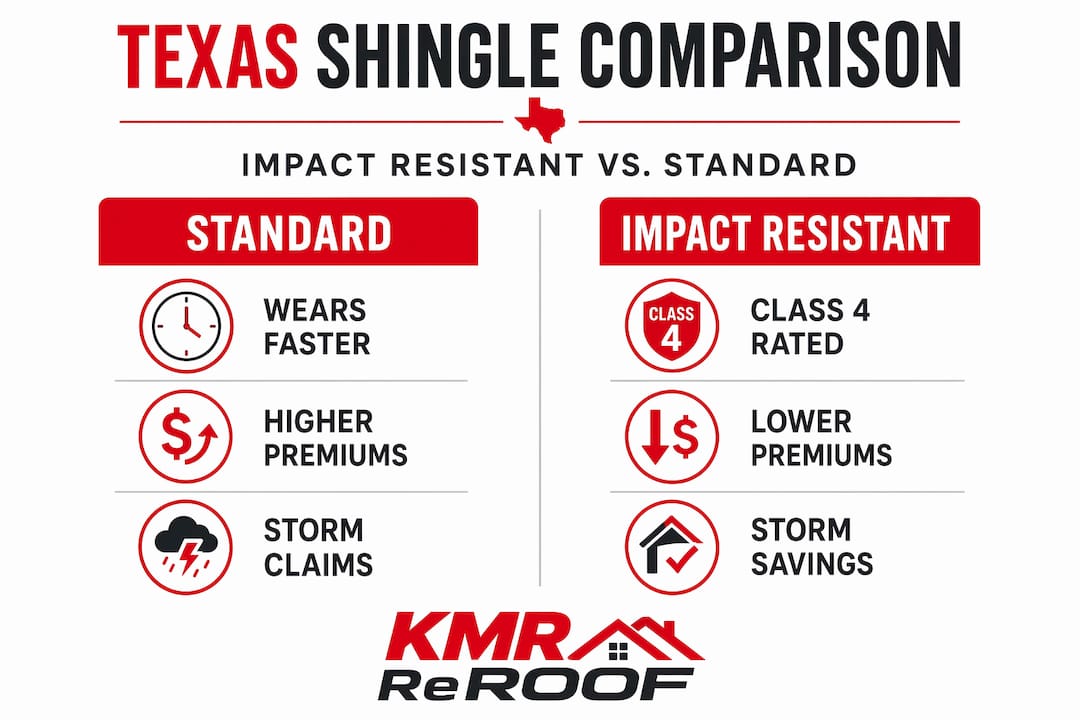
- Fewer repair calls. Impact resistant shingles result in 70 to 80 percent fewer insurance claims compared to standard shingles. Fewer claims means lower lifetime ownership costs.
- Insurance premium savings. Texas homeowners see reductions of 15% to 35% for qualifying Class 4 roofs. On a $3,500 annual premium, that is $525 to $1,225 back in your pocket every year.
- Resale value increase. Homes with verified impact resistant roofs gain 2.8% to 5.6% in resale value in storm-prone regions, a number buyers and appraisers are increasingly recognizing.
- Longer roof lifespan. Because these shingles resist granule loss and cracking, they maintain their waterproofing integrity longer than standard products under the same weather conditions.
“Choosing impact resistant shingles in Texas is one of the few home upgrades where the insurance savings alone can pay back your investment within a predictable timeframe.” That is not marketing. It is math.
Here is a quick comparison of what you gain financially:
| Scenario | Standard shingles | Class 4 impact resistant |
|---|---|---|
| Avg. annual premium (example) | $3,500 | $2,625 to $2,975 |
| Insurance claims in 10 years | 3 to 5 typical | 1 or fewer |
| Out-of-pocket repair costs | High | Significantly reduced |
| Resale value boost | Minimal | 2.8% to 5.6% |
For more detail on how these shingles perform when storms roll in, read about storm resistance benefits in Houston and roof upgrade benefits in Texas.
Common misconceptions and limitations of impact resistant shingles
Here is where most articles stop being useful. Impact resistant shingles are genuinely excellent, but they are not magic. Treating them as a guaranteed shield sets homeowners up for frustration and potential coverage disputes.
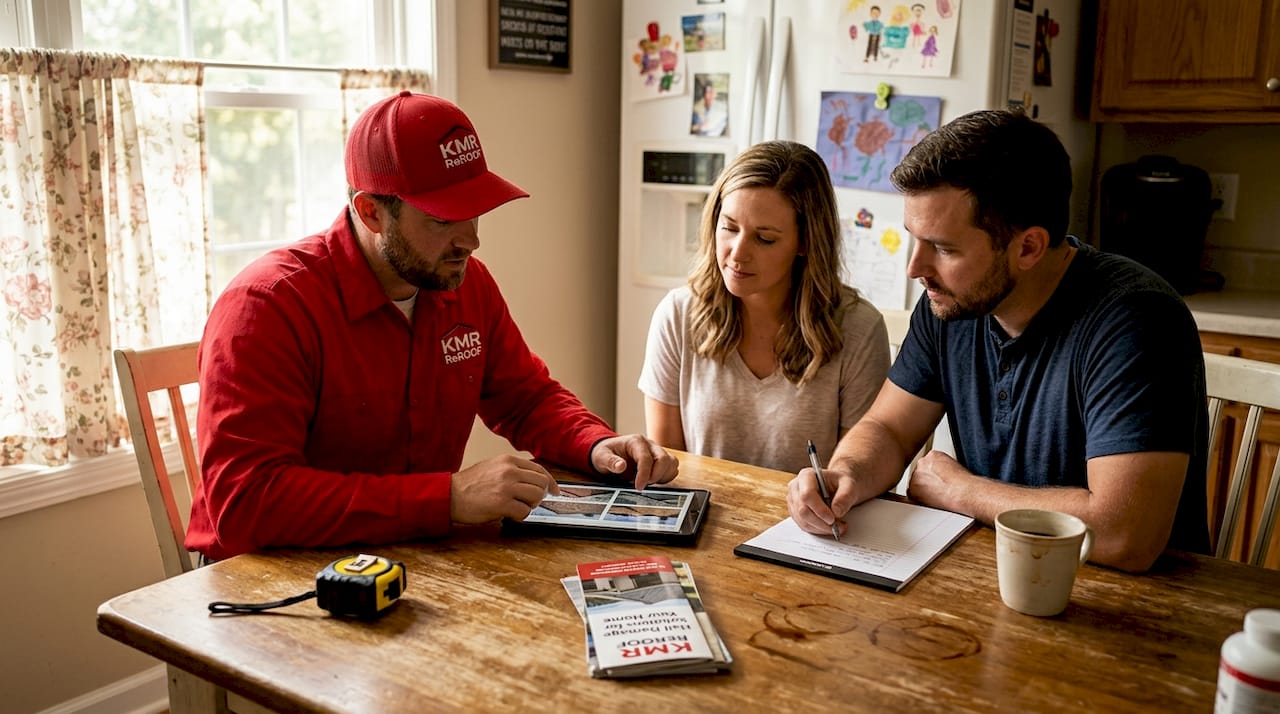
The most important thing to understand: impact-resistant ratings are not “hail-proof” guarantees. They are performance-based metrics that measure granule loss, tears, and dents under controlled lab conditions. A Class 4 shingle hit by golf ball-sized hail at 70 mph in a real storm may still show cosmetic damage. The rating tells you how much better it performs compared to a standard shingle, not that it will emerge flawless.
A few other limitations worth knowing before you upgrade:
- Cosmetic damage exclusions. Some Texas insurers add a cosmetic damage exclusion to policies covering Class 4 roofs. This means dents and dimples from hail are not covered even if the shingle is structurally intact. Read your policy before and after upgrading.
- Discount applies to a portion of your premium. Insurance discounts for Class 4 roofs are often applied specifically to the wind and hail portion of your policy, not the total premium. Your actual savings may be smaller than the headline percentage suggests.
- Not all “impact resistant” labels are equal. Class 3 shingles exist and also carry an impact resistant label, but they will not qualify for the same discounts. Verify that your product is specifically Class 4.
- Installation quality matters as much as product quality. A Class 4 shingle incorrectly nailed has all the vulnerability of a standard shingle once wind gets under it.
Pro Tip: Before signing any roofing contract, ask your insurer exactly how they calculate the discount and which portion of your premium it applies to. You want to know the real dollar figure, not just a percentage that sounds impressive.
For a deeper look at how Texas weather affects roofing materials over time, see weather impact on roofing durability. The IBHS asphalt shingle durability research is also worth bookmarking.
How to choose and install impact resistant shingles for your home
Getting this right is a process, not just a purchase. Follow these steps to make sure you end up with a verified Class 4 roof and the insurance savings to go with it.
- Confirm your insurer’s requirements first. Call your insurance company before selecting any product. Ask what Class rating qualifies, what documentation they need, and whether a cosmetic damage exclusion applies.
- Select only UL 2218 Class 4 certified products. IBHS tests shingles bought retail to help consumers and contractors make informed choices. Their published ratings list is a reliable independent resource.
- Get your contractor to document everything. Your entire roof must be covered with Class 4 rated materials to qualify for the discount, and documentation is required. This means a signed contractor certificate listing the exact product name, brand, Class rating, and installation date.
- Keep product receipts and spec sheets. Insurance adjusters sometimes request proof that the installed product matches what was quoted. Do not rely on memory or a verbal agreement.
- Schedule an inspection if your insurer requires it. Some companies send an adjuster to confirm the installation before applying the discount. Coordinate this with your contractor before they demobilize.
Here is a feature comparison of commonly installed Class 4 options to help guide your conversation with a contractor:
| Shingle type | Class rating | SBS modified | Wind resistance | Best for |
|---|---|---|---|---|
| Architectural Class 4 | UL 2218 Class 4 | Yes | Up to 130 mph | Most Texas homes |
| Designer profile Class 4 | UL 2218 Class 4 | Yes | Up to 130 mph | Higher-end homes |
| Metal roofing | Class 4 equivalent | N/A | 140+ mph | Maximum longevity |
| Standard architectural | None | No | Up to 110 mph | Budget installs only |
For further roofing upgrade guidance in Texas and understanding the storm damage roof repair process, those resources will fill in the gaps.
Why impact resistant shingles are an essential upgrade for Texas homeowners
Most homeowners delay this upgrade because of one thing: upfront cost. A Class 4 roof typically runs 10% to 30% more than a standard shingle installation. That number feels real. What feels abstract is the three hail events you will statistically experience in the next 15 years and what each one costs without the right roof over your head.
Here is the honest perspective from working with homeowners across El Campo and Houston. The cost objection almost always disappears the moment someone does the actual math. If your insurer discounts your annual premium by $700 per year, you recover a $5,000 cost premium in roughly seven years. And that calculation does not include avoided deductibles, avoided repair bills, or the resale value improvement.
Impact resistant roofing is a win-win in Texas: better protection, fewer claims, and significant insurance savings. The homeowners we see struggle are not the ones who paid more for Class 4. They are the ones who paid for a standard roof twice after back-to-back storm seasons.
There is also a market signal worth understanding. Buyers in Houston and El Campo increasingly ask about roofing specs before making offers. A verified Class 4 roof with documentation does not just protect your home. It is a differentiator when you sell. Think of it the same way you think about a newer HVAC system — it is not glamorous, but it closes deals faster and at better prices.
Contractor quality is the part of this equation that gets the least attention. The best shingle in the industry installed by the wrong crew performs like a standard shingle within a few storm seasons. Nail placement, overlap depth, and flashing details are where the protection either holds or fails. Choose your contractor with the same care you choose the product.
For a full look at long-term value, explore quality roofing lifespan and savings.
Upgrade to impact resistant shingles with Mister ReRoof
If you are ready to stop gambling on your roof every storm season, Mister ReRoof is the team El Campo and Houston homeowners call first. We install verified UL 2218 Class 4 impact resistant shingles and metal roofing systems built to handle everything Texas weather delivers. More importantly, we handle the documentation your insurance company requires so you actually get the discount you paid for.
From shingle roof replacement in El Campo to shingle roofing in Hallettsville and across the greater Houston area, our crews are certified, detail-oriented, and accountable. We do not just put a roof on. We make sure your investment works for you on day one and for decades after. Contact Mister ReRoof today for a free estimate and let us show you exactly what your upgrade will cost and save.
Frequently asked questions
What makes impact resistant shingles different from regular shingles?
Impact resistant shingles use SBS-modified asphalt and reinforced fiberglass mats engineered to flex on impact rather than crack, and they must pass a strict Class 4 standard that requires surviving a 2-inch steel ball dropped from 20 feet without cracking.
How much can I expect to save on insurance with impact resistant shingles in Texas?
Texas law mandates that insurers offer discounts for qualifying Class 4 roofs, with most homeowners saving between 15% and 35% on the wind and hail portion of their premium.
Do impact resistant shingles completely prevent hail damage?
No material is completely hail-proof. Impact-resistant ratings are performance-based and describe how much better a shingle resists damage compared to standard products, not a guarantee against all damage in extreme events.
What documentation is needed to get the insurance discount for impact resistant shingles?
You typically need a contractor’s signed certificate listing the exact Class 4 product installed, along with receipts and product spec sheets. Documentation requirements may also include an inspection depending on your insurer.
Are impact resistant shingles more expensive to install?
Yes, Class 4 shingles generally cost 10% to 30% more upfront, but insurance savings and lower claims typically offset that additional cost within five to seven years for most Texas homeowners.
