TL;DR:
- Specifying fire-rated roofing materials alone does not ensure a fire-resistant roof; system-level performance is crucial.
- Changes during construction, such as penetrations or material substitutions, can invalidate tested assemblies and compromise fire safety.
Many construction managers assume that specifying fire-rated roofing products automatically produces a fire-resistant roof. It does not. Fire resistance in industrial roofs is a system-level performance requirement, not a component checklist. A single membrane change, an unprotected pipe penetration, or a substituted insulation board can undo a tested assembly’s compliance entirely. This article cuts through that confusion by walking you through code requirements, rating systems, real material options, and the practical steps that keep your industrial facility protected, insured, and legally sound.
Table of Contents
- Key takeaways
- Fire resistance in industrial roofs under building codes
- Fire rating systems and test standards you need to recognize
- System-level risks that most teams overlook
- Choosing fire-resistant roofing materials for industrial buildings
- Managing fire resistance from design through maintenance
- My perspective on where industrial fire resistance goes wrong
- How Mister ReRoof can help with your industrial roof
- FAQ
Key takeaways
| Point | Details |
|---|---|
| Systems, not products, determine compliance | Fire resistance ratings apply to the full roof assembly, not individual components. |
| IBC Table 601 sets the baseline | Construction type dictates minimum fire-resistance hours for your roof assembly and structural frame. |
| Penetrations are the biggest hidden risk | Unprotected PV cables, HVAC curbs, and cable trays can void assembly compliance overnight. |
| Insurers often exceed code minimums | FM Global and similar carriers impose stricter fire-resistant assembly requirements than the IBC alone. |
| Early coordination prevents costly retrofits | Embedding fire resistance planning from design through maintenance avoids expensive non-compliance fixes later. |
Fire resistance in industrial roofs under building codes
The International Building Code organizes buildings into construction types, and each type carries minimum fire-resistance-hour requirements for its structural components. IBC Table 601 is the primary reference every construction manager and property owner on an industrial project needs to understand before specifying a single material.
Here is what those ratings look like across common construction types:
| Construction type | Roof construction (hours) | Structural frame (hours) |
|---|---|---|
| Type I-A | 1.5 | 3 |
| Type I-B | 1.0 | 2 |
| Type II-A | 1.0 | 1 |
| Type II-B | 0 | 0 |
| Type III-A | 1.0 | 1 |
| Type III-B | 0 | 0 |
| Type V-A | 1.0 | 1 |
| Type V-B | 0 | 0 |
The structural frame and roof construction numbers are separate. A Type II-A building needs a one-hour rated roof assembly and spray-applied fire-resistant material (SFRM) on its structural steel. A Type II-B building requires no steel fireproofing at all. That distinction alone can shift your budget significantly, so confirming your construction type early is non-negotiable.
IBC Table 601 also contains footnotes that modify requirements in ways that catch experienced teams off guard. One common footnote reduces the required fireproofing on roof-only structural members when those members are above a certain height or do not support floor loads. Another allows reductions when sprinkler systems are present. These are not automatic exemptions. Your architect and code consultant need to validate each one against your specific building configuration.
Pro Tip: Confirm your construction type classification with your structural engineer before any material procurement. The wrong assumption here can trigger expensive retrofits or force a redesign of your fireproofing scope.
Fire rating systems and test standards you need to recognize
The United States and Europe use different frameworks to classify roof fire performance, and confusing the two can lead to serious compliance gaps.
In the US, roof coverings receive Class A, B, or C ratings under ASTM E108 and UL 790 testing. Class A is the highest rating, indicating the assembly resists severe fire exposure with minimal flame spread. Class B covers moderate exposure, and Class C covers light exposure. Most industrial buildings require Class A. The critical detail that many people miss is that these ratings apply to the complete tested assembly. The membrane, the insulation, the deck substrate, and the fastening method all factor into the tested system.
In Europe, EN 13501-5 governs external fire performance for roofs. The BROOF(t4) classification represents the highest resistance against external fire threats, testing the full build-up including membrane, insulation, fixings, penetrations, and edge details. Partial component ratings do not guarantee BROOF(t4) compliance. You must test the complete assembly as installed.
| Rating system | Region | Tests | Top rating |
|---|---|---|---|
| ASTM E108 / UL 790 | United States | Flame spread, burning brand, intermittent flame | Class A |
| EN 13501-5 / BROOF(t4) | Europe | External fire performance, full assembly | BROOF(t4) |
| BS 476 (legacy) | England (phasing out by 2029) | Older fire spread test | EXT.F.AA |
England’s Approved Document B is mandating a transition from the older BS 476 standard to EN 13501-5 by 2029. If you are specifying or managing international industrial projects, you need to confirm which standard applies and whether your current documentation reflects modern Euroclass ratings.
Pro Tip: When reviewing product data sheets, look for the tested assembly description, not just the fire class on the label. A membrane labeled Class A is only Class A when installed exactly as described in the test report.
System-level risks that most teams overlook
This is where industrial roofing fire safety compliance most often breaks down in practice. You can specify a fully tested, code-compliant roof assembly and then compromise it entirely during construction or a later retrofit.
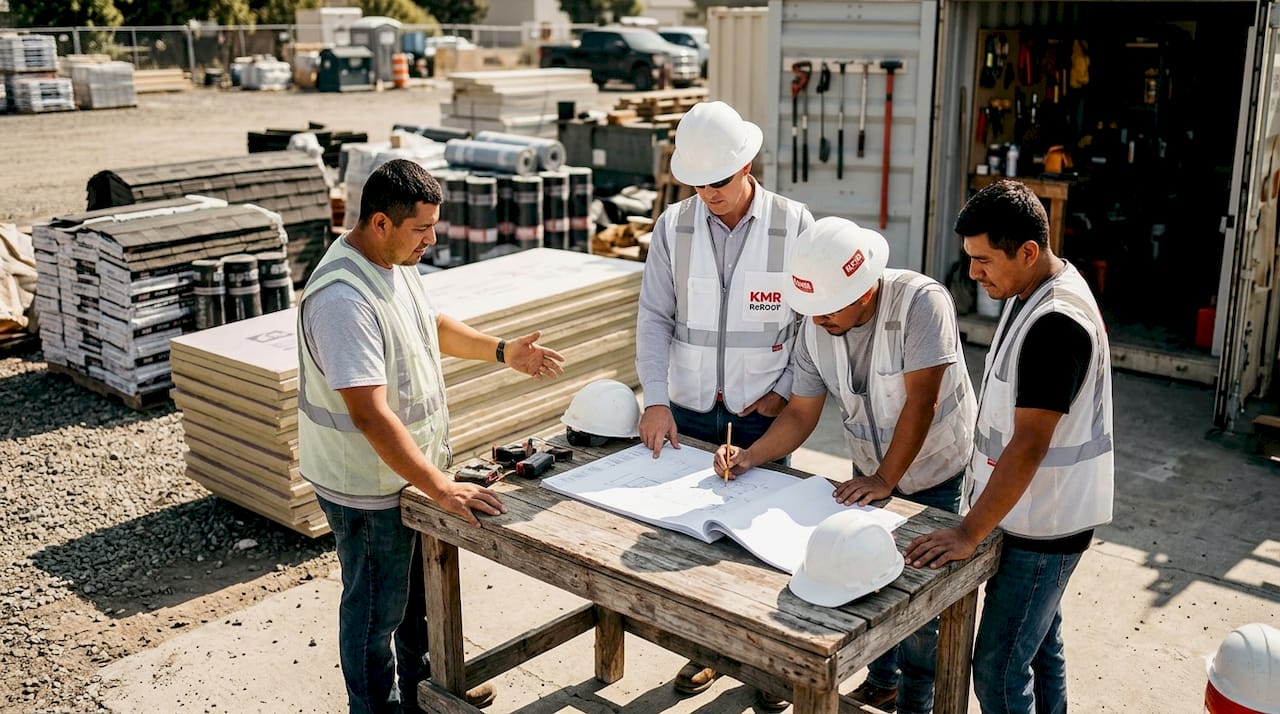
Changes to insulation type, deck configuration, or penetration details can negate assembly compliance even when every individual component carries a fire rating. The tested assembly is a specific recipe. Substitute one ingredient and you are no longer cooking the same dish.
The highest-risk scenarios in industrial settings include:
- Rooftop PV system installations. Solar panels require cable penetrations through the roof membrane, and those cable pathways can create both ignition risk and fire spread routes that bypass compartmentation entirely if not fire-stopped correctly.
- HVAC curb additions. Mechanical curbs cut openings in a tested roof assembly. Without proper fire-stopping collars and membrane integration, the opening voids the system rating.
- Insulation substitutions during value engineering. A contractor swaps one polyisocyanurate board for a similar-looking product from a different manufacturer. If the original test report lists a specific product, that substitution may invalidate the entire assembly’s classification.
- Cable tray and conduit penetrations. These are often treated as minor construction details, but each one is a potential fire pathway if not fire-stopped with an approved intumescent or mineral-based solution.
- Perimeter and edge changes. A tested BROOF(t4) assembly includes specific edge and perimeter details. Changing the parapet height, flashing type, or edge termination without reviewing the test field of application can strip compliance from an otherwise correct installation.
Coordination among the roofing contractor, mechanical trades, electrical subcontractors, and the design team is not optional. It must be explicit and documented, because the people adding a conduit penetration later in the schedule are rarely thinking about the roof assembly fire classification.
Choosing fire-resistant roofing materials for industrial buildings
Selecting the right materials means balancing code requirements, insurer expectations, operational demands, and long-term durability. No single material is universally superior. What matters is the tested assembly, the building type, and the specific risks present in your facility.
Here is a practical overview of common options for fireproof industrial buildings:
- Metal roof panels. Standing seam and metal panel systems are inherently non-combustible and can achieve Class A ratings with appropriate substrates. They perform well in high-temperature industrial environments and require minimal combustible material in the assembly.
- TPO membranes. Thermoplastic polyolefin is widely used in flat industrial roofing and can achieve Class A ratings when tested over the correct deck and insulation combination. TPO is also relatively cost-effective and UV stable.
- EPDM membranes. Ethylene propylene diene monomer performs well in temperature extremes and has good fire resistance characteristics when part of a tested assembly. It is common in retrofit applications.
- Concrete and clay tiles. These are inherently non-combustible and achieve the highest fire resistance ratings, though their weight loads limit their use to structurally appropriate industrial buildings.
- Gypsum-fiber roof decking. Used as a substrate layer, gypsum-fiber boards significantly improve the fire resistance of assemblies built over steel decking. They are common in Type II-A construction to achieve the required one-hour rating.
Insurance requirements often exceed code minimums. FM Global, one of the largest industrial property insurers, publishes its own data sheets specifying approved roof assemblies. A building that passes IBC requirements may still fail FM Global’s approval criteria, which could affect your property coverage terms. Always cross-reference your insurer’s requirements alongside the building code, not after it.
Pro Tip: Review your property insurer’s approved assembly lists before finalizing material specifications. Getting FM Global approval on a non-compliant assembly after construction is significantly more expensive than designing for it from the start.
For more on what fire-resistant roofing options are available and how to evaluate them for Texas properties, the comparison of material types by exposure risk is a good starting point.
Managing fire resistance from design through maintenance
Compliance is not a one-time event at the point of design. It must be actively managed through construction, occupancy, and ongoing maintenance.
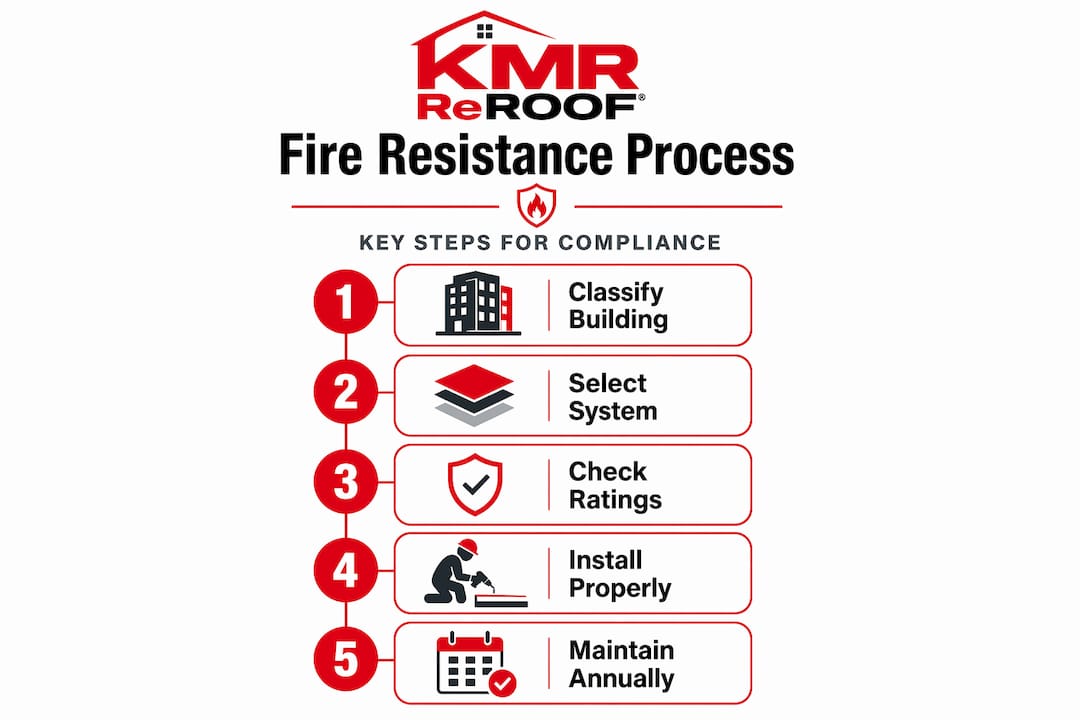
- Confirm your construction type and applicable ratings at project inception. Do not wait for the permit review to discover you need a one-hour rated assembly. This decision should be locked in during schematic design.
- Validate the tested assembly against your specific configuration. Request the full test report from the manufacturer, not just the product data sheet. Confirm that your deck type, insulation, membrane, and fastening pattern match the tested assembly’s field of application.
- Document every penetration before and during construction. Create a penetration log that captures the fire-stopping product used, the installer, and the inspection date for every opening through the roof assembly.
- Require design team sign-off before rooftop equipment is added post-construction. A new HVAC unit or solar array is a system modification, not a maintenance item. Treat it that way.
- Schedule professional inspections on a defined cycle. Use a structured industrial roofing inspection checklist that specifically addresses fire-stopping integrity, membrane condition at penetrations, and any evidence of unauthorized modifications.
- Understand the non-compliance consequences clearly. A roof assembly that fails its fire resistance rating because of an undocumented penetration can trigger insurance claim denials, void building occupancy permits, and expose property owners to significant liability if a fire occurs.
Maintaining fire resistance is not about adding complexity. It is about treating the roof as the engineered system it is, which means tracking it the same way you would any other life-safety system in the building.
My perspective on where industrial fire resistance goes wrong
I’ve watched project teams spend months getting structural fireproofing exactly right on Type I-A buildings, only to hand the project over to a mechanical contractor who punches a dozen unprotected conduit runs through the completed roof assembly in the last two weeks of construction. Nobody flagged it. Nobody had authority over it. The tested system was effectively voided before the owner took possession.
The core problem I see repeatedly is that fire resistance is treated as a materials procurement decision rather than a system design discipline. Teams buy Class A products, check the box, and move on. What they do not do is maintain the chain of custody from the tested assembly spec to the actual installed configuration.
My honest take is this: the code is the floor, not the ceiling. For industrial facilities with high-value equipment, chemical storage, or dense occupancy, the occupancy classification and insurer expectations will almost always push requirements above code minimum. Getting comfortable with that reality early, and building a specification and inspection process around it, is what separates a roof that performs in a fire from one that is merely labeled as fire-resistant.
Embed fire resistance into your project’s coordination meetings from day one. Make it someone’s explicit responsibility. Review it at every rooftop modification. That is the actual practice, not the paperwork.
— Misterreroof
How Mister ReRoof can help with your industrial roof
When fire resistance compliance and long-term durability both matter, the material and the installer both have to perform. Mister ReRoof has hands-on experience replacing industrial roofs across Texas with metal panels, TPO systems, and flat roof configurations that meet code requirements and insurer expectations. From the initial specification through final installation, the team ensures that the assembly you specify is the assembly you get, no undocumented substitutions and no surprises at inspection.
If your industrial facility in the Houston or El Campo area needs a fire-resistant roof replacement, Mister ReRoof offers consultations and free estimates. Explore metal roof replacement in Victoria, TX or fire-rated roof options in Hallettsville to see the range of services available. Contact Mister ReRoof today to get started.
FAQ
What makes a roof “fire-resistant” under US building codes?
Under the IBC, a fire-resistant roof is one whose complete assembly meets the minimum fire-resistance-hour rating for the building’s construction type, as defined in IBC Table 601. The rating applies to the entire system, not individual products.
Can changing insulation void my roof’s fire rating?
Yes. Assembly compliance depends on every component matching the tested configuration. Substituting insulation type or thickness, even with a “fire-rated” product, can invalidate the fire classification of the full assembly.
Do industrial buildings need Class A roofing?
Most industrial occupancies require Class A fire-rated roofing assemblies under the IBC, though the specific requirement depends on construction type and occupancy classification. Insurance carriers like FM Global may impose additional requirements beyond the code minimum.
What fire risks do rooftop PV systems create?
Solar panel installations introduce cable penetrations that, if left without proper fire-stopping, create ignition and fire spread pathways through the roof assembly, potentially bypassing compartmentation and voiding fire resistance compliance.
How often should industrial roofs be inspected for fire compliance?
Professional inspections should follow a defined annual or biannual cycle that specifically checks fire-stopping integrity at all penetrations, membrane condition, and any unauthorized modifications. Using a structured Texas industrial inspection checklist helps standardize the process.
