TL;DR:
- Roofing impacts net operating income by affecting operating expenses, insurance premiums, and energy costs. Proper maintenance and structured programs can prevent costly repairs and preserve property value, enhancing NOI and investment returns.
How does roofing impact net operating income?
The role of roofing in NOI is more direct than most asset managers expect. Every dollar spent on unplanned roof repairs hits operating expenses immediately, reducing NOI dollar for dollar. A roof replacement, by contrast, sits below the NOI line as a capital expenditure, but the reserve allowance lenders require above that line still compresses your reported income. The roof is the one building system that touches both sides of your financial statement simultaneously.
Here is what roofing actually moves on a commercial property’s income statement:
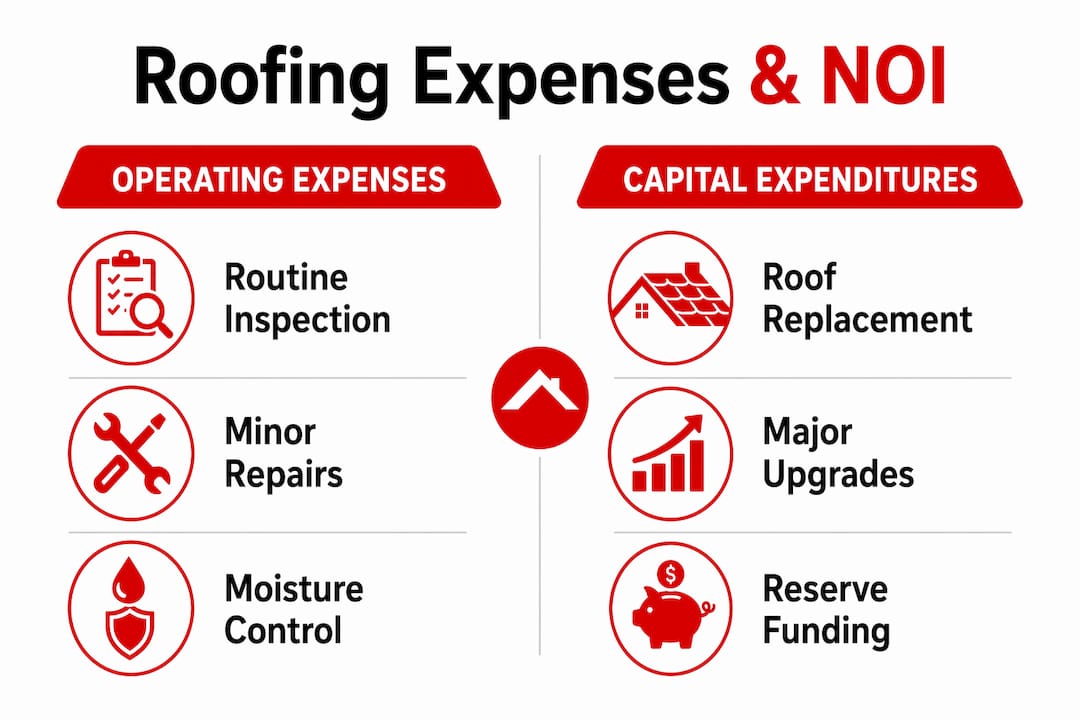
- Operating expenses (OpEx): Routine maintenance, inspections, minor repairs, and emergency leak response all reduce NOI directly.
- Insurance premiums: A poorly maintained roof triggers higher premiums or coverage denial, both of which show up in operating costs.
- Energy costs: Degraded roof insulation raises HVAC loads, increasing utility expenses that flow straight through to NOI.
- Tenant disruption: Roof leaks affecting tenants lead to rent abatements, downtime costs, and lease non-renewals, all of which reduce income.
- Capital reserve requirements: Lenders and appraisers model replacement timelines into their underwriting, effectively penalizing properties with aging roofs even before a check is written.
- Property valuation: At a 7% cap rate, every dollar of annual roof reserve reduction adds $14.28 to property value, because commercial value is calculated as NOI divided by cap rate.
The financial case for treating roofing as a core asset management discipline rather than a maintenance afterthought is built into the math of how commercial properties are valued.
Table of Contents
- Why deferred roof maintenance quietly destroys your NOI
- OpEx vs. CapEx: why the budget distinction matters for your NOI
- How structured roofing programs protect and grow your NOI
- How KMR ReROOF’s services protect commercial property NOI
- Typical roofing costs and timelines that affect your budget
- Misterreroof delivers roofing that protects your property’s income
- Key Takeaways
Why deferred roof maintenance quietly destroys your NOI
Deferred maintenance does not announce itself. It shows up as accelerating reserve drawdowns, scattered water-damage events on the profit and loss statement, rising insurance premiums, and compressed sale multiples when the asset goes to market. By the time the damage is visible, the financial hit has already compounded.
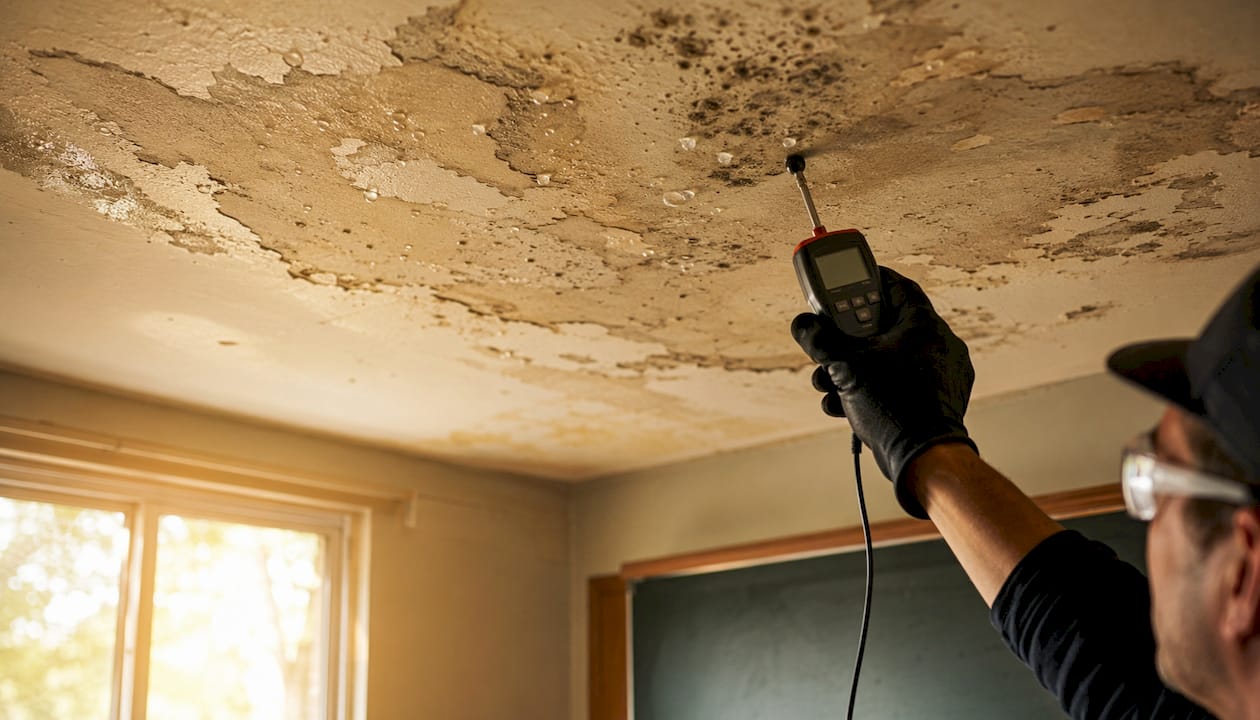
The cost escalation is not gradual. A membrane separation that costs a few hundred dollars to fix today can become a $40,000 interior damage event within months once water reaches insulation, structural decking, and electrical systems. Emergency repairs carry a significantly higher cost premium over planned interventions. That multiplier alone makes the case for proactive maintenance before you factor in insurance consequences.
Insurance carriers have changed the stakes considerably. They now use aerial imagery, claims databases, and roof-age modeling to assess portfolio condition with more precision than many owners apply themselves. The practical result, as Brad Strawbridge has documented across multifamily portfolios, is deductible increases of five to ten times what they were previously, non-renewals on properties that pass a walking inspection but fail an aerial review, and mandatory replacement timelines arriving on 90-day windows. Owners managing roofs reactively are reading lagging indicators while carriers are running a tighter playbook on the same assets.
The misconception worth correcting: many owners treat roof maintenance as something to schedule when a problem appears. Carriers and lenders treat the absence of documented inspection history as evidence of neglect, which affects both coverage eligibility and premium pricing. A missing inspection record can void coverage on a genuine storm claim.
Pro Tip: Review your insurance policy’s inspection documentation requirements before your next renewal. If your carrier requires biannual inspection records for storm claim eligibility, and you cannot produce them, you are carrying uninsured risk regardless of what your premium statement says.
OpEx vs. CapEx: why the budget distinction matters for your NOI
Confusing roof maintenance with roof replacement is one of the more expensive accounting mistakes a commercial property owner can make. The two categories behave completely differently on your financial statements, and misclassifying them creates problems that range from overstated NOI to lease liability.

Roof repairs are operating expenses that reduce NOI directly. Roof replacement is a capital expenditure deducted below the NOI line. That distinction sounds clean until you realize that some institutional lenders and appraisers deduct a replacement reserve allowance above the NOI line as a proxy for normalized CapEx needs. Always confirm which convention applies to any NOI figure you are reviewing or presenting.
| Category | Type | NOI Impact | Lease Responsibility (NNN) |
|---|---|---|---|
| Routine inspections | OpEx | Direct reduction | Typically tenant |
| Minor repairs and patching | OpEx | Direct reduction | Typically tenant |
| Emergency leak response | OpEx | Direct reduction | Shared or disputed |
| Full roof replacement | CapEx | Below NOI line | Typically landlord |
| Replacement reserve allowance | CapEx proxy | Above-line deduction (some lenders) | Landlord |
| Amortized replacement recovery | CapEx recovery | CAM passthrough over useful life | Tenant (via amortization clause) |
Under a triple-net (NNN) lease, tenants typically cover routine maintenance as an operating expense, while the landlord absorbs full roof replacement as a capital expenditure. Misclassifying a roof replacement as a CAM expense creates overbilling liability under tenant leases and, when corrected, removes that revenue from historical NOI statements, which complicates refinancing and sale. The fix used by experienced landlords is an amortization clause: divide the replacement cost by the roof’s useful life and pass that annual fraction through as an allowable CAM charge, recovering the capital investment over the lease term without misrepresenting operating expenses.
Understanding your roof replacement reserve obligations before a transaction closes is the kind of diligence that separates owners who control their NOI from those who discover problems at closing.
How structured roofing programs protect and grow your NOI
A structured maintenance and lifecycle program converts roofing from an unpredictable balance sheet event into a scheduled, budgetable line item. The financial benefit compounds over time: lower annual repair costs reduce operating expenses, which improves NOI; better NOI improves cap rate math; and at the point of sale or refinancing, documented inspection history answers every lender and buyer question before it is asked.
A complete program covers these components:
- Biannual professional inspections: Spring to assess winter damage, fall to prepare for cold-weather stress. This schedule satisfies most warranty requirements and insurance carrier documentation standards.
- System-specific checklists: TPO, EPDM, and metal roofs each have distinct failure modes and warranty requirements. A TPO inspection is not interchangeable with a metal panel inspection, and using the wrong checklist creates documentation gaps that void manufacturer coverage.
- Monthly and quarterly FM tasks: Drain clearing, flashing checks, and surface debris removal between professional visits. Missing this layer creates vulnerability gaps that compound.
- Deficiency tracking: Every identified issue gets logged with photos, severity rating, and a corrective action assignment. This documentation supports insurance claims, warranty submissions, and investor reporting.
- Condition scoring: Assign a numeric condition score to each roof in your portfolio. Owners using current condition data gain control over replacement schedules and capital planning, replacing surprise capital events with scheduled ones.
- Reserve study integration: Update replacement cost estimates at acquisition and at regular intervals. Reserve studies built on real condition data rather than linear depreciation curves are defensible to lenders and capital partners.
- Triggered inspections: After any severe weather event, after rooftop equipment work, after any tenant-reported leak, and before any sale or refinancing event.
A biannual inspection program for a building of typical commercial size costs $600 to $1,600 annually and offers an ROI as high as 80x by preventing expensive water damage events.
For moisture-related maintenance, preventative moisture management practices align closely with what a structured roofing program accomplishes at the building envelope level.
How KMR ReROOF’s services protect commercial property NOI
KMR ReROOF operates from the premise that a commercial roof is a financial asset, not just a building component. Their approach to commercial roofing integrates quality installation, documented inspection programs, and warranty compliance into a single service framework designed to protect the income-generating capacity of the properties they work on.
KMR ReROOF’s commercial services address the specific financial risks that deferred roofing creates:
- Warranty-compliant installations: Manufacturer warranties on TPO, EPDM, and modified bitumen systems require documented annual inspections by authorized contractors. KMR ReROOF’s installation and follow-up programs keep those warranties intact, protecting owners from full replacement liability on defects that would otherwise be covered.
- Insurance-ready documentation: Every inspection produces a condition record that satisfies carrier requirements for storm claim eligibility, directly reducing the risk of claim denial due to missing documentation.
- Energy-efficient roofing systems: Properly installed roofing with intact insulation prevents the HVAC load increases that follow insulation degradation from water intrusion, keeping utility costs from inflating operating expenses.
- Project management during replacement: Tenant disruption during a roof replacement is a real NOI risk. Coordinated scheduling, staging management, and daily dry-in protocols protect tenant operations and lease relationships throughout the project.
- Long-term asset protection: A well-maintained roof with a documented inspection history reduces the roofing reserve a lender or appraiser assigns to the property, directly improving the income-capitalized valuation.
The benefits of quality roofing extend well beyond the physical structure. For commercial property owners, the financial case for professional installation and ongoing maintenance is built into how properties are valued, financed, and insured.
Typical roofing costs and timelines that affect your budget
Getting the numbers right before a roofing project starts is the difference between a planned capital event and one that wipes out a year of NOI. A full commercial roof replacement can cost $150,000–$300,000 or more depending on square footage, materials, and existing conditions. Mismanaged, that single expenditure can eliminate a substantial portion of net operating income and damage tenant relationships in the process.
| Roofing Activity | Typical Cost Range | NOI Impact | Timeline |
|---|---|---|---|
| Professional inspection (per visit) | — | Reduces future OpEx risk | 1 day |
| Biannual program | — | Prevents significant damage events | Ongoing |
| Minor repairs and patching | — | Direct OpEx reduction | Days |
| Emergency repair (reactive) | 4–5x planned cost | Immediate OpEx hit | Urgent |
| Full replacement (commercial) | $150,000–$300,000+ | CapEx, below NOI line | 2–6 weeks |
Material selection affects more than upfront cost. A TPO roofing system with high solar reflectance reduces thermal load on the building, lowering HVAC energy consumption and the utility expenses that flow directly through to NOI. Metal roofing carries higher installation costs but longer service life, which pushes the next replacement event further out and reduces the annual reserve a lender must model into underwriting.
Timing a replacement correctly within your reserve study cycle matters. A roof replaced at year 10 that could have reached year 25 with structured maintenance represents a premature capital expenditure that, depending on building size, can run into hundreds of thousands of dollars. That is the financial argument for lifecycle management expressed in the most direct terms possible.
One planning reality that catches buyers off guard: reserve studies at acquisition often project replacement costs that run two to three times the actual number by execution, once material costs, code requirements, and real roof condition are factored in. Building replacement cost assumptions on current condition data rather than linear depreciation curves is the fix, not a better spreadsheet model.
Misterreroof delivers roofing that protects your property’s income
When a commercial property’s NOI depends on keeping roofing costs predictable and roof systems performing, the contractor you choose determines how much financial risk stays on your balance sheet. Misterreroof brings professional roof replacement expertise to commercial and residential properties across Texas, with installations built to handle the heat, hail, and storm exposure that accelerate roof deterioration in this market.
Mister Reroof specializes in metal roof replacement, shingle roof replacement, flat roof replacement, and TPO roof replacement, all installed with the workmanship standards that keep manufacturer warranties valid and insurance carriers satisfied. For commercial property owners managing NOI, that means fewer emergency repair events, documented installation quality that supports insurance claims, and roofing systems with the service life to push replacement reserves further out on your capital plan.
Texas weather does not give roofs the benefit of the doubt. Misterreroof’s flat roof replacement and TPO installations are designed for the specific thermal and storm demands of the Houston and El Campo markets, where a roof that performs for 20 years elsewhere may face accelerated wear without the right materials and installation approach. Get a free estimate from Misterreroof today and find out what a properly installed roof system means for your property’s long-term operating costs.
Key Takeaways
Roofing directly controls commercial property NOI through operating expenses, insurance costs, energy efficiency, and capital reserve requirements, making it one of the highest-leverage asset management decisions an owner can make.
| Point | Details |
|---|---|
| Deferred maintenance multiplies costs | Emergency roof repairs carry a 4–5x cost premium over planned repairs, and small membrane failures can escalate to $40,000 interior damage events if unchecked. |
| Cap rate math amplifies roof condition | At a 7% cap rate, every $1 reduction in annual roof reserve increases property value by $14.28. |
| OpEx vs. CapEx classification matters | Roof repairs reduce NOI directly; replacement sits below the NOI line, but reserve allowances can still compress reported income. |
| Structured programs deliver measurable ROI | A biannual inspection program for a 20,000 sq ft building costs $600–$1,600 annually and offers an ROI as high as 80x by avoiding costly repairs and disruptions. |
| Misterreroof | Professional roof replacement in Texas with TPO, metal, flat, and shingle systems built to protect property value and keep operating costs predictable. |
