TL;DR:
- A roof is a layered system where the hidden components determine its lifespan more than the shingles. Repair costs exceeding 30% of a full replacement indicate that replacement is the smarter choice. Proper vetting, inspection, and understanding flashing failures are essential to avoid costly, overlooked damage.
Every homeowner needs to know these eight roofing facts: your roof is a system (not just shingles), lifespan varies by material, ventilation follows the IRC 1:150 ratio, the 30% repair-vs-replace rule protects your wallet, flashing and underlayment govern waterproofing, inspections should happen every 1–2 years, contractor vetting requires a COI and permit verification, and overlaying shingles over a failing deck is a costly mistake.
These aren’t abstract tips. They’re the facts that separate homeowners who get 30 years out of a roof from those who replace it at 15. Here’s the full picture.
TL;DR: A roof’s lifespan depends on its hidden layers, not just the shingles you see. Know the warning signs, follow the 30% rule, and always vet your contractor before signing anything.
Quick-facts checklist:
- Your roof is a layered system: decking, underlayment, flashing, ventilation, and covering all matter
- Asphalt shingles last 20–30 years; metal and tile can reach 40–70+ years
- IRC ventilation standard: 1 sq. ft. of net free area per 150 sq. ft. of attic floor space
- If repair costs exceed 30% of a full replacement quote, replace
- Inspect every 1–2 years and after major storms
- Verify your contractor’s COI directly with their insurer, not from a forwarded copy
- Never overlay shingles without confirming the deck is sound
- Flashing failures at chimneys, valleys, and pipe boots cause most leaks, not field shingles
Table of Contents
- 2. Your roof is more than shingles: the hidden layers that determine longevity
- 3. Common roofing materials and realistic lifespans in the U.S.
- 4. How to spot a failing roof before it becomes a crisis
- 5. Maintenance and ventilation: the actions that actually extend roof life
- 6. Costs, warranties, and what actually drives the price difference
- 7. Choosing the right roofing material for your climate, home, and budget
- 8. Hiring a roofer: 7 questions to ask before you sign anything
- 9. Roofing myths and homeowner mistakes that cost real money
- 10. Why experienced roofers prefer full tear-offs: the professional case
- Key Takeaways
- What homeowners consistently overlook
- Misterreroof: professional roof replacement and inspection in Texas
2. Your roof is more than shingles: the hidden layers that determine longevity
A roof is a system, and the shingles are just the outermost layer. What’s underneath determines whether that system lasts 20 years or 40. Industry guidance consistently emphasizes that decking, underlayment, flashing, and ventilation are the components that actually control longevity, not the covering material alone.
Here’s how the layers stack up, from the inside out:
- Decking (sheathing): The structural base, typically OSB or plywood. If it’s rotted or soft, no new covering will save you.
- Ice and water barrier: A self-adhering membrane at eaves, valleys, and penetrations. Mandatory in many cold-climate code jurisdictions.
- Underlayment: Felt or synthetic sheet over the deck. Your last line of defense if shingles fail.
- Drip edge: Metal strip at eaves and rakes that directs water away from the fascia.
- Flashing: Metal at every penetration, valley, and wall intersection. The most common source of hidden leaks.
- Ventilation: Ridge vents, soffit vents, and baffles that regulate attic temperature and moisture.
- Shingles or covering: The visible layer most homeowners focus on exclusively.
Flashing deserves special attention. Most premature failures trace to flashing at chimneys, vents, and valleys rather than the field shingles themselves. A roof can look perfectly fine from the street while actively leaking at a pipe boot. Understanding the role of flashing in your roof’s waterproofing is one of the most practical things you can do before any inspection or repair conversation.
Pro Tip: When a contractor proposes an overlay (new shingles over old), the deck never gets inspected. A full tear-off is the only way to assess deck condition, replace compromised flashing, and qualify for most manufacturer warranties. Pros prefer tear-offs for exactly this reason.
A complete system approach, covering deck, underlayment, and flashing, gives longer-term value than patching visible shingles. This is why many pros recommend tear-offs for older roofs or when warranties matter.
3. Common roofing materials and realistic lifespans in the U.S.
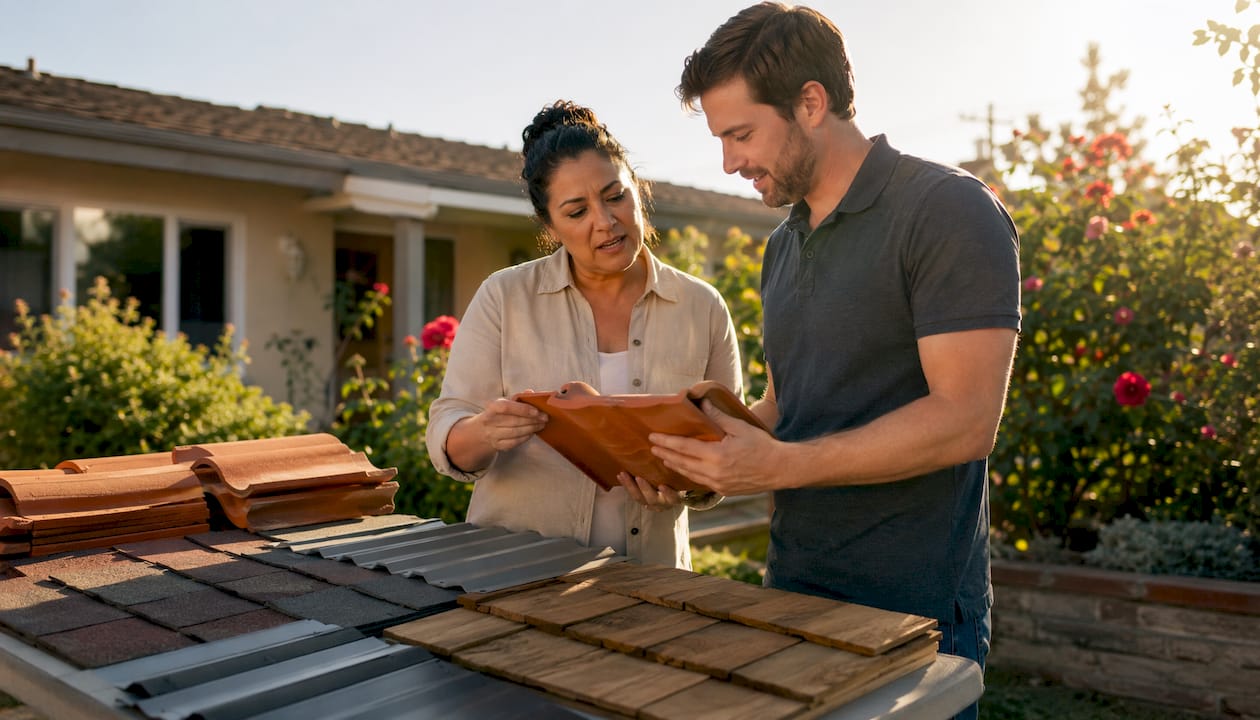
Architectural asphalt shingles typically last 20–30 years; 3-tab asphalt is somewhat shorter-lived; standing-seam metal and tile roofs can last 40–70+ years with proper installation; wood shake roofs last about 30 years; and TPO/EPDM membranes usually last around 20 years depending on care. Those ranges aren’t guarantees. Climate, installation quality, and maintenance all push the number up or down.
| Material | Typical Lifespan | Durability Notes | Best Climate Fit |
|---|---|---|---|
| Architectural asphalt | 20–30 years | Widely available; granule loss accelerates in intense UV | Most U.S. climates |
| 3-tab asphalt | shorter than 20 years | Lighter, lower wind resistance | Mild climates, budget installs |
| Standing-seam metal | 40–70+ years | Excellent wind and impact resistance; reflects heat | Hot/sunny, high-wind, coastal |
| Tile (clay/concrete) | 40–70+ years | Heavy; requires reinforced framing; fire-resistant | Hot/dry, Mediterranean climates |
| Wood shake | about 30 years (with treatment) | Fire risk without treatment | Dry, moderate climates |
| TPO/EPDM (flat) | around 20 years depending on maintenance | Seam integrity is critical; UV-resistant membranes last longer | Low-slope commercial/residential |
Lifespan data from the Colorado Roofing Association confirms that standard architectural asphalt reaches end-of-life around 20 years, while premium materials like metal and tile can last 40–70+ years depending on type and installation. Local codes also matter: IRC sections and regional requirements such as High Velocity Hurricane Zone fastening standards and mandatory ice barrier zones directly influence which materials and specs are appropriate for your area.
Quick pros/cons by material:
- Architectural asphalt: Low upfront cost, easy to source and repair, but shorter lifespan than metal or tile and susceptible to algae in humid climates
- Metal (standing seam): High upfront cost, but reflects significant heat and requires minimal maintenance over its lifespan; can be noisy in heavy rain without insulation
- Tile: Extremely durable and fire-resistant, but heavy enough to require structural assessment before installation
- Wood shake: Natural look, decent insulation value, but demands regular treatment and carries higher fire risk in dry regions
- TPO/EPDM: Cost-effective for flat or low-slope roofs; seam quality during installation determines most of the lifespan
On warranties: manufacturer “lifetime” warranties are often misunderstood. As Consumer Reports notes, most manufacturers pay full replacement value only for the first 10 years of ownership. After that, reimbursement shifts to depreciated value. Workmanship warranties, issued by the contractor, cover installation defects separately and typically run 1–10 years depending on the contractor’s certification level.
4. How to spot a failing roof before it becomes a crisis
Three signs almost always mean replacement rather than repair: widespread curling or granule loss across the field of shingles, multiple active leaks in different locations, and visible sagging or soft spots indicating deck rot. Any one of these alone warrants a professional assessment. Two or more together, and you’re past the repair conversation.
What to check from the ground and in the attic:
- Walk the perimeter and look for shingles that are curling at the edges or cupping upward at the center. Either pattern means the shingle has lost its structural integrity.
- Check the gutters for heavy granule accumulation. Some granule loss is normal; a gutter full of dark grit after every rain is not.
- Look for daylight in the attic. Any visible light through the decking means there’s a gap, and water follows the same path.
- Check attic rafters and decking for dark staining, soft wood, or mold smell. These indicate moisture has been penetrating for some time.
- Look at flashing around chimneys, skylights, and pipe boots from the ground with binoculars. Lifted, cracked, or missing flashing is a common hidden failure point.
- Note any sagging along the ridge line or between rafters. This is a structural warning.
Industry guidance recommends professional inspections every 1–2 years and after any major storm. Attic inspections in particular reveal underlayment and deck problems that a surface-only inspection misses entirely. For a closer look at what storms can hide, hidden roof storm damage is worth reviewing before you assume a storm passed without consequence.
Pro Tip: Spring is often the best time to schedule an inspection. You catch any winter damage early, and you’re ahead of the late-summer demand spike when contractor availability tightens and lead times stretch.
One thing homeowners underestimate: how fast a small leak escalates. Water that reaches the decking can cause rot within weeks in a humid climate. A single missed flashing failure can mean replacing not just shingles but several sheets of decking by the time it’s visible inside the house.
5. Maintenance and ventilation: the actions that actually extend roof life
Regular maintenance, specifically twice-yearly checks plus seasonal tasks, measurably extends roof life. The work isn’t complicated, but skipping it consistently is one of the fastest ways to shorten a roof’s lifespan.
Seasonal maintenance schedule:
- Spring: Inspect for winter damage (lifted shingles, cracked caulk at penetrations, debris in valleys). Clear gutters of winter debris. Check attic for moisture staining after snowmelt or heavy rain.
- Spring/Fall: Trim overhanging branches. Branches that contact the roof abrade shingles and hold moisture against the surface.
- Fall: Clear gutters before leaf season peaks. Blocked gutters force water back under the drip edge and into the fascia.
- After any major storm: Walk the perimeter and check the attic. Don’t wait for a visible interior leak to confirm damage.
- Annually: Check pipe boot seals and any exposed caulk at penetrations. These degrade faster than shingles and are cheap to address proactively.
- As needed: Treat moss or algae growth with a zinc-sulfate solution or a product rated for roofing. Never pressure-wash shingles; it strips granules.
Ventilation checklist:
- Confirm soffit vents are not blocked by insulation (a common problem after attic insulation upgrades)
- Check that ridge vents run the full length of the ridge and are not capped or painted over
- Look for signs of moisture on rafters or decking, which often indicate inadequate exhaust
- Verify the IRC ventilation ratio: 1 sq. ft. of net free area per 150 sq. ft. of attic floor space, or 1:300 when intake and exhaust are balanced and at least 50% of venting is at the ridge
For a detailed breakdown of balanced intake and exhaust systems, roof ventilation for Texas homes covers the specifics. If you’re considering attic venting improvements, a qualified installer can assess whether your current setup meets code before you commit to any changes. Attic venting installation is one of those upgrades that pays back in reduced shingle degradation and lower cooling costs.
Pro Tip: Blocking soffit vents with insulation is one of the most common DIY mistakes during attic insulation projects. It creates a moisture trap that accelerates deck rot from the inside out. Always use baffles to maintain airflow from soffit to ridge.
A safety note: most rooftop maintenance tasks are best left to professionals. Ground-level and attic checks are safe for most homeowners. Anything that requires walking on the roof surface carries real fall risk, particularly on steeper pitches or wet surfaces.
6. Costs, warranties, and what actually drives the price difference
Price is driven by five main factors: material choice, tear-off versus overlay, deck repair needs, roof complexity, and regional labor rates. Understanding each one helps you read an estimate critically rather than just comparing bottom-line numbers.
Cost drivers to watch on any estimate:
- Material: The gap between 3-tab asphalt and architectural shingles is significant; the gap between asphalt and standing-seam metal is larger still
- Tear-off vs. overlay: Tear-off adds labor and disposal costs but is almost always the right call for roofs over 15 years old or with any deck concerns
- Deck repairs: Hidden until the old covering comes off. A contractor who doesn’t mention the possibility of deck repair in their estimate isn’t being thorough.
- Roof complexity: Hips, valleys, dormers, skylights, and multiple penetrations all add labor time and material waste
- Code upgrades: Older homes may require new drip edge, updated flashing specs, or additional ventilation to meet current IRC requirements
- Disposal and permit fees: These should appear as line items, not buried in a lump-sum total
- Timing: Late summer and fall are peak demand periods in most U.S. markets; scheduling in spring often means shorter lead times and sometimes better pricing
On hidden cost escalation: deck repair is the most common surprise in a replacement project. A contractor can’t know the full extent of deck damage until the old covering is removed. When rot is found, the repair adds cost, but skipping it isn’t an option if you want the new roof to perform and the warranty to hold. Frame this as a discovery, not an upsell, and ask your contractor upfront how they handle and price deck repairs when found.
Homeowners insurance typically covers sudden storm damage, not wear-and-tear or maintenance failures. If a hailstorm damages your roof, file promptly and document everything with photos before any repairs begin. If the damage is gradual deterioration, that’s a replacement cost you’ll carry yourself.
7. Choosing the right roofing material for your climate, home, and budget
Pick materials by matching expected lifespan, climate resilience, and budget. The best material for a Houston homeowner dealing with intense heat and occasional hurricanes is not the same as the best choice for someone in Minnesota managing ice dams and heavy snow loads.
Climate suitability matrix:
| Material | Hot/Sunny | Humid/Coastal | Cold/Snowy | High-Wind |
|---|---|---|---|---|
| Architectural asphalt | Good | Good | Good | Good |
| Standing-seam metal | Best | Best | Better | Best |
| Tile (clay/concrete) | Best | Better | Good* | Better |
| Wood shake | Good | Poor | Better | Good |
| TPO/EPDM (flat) | Better | Better | Good | Better |
*Tile requires proper flashing and underlayment for cold climates; freeze-thaw cycles can crack lower-grade concrete tile.
Homeowner priorities checklist:
- Longevity first: Metal or tile. Higher upfront cost, but the math often favors them over a 40-year horizon.
- Lowest upfront cost: Architectural asphalt. Widely available, easy to install, and serviceable in most climates.
- Minimal maintenance: Metal or TPO (for flat roofs). Both require little beyond periodic inspection.
- Resale value: Architectural asphalt and metal both perform well. Tile adds curb appeal in the right markets but can be a liability in areas where buyers aren’t familiar with the maintenance requirements.
- Aesthetic fit: Tile and wood shake for traditional or Mediterranean styles; metal for modern or farmhouse; asphalt for virtually any style.
For mixed priorities, say you want low maintenance and a moderate budget, architectural asphalt with a 30-year warranty rating is usually the practical answer. If budget allows a step up, metal shingles (stamped panels that mimic asphalt or shake) offer metal’s durability with a more traditional look. For flat or low-slope sections, TPO roofing is the standard choice for energy efficiency and membrane longevity in hot climates.
8. Hiring a roofer: 7 questions to ask before you sign anything
The most important contractor checks are an active state license, a verified COI (certificate of insurance), an itemized written estimate, clear permit responsibility, and a workmanship warranty in writing. Get all five confirmed before any money changes hands.
The 7 vetting questions:
- Are you licensed in this state? Ask for the license number and verify it through your state’s contractor licensing board.
- Can you provide a COI directly from your insurer? General liability and workers’ compensation coverage must be active. Request the certificate from the insurer, not a forwarded copy from the contractor.
- Do you have local references from jobs completed in the past 12 months? Recent references matter more than a list of jobs from five years ago.
- Will you provide a fully itemized written estimate? Line items should include materials (manufacturer, product line, color), underlayment spec, flashing work, tear-off, deck repair allowance, disposal, and permit fees.
- Who pulls the permits? The contractor should pull permits, not ask you to do it. A contractor who avoids permits is avoiding inspections.
- What are the workmanship warranty terms? Get the duration, what it covers, and what voids it, in writing.
- What does cleanup include, and who is responsible for landscaping or gutter damage? This should be in the contract, not a verbal assurance.
Red flags to walk away from:
- High-pressure sales tactics or a “today only” price
- A deposit demand exceeding 10% of the total contract value, especially in cash only
- A one-line estimate with no material specs or scope detail
- Any request to sign an assignment-of-benefits form or let the contractor handle your insurance claim without your written, informed consent
- No local physical address or verifiable business history
What to get in writing before work starts:
- Line-item estimate with materials, manufacturer, color, and underlayment spec
- Full scope of work including tear-off, flashing replacement, and deck repair process
- Payment schedule tied to project milestones, not arbitrary dates
- Start and estimated completion dates
- Lien waiver to be signed by the contractor on final payment
For Texas-specific contractor vetting, choosing a reliable roofing contractor covers the state licensing requirements and local red flags worth knowing before you get quotes.
9. Roofing myths and homeowner mistakes that cost real money
The most persistent roofing myths lead to the most expensive mistakes. Here are six that still circulate widely, and what the reality actually is.
Myth-busters:
- Myth: Overlaying shingles is always fine. Reality: Overlays hide the deck. If there’s any rot, moisture damage, or flashing failure underneath, you’re sealing it in. Most manufacturers also void warranties on overlay installations. If your roof is over 15 years old or has any signs of deck damage, a tear-off is the right call.
- Myth: A few missing shingles are just cosmetic. Reality: Missing shingles expose underlayment to UV and water. Underlayment degrades quickly without shingle protection, and a single exposed section can lead to deck rot within one season in a wet climate.
- Myth: DIY repairs are cheaper. Reality: Licensed roofers are trained to detect deck rot, improper ventilation, and flashing failures that a homeowner’s inspection will miss. A DIY patch that covers a flashing failure costs more to fix later than a professional repair would have cost upfront. Fall risk is also real: roofing is consistently among the higher-risk trades for injury.
- Myth: A new roof means no maintenance for 20 years. Reality: Even a brand-new roof needs biannual checks, gutter clearing, and penetration seal inspections. Neglect shortens any roof’s lifespan regardless of material quality.
- Myth: Flat roofs always leak. Reality: Flat roofing myths debunked: a properly installed TPO or EPDM membrane with correctly sealed seams performs reliably for 15–30 years. The leaks people associate with flat roofs almost always trace to poor installation or deferred maintenance, not the membrane system itself.
- Myth: The cheapest bid is the best deal. Reality: A low bid that omits underlayment specs, skips permit fees, or uses a thinner membrane grade will cost more over the roof’s life than a higher bid that covers everything correctly. Always compare bids on scope, not just price.
Quick actions if you spot a problem:
- Granule loss in gutters or curling shingles: schedule a professional inspection within 30 days
- Active interior leak: call a roofer within 24–48 hours and document with photos before any temporary patching
- Soft spots or sagging: do not walk on that section; call immediately
10. Why experienced roofers prefer full tear-offs: the professional case
The core reason professionals prefer tear-offs is straightforward: it’s the only way to inspect and replace every hidden failure point before installing a new system. Tear-offs allow direct inspection and replacement of deck and flashings, preventing latent water damage beneath new coverings. An overlay skips that step entirely.
A complete system approach, covering deck, underlayment, and flashing, gives longer-term value than patching visible shingles. This is why many pros recommend tear-offs for older roofs or when warranties matter.
Decision rules for repair vs. replace:
- If your repair estimate exceeds 30% of a full replacement quote, replacement is usually the smarter long-term investment.
- If the roof is over 20 years old and has had multiple prior repairs, the system is likely approaching end-of-life regardless of how the shingles look.
- If deck rot is suspected anywhere, a tear-off is required to assess the full extent before any new covering goes on.
- If you need a manufacturer warranty to be valid, most require a tear-off and certified installation.
- If you’re planning to sell within 5 years, a documented full replacement with warranty transfer is a stronger selling point than a patched roof of unknown condition.
When to call a pro immediately:
- Any visible sagging along the ridge or between rafters
- Daylight visible through the attic decking
- Active water intrusion during or after rain
- Mold or rot smell in the attic after a wet season
- Flashing that is visibly lifted, cracked, or missing at any penetration
Pro Tip: When verifying a contractor’s COI, request it directly from the insurer, not from a copy the contractor forwards. Forged or outdated COIs are a documented fraud pattern in the roofing industry. A legitimate contractor will have no objection to this request.
Key Takeaways
A roof’s real lifespan is determined by its hidden layers, not just the shingles, and the 30% repair-vs-replace rule is the most reliable financial guide homeowners have for making that call.
| Point | Details |
|---|---|
| Roof is a system | Decking, underlayment, flashing, and ventilation control longevity more than the shingles alone. |
| Material lifespan varies widely | Asphalt lasts 20–30 years; metal and tile can reach 40–70+ years with proper installation. |
| The 30% rule | If repair costs exceed 30% of a full replacement quote, replacement is the smarter long-term investment. |
| Contractor vetting is non-negotiable | Verify COI directly with the insurer, confirm permit responsibility, and get a fully itemized written estimate. |
| Misterreroof for Texas homeowners | Misterreroof provides professional inspection, tear-off, and replacement services in El Campo and Houston, TX, with warranty support included. |
What homeowners consistently overlook
The most common blind spot isn’t the shingles. It’s the flashing. Homeowners spend time worrying about granule loss or shingle color while a slow failure at a chimney base or valley goes unnoticed for years. By the time it shows up as a ceiling stain, the deck underneath has often been compromised for two or three seasons.
The second blind spot is treating a roof inspection as optional until something goes wrong. A professional inspection every 1–2 years costs a fraction of what a single missed deck repair adds to a replacement project. The value of a professional inspection isn’t just peace of mind. It’s documented condition history that matters when you file an insurance claim or sell the house.
Hire a qualified roofer for anything beyond a ground-level visual check. The risk of injury on a roof is real, and the risk of missing a non-obvious failure is higher than most homeowners expect.
Misterreroof: professional roof replacement and inspection in Texas

Mister Reroof handles the full replacement process for homeowners and property owners in El Campo and Houston, TX. That means professional inspection, complete tear-off, deck assessment and repair, new underlayment, and installation of shingles, metal, flat membrane, or TPO, backed by warranty support. No partial patches on systems that need a full replacement, and no overlays that hide problems the next owner discovers.
If you’re seeing any of the warning signs covered in this article, or if your roof is approaching the 20-year mark, the right next step is a professional assessment before the problem escalates. Misterreroof offers free estimates and can walk you through the Texas roof replacement process from inspection to final inspection sign-off. Contact Misterreroof to schedule your assessment and get a free estimate.
Useful sources and further reading
- Colorado Roofing Association: Roof Maintenance, Repair, and Replacement
- This Old House: Read This Before You Redo Your Roof
- FindRoofingPros: Roof Repair vs. Replacement
- National Roofing Authority: Residential Roofing Systems and Standards
- Landmark Roofing: How to Decide What Your Roof Actually Needs This Spring
- The Roofing Brief: How to Choose a Roofing Contractor
- Consumer Reports: Best Roofing Buying Guide
- BBB: Tips for Hiring a Roofing Contractor
- Roofing Contractor Selection Guide: Austin, Texas
