TL;DR:
- A roofing substitution request is a formal proposal made by a contractor to use a different roofing product than originally specified, requiring written approval from the design professional. Proper documentation, including performance comparisons and assembly evaluations, is essential for approval and project protection. Early and thorough submissions help avoid rejection, warranty voidance, and liability issues in Texas roofing projects.
A commercial roofing substitution request is a formal written proposal by a contractor to use a different roofing product than the one specified in the original contract documents, requiring written approval from the design professional before any work proceeds. Property managers and business owners in Texas encounter this process on virtually every flat or industrial roofing project where supply shortages, cost pressures, or product availability force a change. Understanding the rules, documentation requirements, and risks involved protects your project budget, your warranty, and your liability exposure. The industry standard term for this process is a “substitution request,” governed by CSI MasterFormat Division 01 specifications.

What is a commercial roofing substitution request?
A commercial roofing substitution request is a contractor-initiated, written proposal to replace a specified roofing product with an alternative that the contractor claims meets or exceeds the original design intent. This is not an informal conversation or a verbal agreement. It is a documented process governed by contractual procedures in Division 01 specifications, which set the rules for how, when, and by whom substitutions can be proposed and approved.
The process exists because roofing specifications are written around tested assemblies, not just individual products. A flat roof system on a Houston warehouse, for example, may specify a particular TPO membrane because it has been tested as part of a fire-rated, wind-uplift-certified assembly. Swapping one component changes the entire assembly’s performance profile. The substitution request process forces that evaluation to happen on paper before it happens on the roof.
The “or equal” clause is the contractual language that makes substitutions possible. That clause encourages competitive pricing and provides flexibility during supply shortages. The trade-off is that the full burden of proving equivalency falls entirely on the contractor, not the architect or the owner.
How does the substitution request process work?
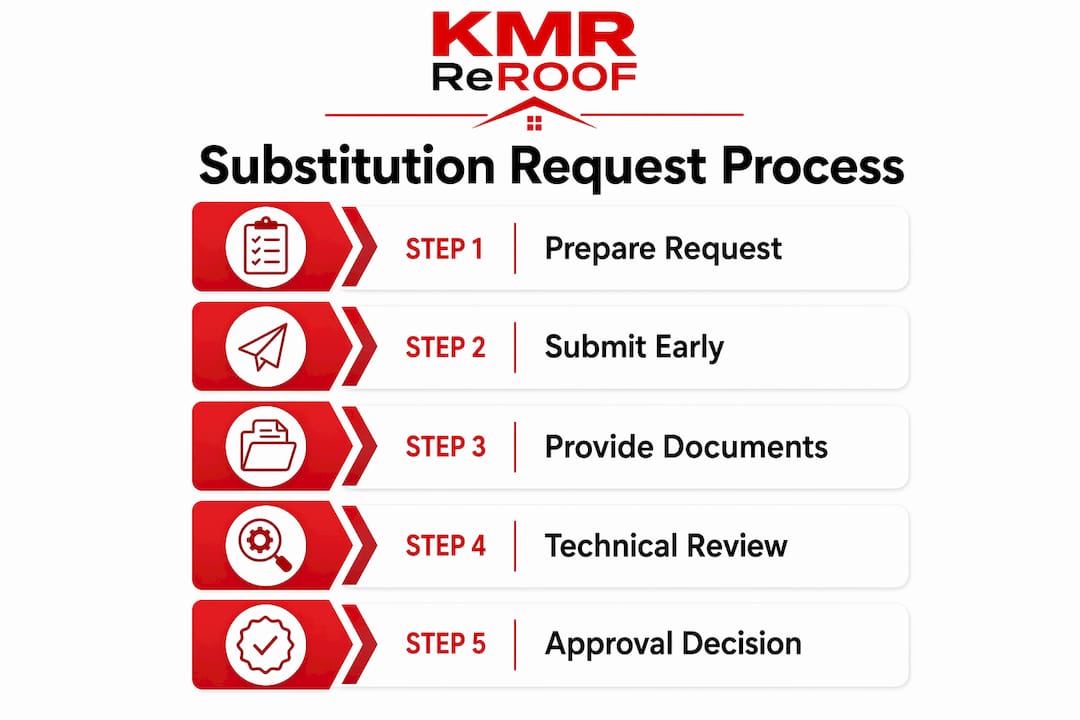
The process follows a defined sequence. Skipping any step typically results in rejection or, worse, an unapproved substitution that creates liability after the roof is installed.
- Contractor initiates the request. The contractor submits a completed substitution request form along with full product documentation. This must happen within the deadline specified in Division 01, which is often 10 to 30 days after contract award.
- Documentation is assembled. The contractor provides side-by-side quantitative comparisons of the specified product versus the proposed alternative. Generic “or equal” claims without point-by-point spec comparisons are rejected immediately.
- Submittal review begins. The architect or engineer reviews the substitution against the project specifications, the tested assembly requirements, and the design intent. This is not a rubber stamp. Reviewers check thermal resistance values, flame spread ratings, wind uplift certifications, and compatibility with adjacent materials.
- Technical evaluation and impact assessment. The design professional assesses whether the substitute affects project schedule, costs, or other trades. A new membrane that requires a different adhesive system, for instance, may affect the insulation layer and the deck attachment method.
- Approval or rejection is issued in writing. Verbal approvals carry no contractual weight. The written decision becomes part of the project record.
- Contract documents are updated. Approved substitutions require a formal modification to the contract documents. This record protects all parties if performance questions arise later.
Pro Tip: Submit your substitution request as early as possible. Late requests compress the review timeline and increase the chance of rejection simply because there is not enough time to evaluate them properly before the scheduled installation date.
Which technical criteria determine approval?
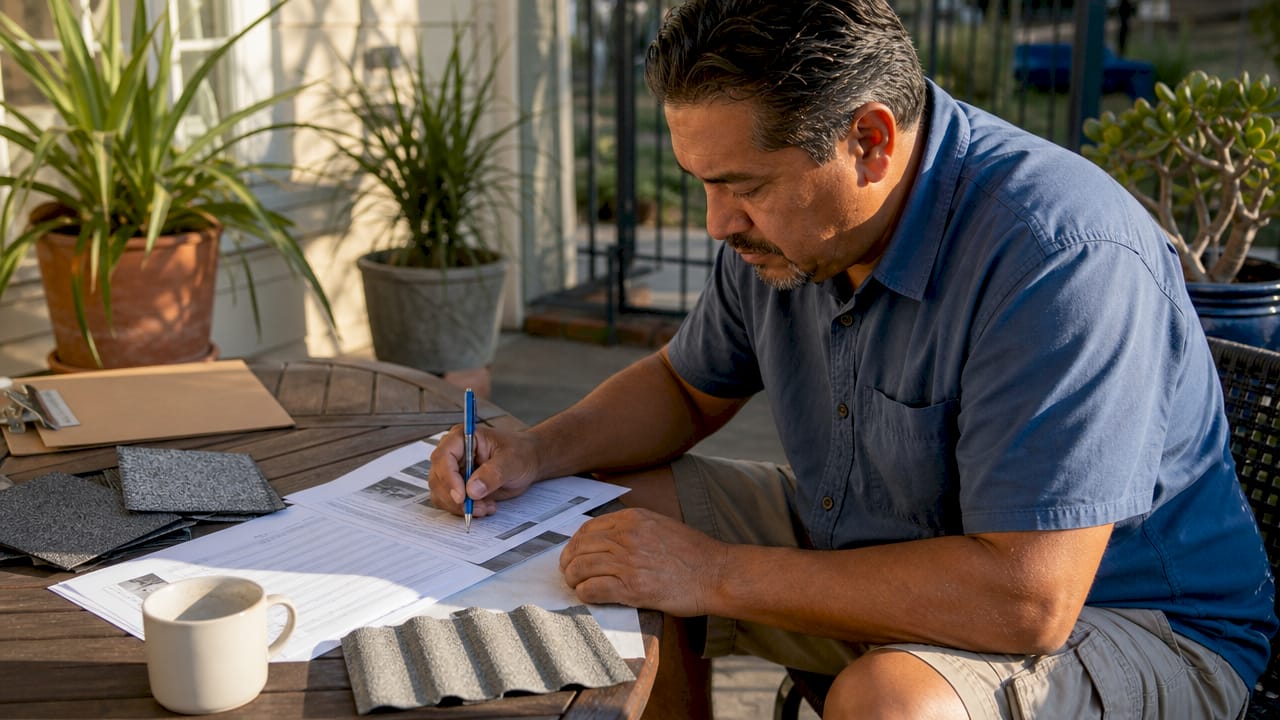
Approval depends on whether the proposed material matches the specified product across every measurable performance attribute. Quantitative equivalency data is the minimum requirement. Vague claims of “equal quality” result in immediate rejection by architects and engineers.
The key performance metrics reviewers check include:
- Thermal resistance (R-value). Insulation substitutions must match or exceed the specified R-value. Texas energy codes set minimum requirements, and a shortfall fails compliance automatically.
- Flame spread and smoke development ratings. These are tested values, not manufacturer claims. A substitute product must carry the same or better ASTM E84 ratings as the specified material.
- Wind uplift certification. Texas coastal and inland wind zones have specific FM Global or UL wind uplift requirements. The substitute assembly must carry the same certification, not just the individual product.
- Compatibility with the existing assembly. A TPO membrane substitution may seem straightforward, but the adhesive, the insulation facer, and the fastener pattern are all part of the tested system. Substitutions involving insulation facers or fastener patterns can invalidate the entire fire-rated roof assembly listing, even if the replacement materials appear equivalent on their own.
- Warranty terms. Some manufacturers void their warranties if non-approved components are used in the assembly. A substitution that saves money upfront may eliminate the manufacturer’s warranty entirely.
Pro Tip: Always request the tested assembly listing number from the substitute product’s manufacturer, not just the individual product data sheet. Architects evaluate assemblies, not components in isolation.
Value engineering substitutions are a separate category. Value engineering may accept performance trade-offs in exchange for cost savings, while a true “or equal” substitution expects identical performance across every attribute. Mixing up these two categories leads to approval process confusion and potential liability gaps.
What are the risks and liabilities involved?
The financial and legal risks of mishandled substitution requests are significant. 30 to 40% of initial substitution requests are rejected, costing an average of $805 per rejection in administrative delays and rework. That figure adds up quickly on a large commercial roofing project with multiple substitution attempts.
The risks extend well beyond rejection costs:
- Contractor liability survives approval. Even with design team approval, liability for the substituted product’s performance remains with the contractor. An architect’s approval covers intended use but does not guarantee identical safety or performance listings.
- Unapproved substitutions void warranties. Installing a product not listed in the approved submittal record can void both the manufacturer’s warranty and the contractor’s workmanship warranty. For a Texas property manager, that means zero coverage when a flat roof leaks two years after installation.
- Fire-rated assembly invalidation. Swapping a single component, such as a different insulation facer or a modified fastener pattern, can remove the roof assembly from its tested fire listing. This creates a code compliance problem and a serious insurance liability.
- Litigation is increasing. Litigation increasingly targets poorly documented or assembly-unevaluated “approved equals.” Courts have found that approval of a substitution does not transfer liability from the contractor to the design professional.
- Project delays from rejected requests. A rejected substitution late in the project schedule can delay installation by weeks while the contractor sources the originally specified product or prepares a new request.
The single best mitigation strategy is thorough documentation submitted early. Proper adherence to CSI MasterFormat 01 25 00 and 01 60 00 reduces costly rejections and protects all parties when performance questions arise after project completion.
How can Texas property managers manage substitution requests effectively?
Texas commercial roofing projects carry specific challenges. Coastal wind uplift requirements, extreme heat cycles, and hailstorm exposure mean that performance specifications are written tightly. A substitution that passes muster in a mild climate may not meet Texas-specific assembly certifications.
Practical steps for Texas property managers and business owners include:
- Read the Division 01 specifications before the project starts. These sections define the substitution request deadline, the required documentation format, and the approval authority. Missing the submission deadline is the most common and most avoidable reason for rejection.
- Require quantitative comparisons, not marketing language. Ask your contractor to provide a side-by-side table comparing every specified performance attribute against the proposed substitute. If the contractor cannot produce this, the request will likely be rejected.
- Engage the architect or engineer early. A pre-submission conversation with the design professional can identify fatal flaws in a proposed substitution before the formal request is filed. This saves time and money.
- Verify assembly-level certifications, not just product certifications. Check that the proposed substitute maintains the FM Global or UL assembly listing required by the project specifications and your insurance carrier.
- Review Texas local roofing codes before approving any substitution. Texas roofing code compliance requirements vary by municipality and wind zone, and a substitution that meets state minimums may still fail local requirements.
- Keep a complete substitution log. Document every request, every response, and every approval or rejection. This record is your first line of defense in any warranty or litigation dispute.
What common substitution alternatives exist for flat and industrial roofs?
Texas flat and industrial roofing projects most often involve substitution requests for membranes, insulation, and fastening systems. Each category carries different performance trade-offs.
| Specified material | Common substitute | Key equivalency check | Primary risk |
|---|---|---|---|
| TPO membrane (60 mil) | TPO membrane (45 mil) | Wind uplift and puncture resistance ratings | Reduced durability in high-traffic areas |
| PVC membrane | TPO membrane | Chemical resistance, weld strength, fire rating | Different adhesive compatibility requirements |
| Polyisocyanurate insulation | EPS or XPS insulation | R-value per inch, facer compatibility, fire listing | Assembly fire listing may not transfer |
| Mechanically fastened system | Fully adhered system | Wind uplift certification, deck compatibility | Higher labor cost, longer installation time |
| Specified fastener pattern | Modified fastener spacing | FM Global wind uplift approval for the assembly | Invalidates tested assembly listing |
Reviewing commercial roofing solutions side by side helps property managers understand which substitutions are genuinely equivalent and which represent a performance downgrade dressed up as cost savings. A 45 mil TPO membrane may cost less than a 60 mil membrane, but the thinner product carries lower puncture resistance ratings and may not meet the wind uplift certification required for your specific Texas location.
Flat roof coverings for commercial properties in Texas are evaluated differently than residential systems. Industrial facilities with rooftop equipment, foot traffic, and chemical exposure need assembly-level substitution reviews, not just product-level comparisons.
Key takeaways
A commercial roofing substitution request requires quantitative documentation, assembly-level evaluation, and written design professional approval to protect your project from rejection, warranty loss, and liability.
| Point | Details |
|---|---|
| Formal written process | Substitution requests must follow Division 01 contractual procedures and be submitted in writing before installation. |
| Quantitative data required | Side-by-side performance comparisons covering R-value, flame spread, and wind uplift are the minimum for approval. |
| Assembly-level review | Evaluate the full tested assembly, not just the individual product, to avoid invalidating fire and wind certifications. |
| Contractor retains liability | Design team approval does not transfer performance liability from the contractor to the architect or engineer. |
| Early submission reduces risk | Late or incomplete requests account for the majority of rejections and project delays on commercial roofing projects. |
What I’ve learned about substitution requests after years in Texas roofing
The biggest mistake I see property managers make is treating a substitution request as a formality. They assume that if the contractor says the product is “equal,” the architect will approve it without much scrutiny. That assumption is wrong, and it costs money.
The requests that get approved quickly share one trait: they make the reviewer’s job easy. They present a clean, column-by-column comparison of every specified attribute, include the tested assembly listing number, and address compatibility with every adjacent material in the system. The requests that get rejected are the ones that lead with price savings and bury the technical data in an appendix.
Assembly-level thinking is the skill most contractors and property managers lack. A single component swap can unravel a fire-rated assembly that took months to specify. I have seen projects where a contractor substituted an insulation facer to save a few cents per square foot, only to discover that the change removed the roof from its UL fire listing entirely. The cost to remediate that situation far exceeded the original savings.
My advice to Texas property managers is to get involved earlier than you think you need to. Review the Division 01 substitution requirements before the bid goes out. Ask your contractor to flag any likely substitution requests during pre-construction. And never accept a verbal approval as a substitute for a written one. The documentation you build during the substitution process is the same documentation that protects you if the roof fails five years from now.
— Misterreroof
Misterreroof’s expertise for Texas commercial roofing projects
Texas property managers dealing with flat or industrial roofing substitution requests need a contractor who understands both the technical requirements and the documentation process.
Mister Reroof works with property managers and business owners across Houston, El Campo, and the surrounding Texas region on flat roof replacement and TPO roofing systems built to meet Texas wind uplift and fire rating requirements. Whether you are navigating a substitution request on an active project or planning a full commercial roof replacement, Misterreroof provides the technical knowledge and local experience to get it done right. Contact Misterreroof for a free estimate and expert guidance on your next commercial roofing project.
FAQ
What is a roofing substitution request in construction?
A roofing substitution request is a formal written proposal by a contractor to use a different product than the one specified in the contract documents. It requires written approval from the architect or engineer before the substitute material can be installed.
What documentation is required for a roofing substitution request?
The contractor must provide a quantitative, point-by-point comparison of the specified product versus the proposed substitute, covering performance metrics like R-value, flame spread, and wind uplift. Vague “or equal” claims without specific technical data are routinely rejected.
Does architect approval remove the contractor’s liability for a substitution?
No. Contractor liability for performance remains with the contractor even after the design team approves a substitution. Approval covers intended use but does not guarantee identical safety or performance outcomes.
How is a substitution request different from value engineering?
A substitution request requires the proposed product to match the specified product’s performance across every attribute. Value engineering may accept trade-offs in performance in exchange for cost savings, making it a separate process with different approval requirements and liability implications.
When must a commercial roofing substitution request be submitted in Texas?
Submission deadlines are set in the Division 01 specifications, typically 10 to 30 days after contract award. Missing this deadline is one of the most common and most avoidable causes of rejection on Texas commercial roofing projects.
