

TL;DR:
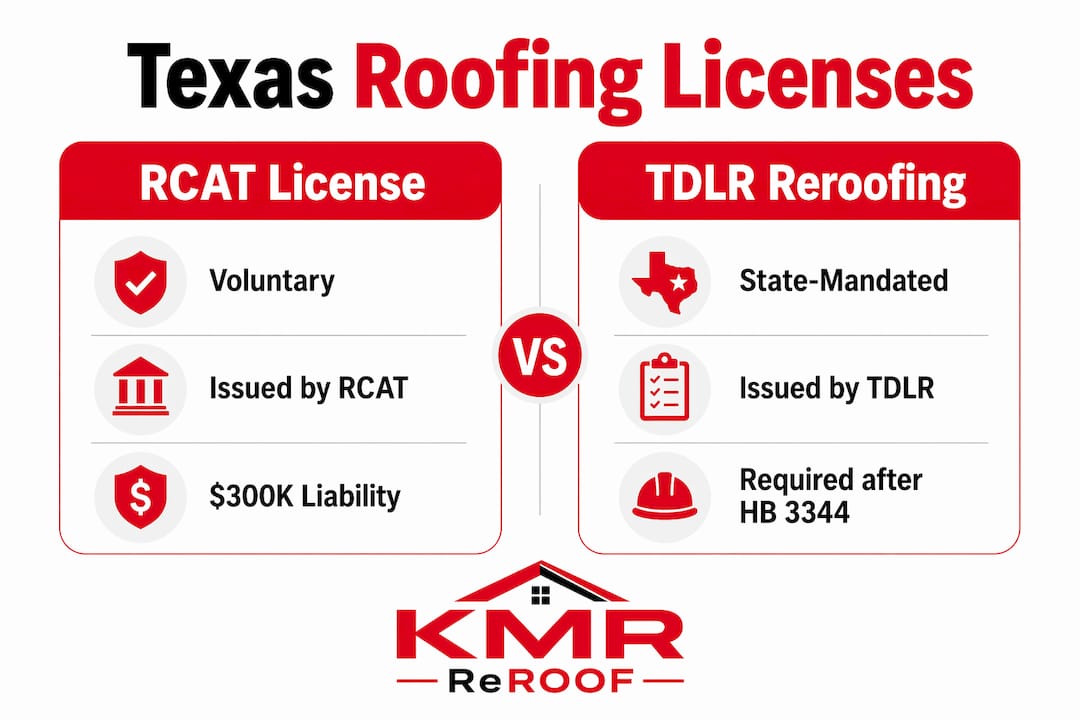
- Texas does not issue a statewide roofing license, but the RCAT credential is a voluntary mark of credibility.
- HB 3344, enacted in 2025, requires a TDLR-issued license specifically for reroofing contractors performing work in the state.
A roofing contractor license in Texas is defined as a voluntary credential issued by the Roofing Contractors Association of Texas (RCAT), because Texas has no statewide roofing license requirement the way it mandates licenses for electricians or plumbers. That single fact surprises most homeowners and many contractors. The term “licensed roofer” means something specific in Texas, and understanding the difference between voluntary RCAT credentials, local municipal registrations, and the new state reroofing license under HB 3344 is the only way to make smart decisions. This guide breaks down every layer of the Texas roofing licensing system so you know exactly what applies to your situation.
What is a roofing contractor license in Texas?
A roofing contractor license in Texas most commonly refers to the Licensed Roofing Contractor (LRC) credential offered by RCAT, a private trade association. RCAT’s voluntary licensing program was created specifically to fill the accountability gap left by the state’s hands-off approach to roofing regulation. Without a state mandate, any person could legally pick up a hammer and call themselves a roofer. RCAT stepped in to provide testing, insurance verification, and ethics standards that protect both contractors and consumers.
To qualify for RCAT’s LRC credential, applicants must meet a defined set of eligibility criteria:
- Experience: At least 2 continuous years as a roofing principal domiciled in Texas
- Exams: Passing scores on both the business and safety exam and the residential or commercial roofing exam
- General liability insurance: $300,000 minimum for residential work or $500,000 for commercial projects
- Workers’ compensation: Active coverage or a completed DWC Form-005 as an approved alternative
- Application: Notarized forms and supporting documentation submitted to RCAT
The insurance thresholds matter more than most contractors realize. A $300,000 general liability policy is the floor for residential work, meaning a single storm-damage claim on a large Houston home could push right up against that limit. Commercial contractors face a $500,000 minimum for good reason.
Pro Tip: Before submitting your RCAT application, gather every document first. Notarized forms, insurance certificates, and exam scores must all be complete at submission. Incomplete applications delay the clock, and RCAT does not issue the credential until everything checks out.

The RCAT credential signals to homeowners that a contractor has cleared a real bar. It is not a government license, but it carries weight in the Texas market because it is the only structured credentialing system most roofing contractors will encounter before HB 3344 takes full effect.
Does Texas have a state-issued roofing license?
Texas does not issue a general statewide roofing contractor license, but that changed in one specific area with the passage of HB 3344 in 2025. This law creates a state-issued license specifically for reroofing contractors, administered by the Texas Department of Licensing and Regulation (TDLR). It is the first time Texas has required any roofing-specific state credential, and it signals a meaningful shift in how the state views consumer protection in the roofing industry.
Here is what HB 3344 requires and how it works in practice:
- Licensing mandate: Any contractor advertising or working as a “licensed reroofing contractor” must hold a valid TDLR-issued license. Misusing that title without the state license carries legal penalties.
- Application timeline: TDLR must issue the license within 10 days of receiving a complete application. Licenses are valid for two years before renewal.
- Advertising controls: Contractors cannot imply state licensure in marketing materials unless they hold the TDLR reroofing license.
- Written contract requirements: Licensed reroofing contractors must provide written contracts that meet specific disclosure standards before work begins.
- Searchable database: TDLR maintains a public database so homeowners can verify a contractor’s license status before signing anything.
“HB 3344 provides a meaningful step for consumer protection by requiring proof of competency and a searchable license database for reroofing.” — Texas Reroofing Contractor Licensing Bill Analysis
The distinction between the RCAT credential and the HB 3344 reroofing license is critical. RCAT is voluntary and covers both new construction and reroofing. The TDLR reroofing license is state-mandated but applies only to reroofing work. A contractor doing full new-build roofing still has no state license requirement beyond local rules.
What local licensing rules do Texas roofing contractors need to follow?
Local government requirements are where Texas roofing contractor regulations get practical and binding. Cities like Austin, San Antonio, and Houston each maintain their own contractor registration systems, and pulling a permit in those cities requires proof of registration and insurance. A contractor who skips local registration cannot legally pull permits, which means the work is unpermitted and the homeowner carries the risk.
Typical local requirements across major Texas municipalities include:
- Contractor registration: A city-specific registration number required before any permit application
- Proof of general liability insurance: Minimums vary by city but commonly range from $100,000 to $500,000
- Workers’ compensation documentation: Required in most major cities for any crew with employees
- Business license or DBA filing: Proof that the business entity is legally registered in Texas
The consequences of skipping local registration go beyond fines. Unpermitted roofing work can void a homeowner’s insurance coverage on that roof, create title issues when the property sells, and expose the contractor to stop-work orders and civil liability. In Houston, the city’s permitting office actively cross-references contractor registration numbers against active insurance certificates.
Pro Tip: Check the specific requirements for every city where you plan to work, not just your home base. A contractor registered in El Campo still needs to meet Houston’s separate registration requirements before pulling permits inside city limits.
The layered approach to licensing is the most accurate mental model for Texas. Think of it as three tiers: local registration unlocks legal work authorization, voluntary RCAT credentials build market credibility, and the new TDLR reroofing license satisfies state law for reroofing-specific advertising and contracts.
How to get a roofing contractor license in Texas
Getting licensed in Texas means navigating two separate tracks depending on your goals: the RCAT voluntary credential and the TDLR reroofing license under HB 3344. Most serious contractors will pursue both.
Steps for RCAT licensing:
- Confirm you have at least two continuous years of roofing experience as a principal in Texas.
- Obtain general liability insurance at the required threshold ($300,000 residential or $500,000 commercial).
- Secure workers’ compensation coverage or complete DWC Form-005 if applicable.
- Schedule and pass the RCAT business and safety exam, then the residential or commercial roofing exam.
- Assemble all notarized application forms, insurance certificates, and exam score documentation.
- Submit the complete application to RCAT and wait for credential issuance.
Steps for TDLR reroofing license under HB 3344:
- Prepare your application with proof of business registration and insurance.
- Submit to TDLR. The agency must issue your license within 10 days of a complete submission.
- Review and comply with the written contract disclosure requirements before starting any reroofing job.
- Mark your two-year renewal date and track it. Letting the license lapse while advertising as a licensed reroofing contractor creates legal exposure.
The table below compares both licensing tracks side by side:
| Feature | RCAT Voluntary License | TDLR Reroofing License (HB 3344) |
|---|---|---|
| Issuing body | RCAT (private association) | Texas Department of Licensing and Regulation |
| Required by law? | No | Yes, for reroofing contractors |
| Exam required? | Yes (business, safety, roofing) | Not specified in current bill text |
| Insurance minimum | $300K residential / $500K commercial | Determined by TDLR rules |
| Validity period | Varies by RCAT renewal cycle | Two years |
| Scope | New construction and reroofing | Reroofing only |
Successful RCAT applications hinge on document completeness at submission. A missing insurance certificate or an un-notarized form restarts the review clock. Treat the application like a legal filing, not a form you fill out on a slow afternoon.
Key takeaways
Texas roofing licensing is a layered system: local registration governs legal work authorization, RCAT credentials build market credibility, and the TDLR reroofing license under HB 3344 now mandates state compliance for reroofing contractors.
| Point | Details |
|---|---|
| No general state license | Texas does not require a statewide roofing contractor license for most roofing work. |
| RCAT fills the gap | The voluntary RCAT credential requires two years of experience, exams, and insurance minimums. |
| HB 3344 changes reroofing | TDLR now issues a mandatory reroofing license; misusing the title without it carries legal penalties. |
| Local rules are binding | Cities like Houston and Austin require contractor registration before permits can be pulled. |
| Document completeness matters | RCAT and TDLR applications both depend on submitting complete, notarized documentation from the start. |
Why the licensing confusion in Texas costs contractors real money
The absence of a statewide roofing license has created a market where the word “licensed” means at least three different things depending on who is saying it. I have seen contractors lose bids to competitors who printed “licensed and insured” on their truck without holding a single verifiable credential. I have also seen homeowners sign contracts with unlicensed roofers after a hailstorm, only to discover months later that the work was unpermitted and their insurance carrier would not cover a subsequent leak.
The confusion is not accidental. Texas’s deregulated approach made entry easy, which drove down prices but also flooded the market with operators who have no accountability structure. RCAT’s voluntary program exists precisely because the industry recognized that consumer trust requires a credible signal, and a state that would not provide one forced the industry to build its own.
My honest advice to contractors: pursue both the RCAT credential and the TDLR reroofing license, even if neither is technically required for your specific work type. The RCAT credential differentiates you in a crowded market. The TDLR license protects you legally if you do any reroofing and want to advertise that fact. Skipping both because “Texas doesn’t require it” is a short-term calculation that costs you bids and exposes you to liability.
For homeowners, the practical move is to verify contractor credentials before signing anything. Ask for the contractor’s RCAT license number, check TDLR’s public database for the reroofing license, and confirm local registration with your city’s permitting office. A contractor who cannot produce any of those three things is operating without a safety net, and that risk transfers directly to you.
— Misterreroof
Work with a roofing contractor who knows Texas standards
Mister ReRoof operates in El Campo and Houston, TX, and every project we take on reflects the licensing and insurance standards Texas homeowners deserve. We understand the difference between RCAT credentials, TDLR reroofing requirements, and local Houston permitting rules because we work inside that system every day. Whether you need a shingle roof replacement, a metal roof, a flat roof, or a TPO system, our team delivers work that meets code and holds up to Texas weather. Start with our Texas roof replacement guide to understand what a proper replacement project looks like, then contact Mister ReRoof for a free estimate.
FAQ
Does Texas require a roofing contractor license?
Texas does not require a general statewide roofing contractor license. However, HB 3344 now mandates a TDLR-issued license for reroofing contractors, and most Texas cities require local contractor registration before permits can be pulled.
What is the RCAT roofing license in Texas?
The RCAT Licensed Roofing Contractor credential is a voluntary certification issued by the Roofing Contractors Association of Texas. It requires two years of Texas roofing experience, passing exams, and maintaining general liability insurance at $300,000 or $500,000 depending on project type.
What does HB 3344 mean for roofers in Texas?
HB 3344, enacted in 2025, creates a state-issued reroofing contractor license administered by TDLR. Contractors who advertise as a “licensed reroofing contractor” without this credential face legal penalties, and TDLR must issue the license within 10 days of a complete application.
Do I need a license to roof in Houston?
Houston requires contractor registration and proof of insurance before permits can be issued. There is no Houston-specific roofing license exam, but operating without registration means you cannot legally pull permits for any roofing work inside city limits.
How long does it take to get an RCAT roofing license in Texas?
The timeline depends entirely on application completeness. Notarized forms, insurance certificates, and passing exam scores must all be submitted together. Incomplete applications restart the review process, so assembling all documents before submission is the fastest path to approval.
