
Before you sign anything or hand over a deposit, these are the questions every homeowner must ask: Is the contractor licensed and insured? What exactly gets torn off and replaced? What underlayment, flashing, and ventilation work is included? Who pulls the permit? What does the warranty actually cover, and does it transfer? How is payment structured? And if insurance is involved, what role will the contractor play?
Here is the shortlist to use on your very first call:
- Is the contractor carrying general liability and workers’ compensation insurance, and can they provide the certificate directly from the insurer?
- Will the old roofing be fully torn off, or is this an overlay?
- What underlayment type and ice-and-water shield locations are included?
- Will flashing be replaced, not just resealed?
- Who pulls the permit, and will a final municipal inspection be scheduled before the last payment?
- What is the workmanship warranty length, and does it transfer to a new owner?
- What is the payment schedule, and is the deposit under 30%?
- Did the contractor physically inspect the attic during the estimate?
Get at least three written, itemized estimates before you commit. If a contractor cannot answer these questions clearly, that itself is the answer.
Table of Contents
- Top questions about reroofing, organized by category
- What must be in your written estimate and contract
- Key technical details you should ask about before work starts
- If you plan to use homeowner’s insurance: what to ask and what to avoid
- How to compare bids and choose the right contractor
- How to choose roofing materials for your home and neighborhood
- Key Takeaways
- What most homeowners get wrong before a reroof
- Misterreroof handles the checklist so you do not have to guess
- Useful sources for further reading
Top questions about reroofing, organized by category
Knowing what to ask is half the battle. The other half is knowing what a good answer sounds like.
Contractor legitimacy
Are you licensed and insured? Texas does not license roofing contractors at the state level, so “licensed” in Texas means a local business registration, not a state credential. What actually matters: a verifiable physical business address, a general liability certificate, and workers’ compensation coverage. Ask for the certificate of insurance and call the insurer to confirm it is active.
Do you hold any manufacturer certifications? GAF Master Elite, CertainTeed SELECT ShingleMaster, and similar designations require training and volume thresholds. A certified contractor can offer the manufacturer’s system warranty, which is broader than the standard product warranty.
Can you provide two or three recent local references and before-and-after photos? References from your own zip code matter. A crew that works regularly in your area knows local code requirements and common weather-related deck issues.
Scope and materials
Will the old roofing be fully removed? An overlay (new shingles over old) saves money short-term but adds weight, hides deck damage, and often voids manufacturer warranties. Most local codes limit the number of layers allowed.
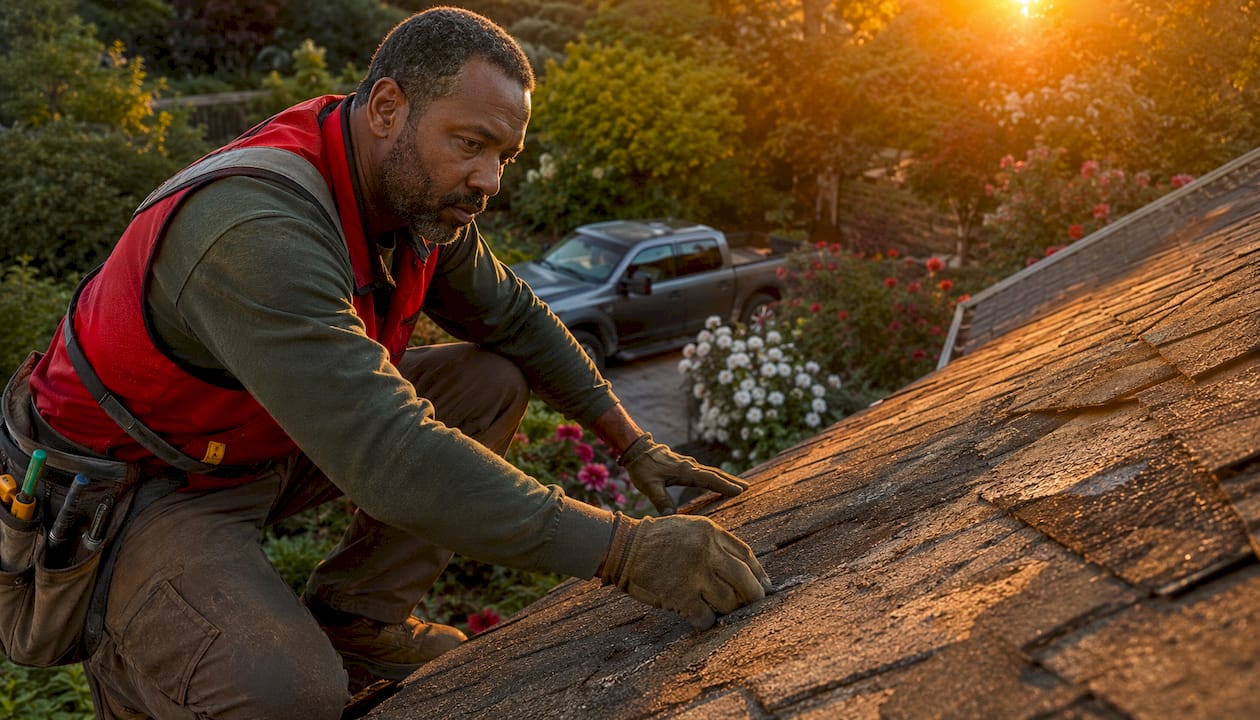
What underlayment will you use, and where does ice-and-water shield go? Synthetic underlayment outperforms felt in moisture resistance. Ice-and-water shield should cover valleys, eaves, and penetrations at minimum.
Will all flashing be replaced? Resealing old flashing is a shortcut. New flashing at chimneys, skylights, walls, and valleys is the standard for a full replacement.
What ventilation changes are planned? Attic ventilation directly affects shingle lifespan and energy costs. Ask for the intake-to-exhaust ratio the contractor plans to achieve.
Workmanship and warranties
What does your workmanship warranty cover, and for how long? Workmanship and manufacturer warranties are separate documents. Get both in writing. Ask specifically: what voids the workmanship warranty, and does it transfer if you sell the house?

What manufacturer system warranty are you offering? A system warranty (covering both materials and installation) requires a certified contractor. Confirm the warranty registration process and who handles claims.
Timeline and permits
Who pulls the permit, and when? The contractor should pull it, not you. Permits protect you legally and trigger inspections that catch installation errors.
What is the realistic timeline? A typical single-family installation runs 1–3 days; the full project from planning through final inspection usually takes 2–6 weeks when permitting and scheduling are included.
Cost and payment
What is the payment schedule? A safe structure: a small upfront deposit, one or two progress payments tied to milestones, and the final balance only after completion, cleanup, and your walkthrough.
How are decking repairs priced? Damaged sheathing is discovered after tear-off. Ask for a per-sheet price upfront so there are no surprise invoices mid-project.
Cleanup and site protection
How will you protect my landscaping and property? Tarps should cover plantings, AC units, and any area where debris can fall. Ask specifically about nail sweeps, since a missed roofing nail in a lawn or driveway causes real damage.
Who is responsible for debris removal and dumpster placement? Confirm the dumpster location and whether it requires a permit from your municipality.
Pro Tip: Ask whether the contractor physically inspects the attic during the estimate, not just the roof surface. A contractor who skips the attic is likely missing ventilation imbalances and hidden deck rot that can void manufacturer warranties and cause premature failure. This single question separates thorough contractors from fast-bid operations.
What must be in your written estimate and contract
A verbal promise is worth nothing once the crew is on your roof. Every item below should appear in writing before you sign.
Required line items
| Line Item | What to Confirm |
|---|---|
| Materials | Manufacturer name, product line, color, and weight class |
| Tear-off plan | Number of layers removed, disposal method |
| Underlayment | Type (synthetic vs. felt) and coverage area |
| Ice-and-water shield | Specific locations (eaves, valleys, penetrations) |
| Flashing | Replacement vs. reuse at each location |
| Ventilation | Current ratio, planned changes, product names |
| Decking repairs | Per-sheet price for damaged sheathing |
| Permit responsibility | Named party responsible for pulling and posting |
| Cleanup plan | Nail sweep, debris removal, dumpster location |
| Start and completion dates | Estimated dates with weather-delay language |
| Payment schedule | Deposit amount, milestone triggers, final payment terms |
| Workmanship warranty | Length, what voids it, transferability |
| Manufacturer warranty | System vs. product-only, registration process |
Municipal re-roof packets in Texas often require drip edge on asphalt shingle projects and limit the number of existing layers that can remain. Your contract should reflect local code, not just the contractor’s standard scope.
Red flags to walk away from
- Vague scope (“replace roof as needed”) with no material specifications
- Deposit demand above 30% of the total contract
- Contractor offers to waive your insurance deductible
- Contractor wants to sign insurance paperwork on your behalf
- No certificate of insurance, or COI that cannot be verified with the insurer
- Pressure to sign before you have compared at least two other bids
- No workmanship warranty in writing
Your contract should also include a lien waiver clause: the contractor provides a signed lien waiver upon final payment, protecting you from subcontractor claims against your property.
Key technical details you should ask about before work starts
Most homeowners focus on shingle color and price. The components that actually determine how long a roof lasts are the ones you cannot see once the job is done.
Ventilation
Attic ventilation balances intake (soffit vents) and exhaust (ridge or box vents). An imbalanced system traps heat and moisture, which degrades shingles from the underside and can cause deck rot. Ask the contractor for the current intake-to-exhaust ratio and what the plan is to correct it. A good answer includes specific vent products and square footage of net free area.
Underlayment
Underlayment is the water-resistant layer between the deck and the shingles. Synthetic underlayment is more tear-resistant and moisture-stable than traditional felt. Ventilation, flashing, and underlayment are consistently cited as the hidden components most responsible for early roof failure. Ask which product the contractor uses and why.
Flashing
Flashing seals every roof penetration and transition. Step flashing at walls, counter-flashing at chimneys, and valley flashing are the three areas where water most often finds a path inside. Resealing old flashing with caulk instead of replacing it is one of the most common installation shortcuts. For a deeper look at flashing best practices, ask for photos of the completed flashing work before the final shingles go on.
Deck condition
The decking is the structural base everything else attaches to. Soft spots, delamination, and rot are only visible after tear-off. Ask for a per-sheet repair price upfront, and request that the crew flag any damaged sections before covering them. A reputable contractor will photograph damaged decking and show you before replacing it.
Pro Tip: Request dated photos of the completed underlayment, flashing, and nailing pattern before the final shingles are applied. These photos are your only proof that the hidden work was done correctly. A contractor who refuses this request is telling you something important.
If you plan to use homeowner’s insurance: what to ask and what to avoid
Insurance-funded reroofing has its own set of rules, and the contractor’s role is more limited than many homeowners realize.
Your role vs. the contractor’s role
You file the claim. Your insurer sends an adjuster. The adjuster determines the covered scope and payment. The contractor does the work and gets paid from that settlement. That is the correct sequence.
A contractor who wants to file on your behalf, negotiate your settlement, or sign documents as your representative is acting as a public adjuster. In many jurisdictions, including Texas, contractors acting as public adjusters face legal restrictions because it creates a direct conflict of interest between maximizing the claim and doing the work for a fair price.
Questions to ask about the insurance workflow
- Will you provide a written scope of work that matches the insurer’s approved scope?
- Will you work directly with my insurer’s adjuster for supplemental items, without acting as my adjuster?
- Who signs the certificate of completion, and when?
- Will you provide documentation (photos, permit copies, inspection reports) for my claim file?
Documentation checklist for insurance claims
- Dated photos of damage before work begins
- Signed, itemized scope of work
- Permit copies (pulled before work starts)
- Final municipal inspection report
- Signed lien waiver on final payment
For coastal Texas homeowners in TWIA-covered counties, a WPI-8 Certificate of Compliance is required after installation and must be scheduled before the contractor completes the final layer. This certificate documents nailing patterns and other details that become permanently hidden once the last shingles go down.
How to compare bids and choose the right contractor
Getting three bids is the floor, not the ceiling. Here is how to evaluate them once you have them.
Step-by-step selection process
- Verify identity and insurance. Confirm the physical business address and call the insurer on the certificate of insurance to verify the policy is active and covers the project scope.
- Confirm an in-person attic inspection. Any contractor who bids without inspecting the attic is guessing at the ventilation and deck condition.
- Compare itemized scopes side by side. Lay the three bids next to each other and check each line item from the table above. A lower price with a vague scope is not a bargain.
- Check manufacturer certifications. Ask which system warranty the contractor can offer and verify the certification on the manufacturer’s website.
- Call two recent local references. Ask specifically: Did the crew show up on schedule? Were there surprise charges? Did the contractor pull the permit and schedule the inspection?
- Verify permit history. Ask the contractor which municipality they have pulled permits in recently. You can often verify this through your local building department.
Scoring your bids
When comparing bids, weight these criteria:
- Scope completeness (all line items present, specific materials named)
- Ventilation plan (current ratio documented, correction specified)
- Warranty terms (workmanship length, transferability, manufacturer system vs. product-only)
- Deposit terms (under 30%, final payment after inspection)
- Local references (verifiable, recent, same county)
- Price (competitive, but not the deciding factor)
The mid-priced, fully documented bid almost always outperforms the lowest bid over a 10-year horizon. A vague scope at a low price means the contractor is planning to cut something, and you will not know what until it fails.
Misterreroof provides itemized written estimates, documents the attic inspection, and schedules the final municipal inspection before requesting the last payment. You can verify contractor credentials and what documentation to expect before signing anything.
Pro Tip: When you call references, ask one specific question: “Did the contractor come back after the job to address anything?” A contractor who returns promptly for a callback is one who will honor the workmanship warranty. A contractor who ghosts after final payment will ghost on warranty claims too.
How to choose roofing materials for your home and neighborhood
Material selection is not just about aesthetics. Local codes, HOA rules, and Texas weather all narrow the field before personal preference enters the picture.
Asphalt shingles remain the most common choice for residential roofing in Texas. Architectural (dimensional) shingles offer better wind resistance and a longer warranty than three-tab shingles. For Houston and the Gulf Coast, look for shingles rated for 130 mph wind uplift or higher. Check your shingle options for Houston homes before committing to a product line.
Metal roofing performs exceptionally well in Texas heat and hail zones. Standing-seam metal systems carry 40-to-50-year lifespans and reflect solar heat, which reduces cooling loads. HOAs sometimes restrict metal to specific profiles or colors, so confirm before ordering. Misterreroof’s metal roofing for Texas page covers the performance case in detail.
TPO and flat roofing are the standard for low-slope commercial and residential applications. TPO membranes are heat-welded at seams, which eliminates the adhesive failures common in older flat systems. If your home has a flat section, TPO roofing in Houston is worth a direct conversation with a contractor who installs it regularly.
Before finalizing any material, check three things: your municipality’s code (some require specific fire ratings), your HOA’s design guidelines, and your insurer’s preferred material list. A material your insurer does not recognize may affect your replacement cost coverage.
Key Takeaways
Asking the right questions before a reroof protects your investment, your warranty, and your insurance coverage, and the single most important question is whether the contractor inspected your attic before pricing the job.
| Point | Details |
|---|---|
| Verify insurance directly | Call the insurer on the certificate; do not accept a contractor’s word that coverage is active. |
| Deposit limit | Never pay an excessive upfront deposit; hold the final payment until after the municipal inspection. |
| Hidden components matter most | Ventilation, underlayment, flashing, and deck condition determine longevity more than shingle brand. |
| Insurance deductible waiver is illegal in Texas | A contractor who offers to waive your deductible is breaking Texas law and risking your coverage. |
| Misterreroof | Provides itemized estimates, attic inspections, and schedules the final municipal inspection before final payment in El Campo and Houston, TX. |
What most homeowners get wrong before a reroof
The pattern that shows up most often in reroofing projects gone wrong is not picking the wrong shingle. It is skipping the attic inspection and accepting a vague scope because the price looked right.
Ventilation imbalance is the most common hidden problem, and it is invisible from the roof surface. A crew that does not check the attic before pricing cannot account for it, which means either the problem gets ignored or it shows up as a surprise charge after tear-off. Neither outcome is acceptable when you are spending thousands of dollars on a system meant to last 25 years.
The second mistake is treating the workmanship warranty as a formality. Read it. Ask what voids it. Ask whether it transfers. A warranty that disappears the moment you sell the house is not protection; it is a marketing line.
The contractor-selection checklist in this article is the same framework Misterreroof uses internally. Verify credentials, inspect the attic, document everything, and hold the final payment until the inspection is done. That sequence is not complicated. It just requires asking the questions before the crew shows up, not after.
Misterreroof handles the checklist so you do not have to guess
Replacing a roof in El Campo or Houston means dealing with Gulf Coast humidity, hail seasons, and local code requirements that change by municipality. Misterreroof covers shingle, metal, flat, and TPO roof replacement, and every project starts with a documented attic inspection and an itemized written estimate that names the manufacturer, product line, underlayment type, flashing plan, and ventilation scope.
The final municipal inspection is scheduled before the last payment is requested. That is not a policy Mister Reroof invented; it is what the checklist above requires of any contractor worth hiring. For Texas homeowners ready to move from questions to a signed scope, the Texas roof replacement guide walks through every phase. Request a free estimate and attic inspection to get started.
Useful sources for further reading
| Source | What it helps with |
|---|---|
| Texas Department of Insurance: Roofing and Insurance Know the Law | Legal rules on contractor roles in insurance claims; deductible waiver prohibition in Texas |
| TDI Windstorm Roofing FAQs | Contractor verification steps, WPI-8 requirements for coastal Texas counties |
| City of McKinney Re-Roof Packet | Sample permit requirements, drip edge rules, inspection checklist for Texas municipalities |
| RoofVista Roof Replacement Checklist | Warranty evaluation, timeline benchmarks, homeowner preparation steps |
| HomeAdvisor: 10 Things to Consider Before Reroofing | Hidden installation components, budgeting for full replacement scope |
| Questions to Ask a Roofing Contractor | Payment schedule guidance, attic inspection importance, contractor interview questions |
| Misterreroof: Texas Homeowner Roof Replacement Guide | Local service overview, estimate process, and next steps for El Campo and Houston homeowners |
| Choosing a Roofing Contractor in Austin, Texas | Regional contractor-vetting perspective for Texas homeowners |
Print or save before your contractor meetings: the TDI windstorm FAQ (for insurance and credential verification), your municipality’s re-roof packet (for permit and inspection requirements), and the RoofVista checklist (for scope and warranty comparison). These three documents cover the questions a contractor cannot talk you out of asking.
