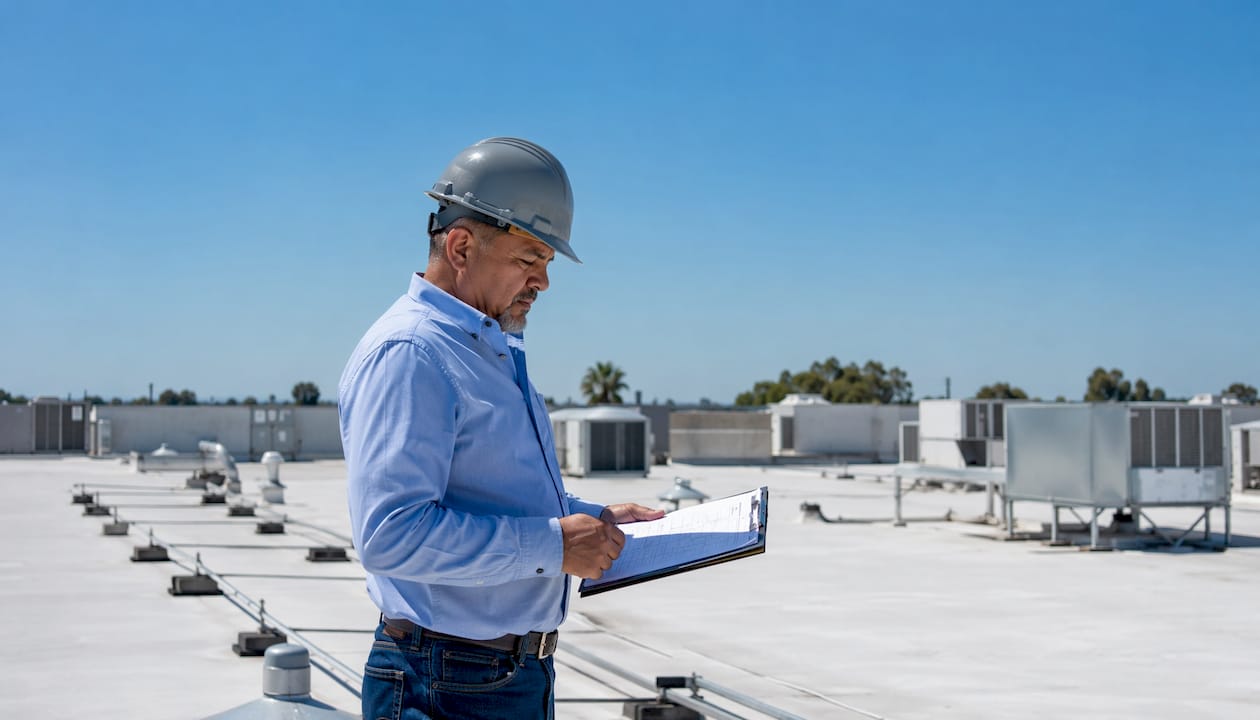
The core features of commercial roofs are their system type (single-ply membrane, modified bitumen, built-up roofing, metal, liquid-applied, or vegetative), drainage and slope design, thermal insulation, cover board, flashing and edge metal, and a documented warranty and maintenance plan. Get any one of those wrong and you’re not looking at a minor inconvenience — you’re looking at premature failure, voided warranties, and a replacement bill years ahead of schedule.
Here’s what every commercial property owner and facility manager needs to verify before signing a roofing contract:
- System type match: The membrane or assembly must suit your rooftop’s chemical exposures, equipment loads, and climate. A kitchen exhaust vent that discharges grease directly onto a TPO membrane will degrade it; PVC is the correct call there.
- Drainage and slope: Low-slope commercial roofs require engineered drainage — internal drains, scuppers, or both — sized for local rainfall intensity. Ponding water (standing more than 48 hours after rain) accelerates membrane degradation and voids most warranties.
- Thermal insulation: Polyiso and XPS boards are the standard. Energy code changes have pushed required R-values higher, making insulation thickness a central selection factor, not an afterthought.
- Cover board: A layer between insulation and membrane that improves impact resistance, provides a stable adhesion surface, and protects insulation from foot traffic.
- Flashing and edge metal: The most common leak points on any commercial roof. Proper termination at walls, curbs, penetrations, and perimeter edges is non-negotiable.
- Warranty and maintenance plan: Manufacturer warranties typically range from 10 to 35 years, depending on the system, and most require documented inspections and certified installation to stay in force.
Commercial roofing also follows the International Building Code, with local amendments that govern fire ratings, wind uplift resistance, and energy compliance. Contractor licensing requirements differ from residential work — verify that any crew you hire holds manufacturer certification for the specific system being installed. Misterreroof verifies local code compliance for every project in El Campo and Houston, TX.
Table of Contents
- What types of commercial roofing systems are available, and which fits your building?
- What does a commercial roof assembly actually include?
- How does the installation method affect performance and cost?
- Which performance features matter most for commercial roofs?
- What do commercial roofing systems typically cost, and how long do they last?
- How do you keep a commercial roof warranty valid through maintenance?
- How do you choose the right commercial roof for your building?
- What causes commercial roofs to fail prematurely, and how do you prevent it?
- Key Takeaways
- Why maintenance and certification are the real differentiators
- Misterreroof handles commercial roofing in El Campo and Houston, TX
- Useful sources and further reading
What types of commercial roofing systems are available, and which fits your building?
Single-ply membranes dominate low-slope commercial roofing because they balance installation speed, cost, and energy performance. But “single-ply” covers three very different materials, and the differences matter.
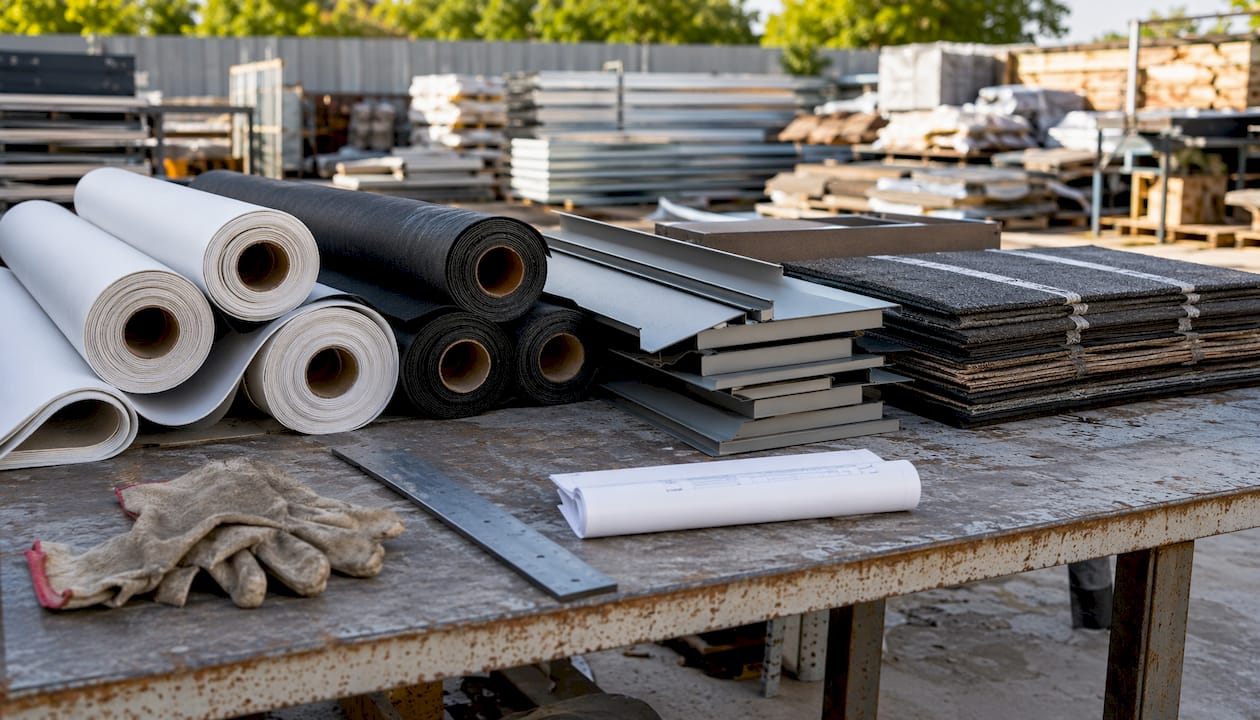
TPO (Thermoplastic Polyolefin) is the most widely installed single-ply membrane in the U.S. today. White or light-colored TPO reflects solar heat well, and its heat-welded seams create a strong, continuous bond. It works best on standard low-slope roofs without significant chemical exposure. Typical lifespan: 15–25 years with proper maintenance.
PVC (Polyvinyl Chloride) costs more than TPO but earns it in chemical-resistance situations. Restaurants, food processing facilities, and any building with grease-laden exhaust need PVC — chemical exposure from kitchen grease and industrial solvents will degrade TPO and EPDM membranes, making PVC the only appropriate single-ply choice in those environments. Lifespan: 20–30 years.
EPDM (Ethylene Propylene Diene Monomer) is a synthetic rubber membrane with a long track record, particularly in northern climates. It handles temperature extremes well and is cost-effective, but its seams rely on adhesive or tape rather than heat welding, which introduces more potential leak points. Best for buildings without chemical exposure and owners prioritizing low upfront cost. Lifespan: 20–30 years.
Modified bitumen (SBS and APP variants) is an asphaltic system applied in multiple plies. Modern SBS and APP membranes offer significantly improved elongation and puncture resistance compared with older asphalt roofs — the polymer modification changes the performance calculus for owners who had written off asphaltic systems. Good for roofs with moderate foot traffic and buildings where redundancy matters. Lifespan: 15–25 years.
Built-up roofing (BUR) layers alternating felt and hot asphalt, finished with a gravel or cap sheet. BUR systems provide genuine redundancy — a pinhole in one ply doesn’t immediately become a leak — but they’re heavy, require specialist hot-applied crews, and may need a structural review before you add more layers. Still common on existing building stock; less common on new construction.
Metal roofing covers both steep-slope and low-slope applications. Standing seam metal is the go-to for longevity (40–60+ years), solar panel compatibility, and hail and wind performance. It costs more upfront but often wins on a life-cycle cost basis. Texas hail exposure makes metal worth serious consideration for owners planning a 30-year hold.
Liquid-applied membranes are spray- or roller-applied coatings that cure into a seamless waterproofing layer. They shine on roofs with dense penetrations, complex geometry, or existing substrates that make sheet membrane installation impractical. They’re not a replacement for a full assembly on a new build, but for a retrofit or a roof with 20 penetrations per 1,000 square feet, they’re often the most practical answer.
Green/vegetative roofs add a growing medium and plant layer over a waterproofing membrane and root barrier. They reduce stormwater runoff, improve insulation performance, and can extend membrane life by protecting it from UV and thermal cycling. The structural load requirement — typically 15–150 lbs per square foot depending on system depth — is the first thing to verify with a structural engineer. The Green Roofs for Healthy Cities organization publishes technical guidance on load and drainage design.
Photovoltaic (PV) integration pairs solar panels with the roofing system. Ballasted racking on a TPO or EPDM membrane is common; standing seam metal allows clamp-on attachment without penetrations. The U.S. Department of Energy notes that roof-mounted PV systems require coordination between the roofing contractor and the solar installer to avoid voiding either warranty.
| System | Best for | Lifespan (years) | Installed cost (per sq ft) | Maintenance needs | Solar reflectance | Roof load | Warranty (typical) |
|---|---|---|---|---|---|---|---|
| TPO | Standard low-slope, energy-conscious owners | 15–25 | $5–$10 | Low | High (white membrane) | Light | 10–35 yr manufacturer |
| PVC | Chemical exposure, restaurants, food processing | 20–30 | $6–$12 | Low–moderate | High | Light | 10–35 yr manufacturer |
| EPDM | Budget-focused, northern climates, low chemical exposure | 20–30 | $4 | Low | Low (black) / moderate (white) | Light | 10–35 yr manufacturer |
| Modified bitumen | Moderate foot traffic, redundancy-focused | 15–25 | $4 | Moderate | Moderate (cap sheet dependent) | Moderate | 10–35 yr manufacturer |
| BUR | Existing stock, redundancy, high-traffic roofs | 20–30 | $5–$10 | Moderate–high | Low–moderate | Heavy | 10–35 yr manufacturer |
| Metal (standing seam) | Long-hold buildings, hail/wind zones, solar-ready | 40–60+ | $10–$20 | Low | Moderate–high (coated) | Moderate | 10–35 yr manufacturer |
| Liquid-applied | Complex geometry, dense penetrations, retrofits | 10–20 | $3 | Moderate | Varies by coating | Light | 10–35 yr manufacturer |
| Green/vegetative | Stormwater management, urban heat island reduction | Membrane: 30–50 | $15–$30 | High | N/A (vegetated surface) | Heavy | 10–35 yr manufacturer |
Cost ranges are general estimates for budgeting purposes. Final installed costs depend on project complexity, insulation requirements, rooftop equipment, and local labor rates.
What does a commercial roof assembly actually include?
A commercial roof is not just a membrane. It’s a layered system, and each layer has a specific job. Understanding the full assembly helps you spot when a bid is cutting corners.
- Structural deck: Steel, concrete, or wood. The deck is the foundation everything else sits on. Steel decking is most common on commercial buildings; its profile and gauge affect how insulation is fastened and how much wind uplift the system can resist.
- Vapor retarder: Used in cold climates or high-humidity interiors (commercial kitchens, pools, manufacturing) to prevent condensation from migrating into the insulation. Not always required, but skipping it when it’s needed causes insulation degradation and mold.
- Thermal insulation: Polyiso (polyisocyanurate) is the most common choice — it delivers the highest R-value per inch of any board insulation, typically around R-6 per inch. XPS (extruded polystyrene) is used where moisture resistance is the priority. Insulation is often installed in two layers with staggered joints to eliminate thermal bridging at seams.
- Cover board: A rigid board (gypsum, wood fiber, or high-density polyiso) installed between the insulation and membrane. Cover boards protect insulation from hail impact, provide a stable surface for adhesive or mechanical fasteners, and improve fire resistance. Skipping the cover board is a false economy — it’s one of the most cost-effective ways to extend membrane life.
- Primary membrane: The waterproofing layer. See the system comparison above for material-specific details.
- Flashing: Sheet metal or membrane material used to seal transitions at walls, curbs, penetrations (HVAC units, pipes, skylights), and perimeter edges. Flashing failures are the leading cause of commercial roof leaks. Every penetration needs a properly designed flashing detail — not just a bead of caulk.
- Edge metal: Gravel stops, coping, and fascia that terminate the membrane at the roof perimeter and resist wind uplift. Undersized or improperly fastened edge metal is a common failure point in high-wind events.
- Drainage system: Internal drains (with strainers and overflow drains), scuppers through parapet walls, or gutters. The drainage system must be sized for the roof area and local design rainfall. Blocked drains are the single fastest way to create ponding water problems.
For a detailed visual breakdown of each layer, the roofing system components guide at Misterreroof walks through deck-to-membrane assembly with property owners in mind.
Pro Tip: Buy a complete system warranty from a single manufacturer whenever possible. When the insulation, cover board, and membrane all come from one manufacturer’s approved assembly, you get one warranty that covers the whole system — not three separate warranties that each exclude the interface between layers. Mismatched components from different manufacturers are one of the most common causes of denied warranty claims.
How does the installation method affect performance and cost?
The way a membrane attaches to the roof deck is not a contractor preference — it’s a performance decision that affects wind resistance, thermal efficiency, repairability, and project timeline.

Mechanically attached systems use fasteners and plates driven through the membrane and insulation into the deck. It’s the fastest and least expensive installation method, and it works on most deck types. The trade-off: fasteners create thermal bridges through the insulation, slightly reducing effective R-value, and the membrane can flutter between fastener rows in high winds — a concern in hurricane-prone coastal Texas.
Fully adhered systems bond the membrane to the cover board or insulation with adhesive across the entire surface. No flutter, better wind performance, and no thermal bridging from fasteners. It costs more in labor and adhesive, and the substrate must be clean, dry, and compatible. For buildings in high-wind zones or with strict energy performance targets, fully adhered is usually worth the premium.
Ballasted systems lay the membrane loosely and hold it down with river rock or pavers. Simple to install and easy to repair — just move the ballast. The problem is weight: ballasted systems add 10–20 lbs per square foot, which requires a structural review. They’re also not ideal in high-wind zones where ballast can become a projectile.
| Method | Wind resistance | Thermal performance | Repairability | Relative cost | Best for |
|---|---|---|---|---|---|
| Mechanically attached | Moderate | Moderate (fastener bridging) | Easy | Lower | Standard low-slope, most deck types |
| Fully adhered | High | High | Moderate | Higher | High-wind zones, energy-code-sensitive projects |
| Ballasted | Moderate | High | Easy | Lower (material) | Structurally robust roofs, low-wind areas |
| Torch/hot-applied (mod bit, BUR) | High | High | Moderate | Moderate–high | Existing stock, high-redundancy needs |
| Heat-welded seams (TPO/PVC) | High at seams | N/A (seam method) | Moderate | Included in system | All TPO and PVC installations |
Heat-welded seams for TPO and PVC membranes use a hot-air welder to fuse overlapping sheets into a continuous bond. A properly welded TPO or PVC seam is actually stronger than the membrane itself. EPDM seams, by contrast, use adhesive or tape — they work, but they require more careful surface preparation and are more sensitive to installation temperature.
Torch and hot-applied methods for modified bitumen and BUR require specialized equipment and trained crews. Commercial projects using hot-applied systems carry additional fire safety requirements during installation, and some jurisdictions require a fire watch after torching. Verify that your contractor carries the appropriate certifications and insurance before work begins.
Commercial projects commonly take weeks to months, and contracts frequently include retainage — a withheld percentage of payment held until substantial completion. Plan your payment schedule accordingly, and make sure the contract specifies milestone-based release terms.
Which performance features matter most for commercial roofs?
Lifespan, energy performance, and resistance to the specific stresses your building faces — those are the three axes every facility manager should evaluate. The features of commercial roofs that look good on a spec sheet don’t always translate to the performance that matters in your specific climate and building use.
Durability and lifespan depend on the system, the installation quality, and how consistently the roof is maintained. A TPO roof installed by a certified crew and inspected twice a year can reach or exceed its rated lifespan. The same membrane installed by an uncertified crew and never inspected may fail in half that time. Maintenance is not optional — it’s the variable that most determines whether you hit the top or bottom of any lifespan range.
Energy performance centers on two metrics: solar reflectance (SR) and thermal emittance. Cool roofs with high SR values reflect solar radiation rather than absorbing it, reducing cooling loads in hot climates like Houston and El Campo. White TPO and PVC membranes typically achieve SR values above 0.70, which meets ENERGY STAR requirements for low-slope roofs. Dark membranes like black EPDM absorb heat — fine in cold climates, a liability in Texas summers. Research from Oak Ridge National Laboratory confirms that cool roofs combined with adequate insulation produce measurable reductions in peak cooling demand.
- Chemical resistance: PVC is the only single-ply membrane reliably resistant to oils, greases, and many industrial solvents. TPO and EPDM will soften and degrade under sustained chemical exposure — a fact that affects both performance and warranty eligibility.
- Puncture and foot-traffic resistance: Cover boards significantly improve membrane resistance to puncture from rooftop equipment maintenance. Protected membrane assemblies (where insulation sits above the membrane) offer even better protection but require specific drainage design.
- Ponding water behavior: No membrane is designed for permanent standing water. Ponding accelerates UV degradation, adds structural load, and is explicitly excluded from most manufacturer warranties. Proper slope-to-drain design (minimum 1/4 inch per foot) is the prevention.
- Wind and impact resistance: Metal roofing and fully adhered single-ply systems offer the strongest wind performance. For Texas hail exposure, impact-resistant membranes and metal panels with verified FM or UL ratings provide the best protection.
TPO roofing energy benefits are particularly relevant for Houston-area buildings where cooling costs dominate the energy budget.
What do commercial roofing systems typically cost, and how long do they last?
Budget ranges vary significantly by system, building complexity, and local labor costs. The figures below are general installed-cost ranges for planning purposes — not bids. A roof with 30 HVAC penetrations, a parapet wall on all four sides, and existing insulation that needs removal will cost more than a clean, open deck.
| System | Installed cost (per sq ft) | Expected service life | Key cost drivers |
|---|---|---|---|
| TPO | $5–$10 | 15–25 years | Insulation thickness, attachment method, penetration count |
| PVC | $6–$12 | 20–30 years | Material premium, chemical-resistant flashing details |
| EPDM | $4 | 20–30 years | Seam method (tape vs. adhesive), insulation |
| Modified bitumen | $4 | 15–25 years | Ply count, cap sheet type, equipment access |
| BUR | $5–$10 | 20–30 years | Hot-applied labor, gravel ballast, structural review |
| Metal (standing seam) | $10–$20 | 40–60+ years | Panel profile, coating, substrate prep |
| Liquid-applied | $3 | 10–20 years | Substrate condition, number of coats, penetration detailing |
| Green/vegetative | $15–$30 | Membrane: 30–50 years | Growing medium depth, drainage layer, structural upgrades |
Most systems have manufacturer warranty options ranging from 10 to 35 years, depending on system type and installation details.
Overlays — installing a new membrane over an existing one without full tear-off — can reduce upfront cost by eliminating tear-off and disposal fees. They’re a legitimate option when the existing insulation is dry and structurally sound. The downside: you’re adding weight, and if the existing membrane fails underneath, you may end up tearing off two layers instead of one. Most manufacturers limit the number of allowable overlays, and some warranty programs require a full tear-off for coverage. Treat overlays as a short-term budget decision with long-term trade-offs, not a permanent solution.
Rooftop equipment removal and reinstallation — HVAC units, exhaust fans, conduit runs — adds cost and time to any replacement project. Get a clear scope from your contractor on who handles equipment disconnection and whether that work is included in the roofing bid.
How do you keep a commercial roof warranty valid through maintenance?
A warranty is only as good as the maintenance record behind it. Manufacturer warranties on commercial roofing systems vary, but most include conditions that, if unmet, give the manufacturer grounds to deny a claim.
Inspection cadence: Inspect twice a year — spring and fall — plus after any significant weather event (hail, high winds, heavy rain). Each inspection should cover:
- Seams and laps for lifting, splitting, or adhesive failure
- Flashing at all walls, curbs, and penetrations for separation or cracking
- Drains and scuppers for blockage and proper flow
- Membrane surface for punctures, blisters, or ponding evidence
- Edge metal for wind uplift damage or separation
Document every inspection with photos and written notes. A maintenance log with dated entries is your primary evidence in a warranty dispute.
Warranty types:
- Manufacturer material warranty: Covers defects in the membrane material itself. Usually does not cover workmanship or installation errors.
- Contractor workmanship warranty: Covers installation defects. Typically 1–5 years, issued by the contractor.
- System warranty: The most comprehensive option — covers both materials and labor for a defined period. Requires installation by a manufacturer-certified contractor and usually mandates documented maintenance.
GAF’s commercial roofing guidance is explicit: proactive maintenance is increasingly treated as a warranty condition, not a recommendation. If you can’t produce inspection records, a manufacturer can argue the damage resulted from neglect rather than a product defect.
Common warranty exclusions: Ponding water, damage from rooftop traffic without walk pads, chemical exposure outside the membrane’s rated tolerance, and modifications made by uncertified contractors. Read the exclusions before you sign — not after you file a claim.
Pro Tip: A maintenance agreement with a certified roofing contractor is often the most cost-effective warranty protection you can buy. It ensures inspections happen on schedule, creates the documentation trail manufacturers require, and catches small problems — a lifted flashing, a blocked drain — before they become warranty-voiding failures.
For a detailed inspection checklist, the commercial roof maintenance guide at Misterreroof covers what to look for and how to document it.
How do you choose the right commercial roof for your building?
Start with the constraints, not the preferences. The right system is the one that fits your building’s physical realities, your operational requirements, and your budget — in that order.
Decision checklist:
- Climate fit: Hot and humid (Houston, El Campo) favors high-SR reflective membranes and adequate insulation. Hail-prone areas favor impact-rated metal or protected membrane assemblies. Review local code requirements for wind uplift and energy compliance — Texas local roofing codes vary by jurisdiction and affect material selection.
- Rooftop equipment: HVAC units, exhaust fans, and conduit runs affect membrane selection, penetration count, and installation complexity. A roof with 40 penetrations needs a different approach than an open warehouse deck.
- Chemical exposure: Identify every exhaust discharge point and what it emits. If any source discharges grease, oil, or solvents, PVC is the membrane to specify.
- Desired lifespan and budget: Match the system’s expected service life to your hold period. A 15-year TPO roof makes sense for a building you plan to sell in 10 years. A 50-year metal roof makes sense for a building you own outright and plan to hold.
- Maintenance capacity: Some systems require more attention than others. If your team can’t commit to twice-yearly inspections and documented maintenance, factor that into your system choice and budget for a maintenance contract.
Questions to ask prospective contractors:
- What manufacturer certifications do you hold for this specific system?
- Can you provide commercial references for projects of similar size and complexity?
- Are you licensed and bonded for commercial work in this jurisdiction?
- How do you handle phased work if the building must stay operational during installation?
- What are the retainage terms, and when is final payment released?
Red flags on bids:
- No flashing details or allowances in the scope of work
- Inconsistent or unspecified insulation R-values
- No mention of drainage slope verification
- Absence of manufacturer-approved installation details in the specification
- A price significantly below other bids without a clear explanation of what’s excluded
For multi-family and larger commercial projects, Build SRQ’s multi-family roofing resource offers useful context on project logistics and phasing considerations.
What causes commercial roofs to fail prematurely, and how do you prevent it?
Most premature commercial roof failures trace back to a small set of preventable problems. Knowing the failure modes in advance lets you write better specifications and ask better questions.
Poor assembly integration is the leading cause. When insulation, cover board, and membrane come from different manufacturers without a coordinated system specification, the interfaces between layers become vulnerabilities. Adhesive incompatibility, fastener pull-through, and thermal movement mismatches all show up at those interfaces. The prevention: specify a complete manufacturer-approved assembly and require documentation that every component is on the manufacturer’s approved products list.
Inadequate drainage and ponding water is the second most common failure driver. Ponding water adds load, degrades membrane chemistry, and provides a constant hydrostatic pressure at seams and flashings. A roof that ponds regularly will fail before its rated lifespan regardless of membrane quality. Prevention requires proper slope-to-drain design at the specification stage — not a fix applied after installation.
Incorrect membrane selection for chemical exposure is entirely avoidable but still common. A TPO membrane installed on a restaurant roof with grease exhaust will soften and degrade at the discharge point, often within a few years. The chemical resistance of PVC versus TPO and EPDM is a materials-chemistry reality, not a marketing claim. Specify the right membrane for the actual chemical environment.
Untrained or uncertified installers account for a disproportionate share of seam failures and flashing defects. Commercial roofing requires different skills and certifications than residential work — a crew experienced in shingle installation is not automatically qualified to weld TPO seams or detail a parapet flashing. Verify manufacturer certification before work begins, not after a leak appears.
Practical prevention steps:
- Commission a thermal imaging or moisture survey before any overlay or re-cover project to identify wet insulation that must be removed.
- Maintain a documented roof record: original installation specs, warranty documents, inspection logs, and repair records. This file is your evidence in a warranty claim and your baseline for the next replacement.
- Plan maintenance to preserve guarantees — a missed inspection is a gap in your warranty documentation that a manufacturer can exploit.
The commercial roof inspection guide at Misterreroof covers how to identify early warning signs before they become structural problems.
Key Takeaways
The most important decision in commercial roofing is matching the system type to your building’s actual chemical exposures, rooftop loads, climate, and maintenance capacity — everything else follows from getting that right.
| Point | Details |
|---|---|
| System-to-building match | Chemical exposure, rooftop equipment, and climate must drive membrane selection before cost or preference. |
| Warranty requires maintenance | Manufacturer warranties require documented inspections and certified installation to remain valid. |
| Assembly quality over price | Mismatched components between insulation, cover board, and membrane are a leading cause of premature failure. |
| Drainage is non-negotiable | Ponding water voids most warranties and degrades every membrane type — slope-to-drain design must be specified upfront. |
| Misterreroof for Texas buildings | Misterreroof installs and replaces commercial flat, TPO, and metal roofs in El Campo and Houston, TX, with manufacturer-certified crews and maintenance agreements that protect your warranty. |
Why maintenance and certification are the real differentiators
The commercial roofing industry has a tendency to sell systems on material specs — SR values, R-values, tensile strength — and those numbers matter. But the gap between a roof that performs for 25 years and one that fails in 12 almost never comes down to the membrane. It comes down to whether the seams were welded correctly, whether the flashings were detailed properly, and whether someone walked that roof twice a year and fixed the small things before they became large ones.
Texas weather makes this more acute, not less. The combination of summer UV intensity, hail seasons that can drop golf-ball-sized ice on a flat roof, and the occasional hurricane remnant pushing sustained winds through Houston means a commercial roof here faces more stress cycles per year than roofs in most of the country. A system that would last 25 years in a mild climate might deliver 18 in this one — unless the maintenance is consistent and the installation was done right the first time.
The certification requirement isn’t bureaucratic box-checking. A manufacturer-certified installer has been trained on that specific system’s seam technology, flashing details, and approved substrate requirements. When something goes wrong — and eventually something always does — the warranty claim depends on proving that the installation met the manufacturer’s standards. Without certified installation documentation, that claim is very difficult to support.
Misterreroof’s focus on manufacturer-certified installations and documented maintenance agreements reflects what we’ve seen work in this market: owners who treat the roof as a managed asset rather than a sunk cost get significantly more service life out of every system we install.
Misterreroof handles commercial roofing in El Campo and Houston, TX
When you’re ready to move from evaluation to action, Mister Reroof provides commercial flat roof replacement, TPO installation, metal roofing, and inspection and maintenance contracts across El Campo and Houston, TX. Every installation uses manufacturer-certified crews, which means your warranty starts on solid ground from day one.
The process starts with a free inspection and estimate. Misterreroof’s team assesses your existing assembly, identifies drainage and flashing issues, and recommends the system that fits your building’s actual exposures and budget — not the one with the highest margin. Maintenance agreements are available to keep your warranty documentation current and catch problems before they escalate.
If you’re managing a flat roof replacement, the flat roof replacement guide for Houston properties walks through what to expect at each project stage. For TPO specifically, the TPO roof replacement page covers system options and local installation considerations. Contact Misterreroof today to schedule your free commercial roof inspection and get a written estimate.
Useful sources and further reading
The following sources support the technical claims in this article and provide starting points for deeper research on specifications, codes, and manufacturer guidance.
- International Building Code (IBC) — commercial roofing standards: Covers how commercial roofing differs from residential in code classification, contractor licensing, and installation requirements.
- GAF commercial roofing guidance: Key considerations for building owners on insulation, energy codes, and system selection.
- CertainTeed — types of commercial roofing systems: Manufacturer-level overview of modified bitumen, single-ply, and BUR systems with performance comparisons.
- Flat Roof Report — system selection guidance: Practical guidance on membrane selection for chemical exposure environments.
- Commercial Building Authority — commercial roofing systems: Layer-by-layer assembly description with failure mode context.
- ORNL — cool roofs and thermal insulation: Research on energy savings and peak demand reduction from cool roof and insulation combinations.
- Lawrence Berkeley National Laboratory — cool roofs: Technical background on solar reflectance and thermal emittance for low-slope commercial roofs.
- U.S. Department of Energy — solar PV basics: Foundational resource for PV integration on commercial roofs.
- Green Roofs for Healthy Cities: Technical and policy guidance on vegetative roof systems, load requirements, and drainage design.
- IIBEC (International Institute of Building Enclosure Consultants): Professional organization for building enclosure consultants; useful for finding qualified roof consultants and technical standards.
- Misterreroof — commercial roof maintenance guide: Inspection schedules, maintenance checklists, and record-keeping guidance for facility managers in El Campo and Houston, TX.
