TL;DR:
- Regular commercial roof maintenance, including biannual inspections and drain cleaning, significantly extends roof lifespan and reduces costly replacements. Recognizing early signs of damage, such as ponding water and lifted flashing, allows for timely repairs or replacement to prevent systemic failure. Proper documentation and routine upkeep are essential for insurance claims, cost savings, and maintaining building value over time.
Commercial roof maintenance is the scheduled process of inspections, cleaning, repairs, and documentation designed to protect your building investment and prevent expensive failures. For commercial properties covered in TPO, EPDM, or modified bitumen membranes, a structured upkeep program is the difference between a 30-year roof and a 15-year replacement bill. According to 2026 industry data, annual maintenance costs run $0.05–$0.15 per square foot, compared to $5–$12 per square foot for premature replacement. That math alone makes this commercial roof maintenance guide worth reading before your next inspection cycle.
What does a commercial roof maintenance program include?
A complete commercial roofing upkeep program covers five core activities: visual inspection, minor repairs, drain maintenance, sealant and caulking renewal, and documentation. Each activity has a defined frequency, and skipping any one of them creates gaps that compound over time. The five maintenance components outlined by the Flat Roof Report form the backbone of every credible maintenance schedule in the industry.
Inspection schedule and frequency
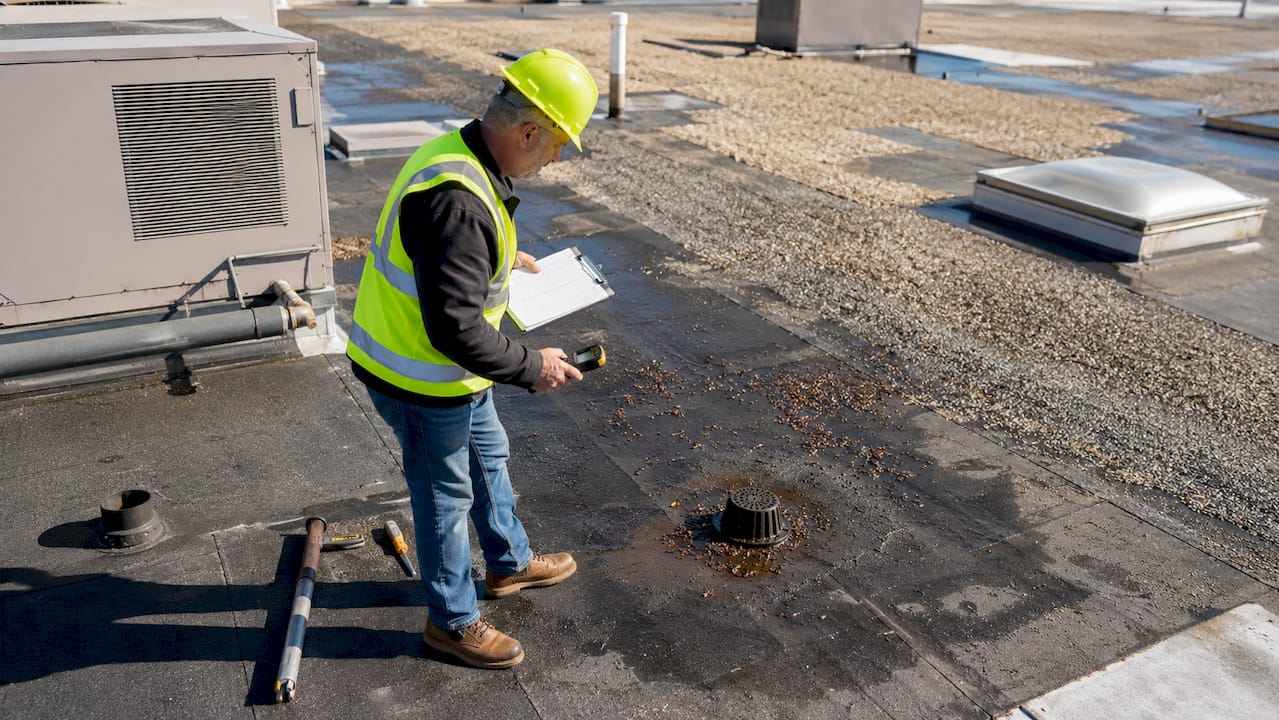
Biannual professional inspections in spring and fall are the industry standard for commercial properties. Spring inspections catch winter damage before summer heat stresses the membrane further. Fall inspections prepare the roof for freeze-thaw cycles and heavy rain. A $300 biannual inspection can prevent repair events exceeding $25,000, which represents roughly 80 times the return on investment.
Quarterly cleaning of drains, gutters, and scuppers keeps water moving off the roof. Monthly walkthroughs by facility staff catch debris accumulation between professional visits. Post-storm checks after winds above 60 mph or hail events should be added to the schedule regardless of season. For Texas properties, that means scheduling post-storm inspections after Gulf Coast weather events, not just the standard spring and fall visits.
Maintenance activity table
| Activity | Frequency | Who Performs It |
|---|---|---|
| Full professional inspection | Twice yearly (spring and fall) | Licensed roofing contractor |
| Drain and gutter clearing | Quarterly or after heavy rain | Facility management staff |
| Sealant and caulking renewal | Annually or as needed | Licensed roofing contractor |
| Debris removal from roof surface | Monthly | Facility management staff |
| Roof maintenance log update | After every inspection or repair | Facility manager |
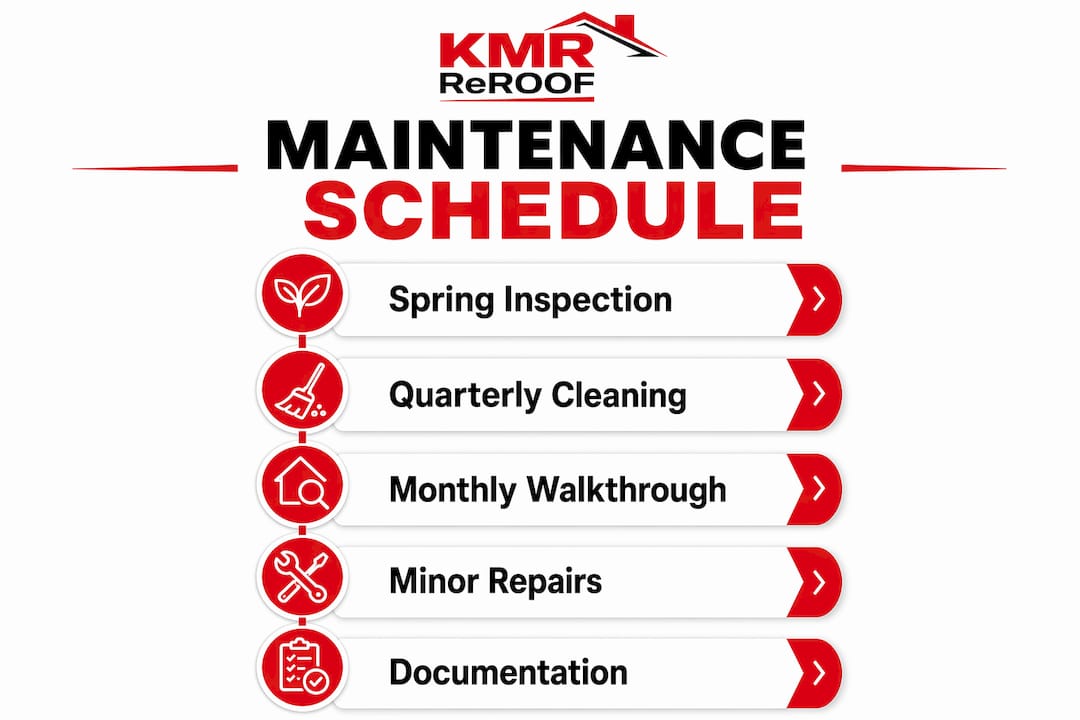
Pro Tip: Create a “living” roof maintenance log that records dates, locations, photos, and repair details after every visit. This document becomes your most valuable asset when filing warranty or insurance claims.
How do you identify signs of commercial roof damage early?
Interior warning signs appear before exterior damage becomes visible. Musty odors and ceiling stains signal hidden leaks that have already penetrated the membrane and begun saturating insulation below. Water intrusion damages insulation, electrical systems, and roof decking well before a visible drip appears inside your building. By the time occupants notice a stain, the moisture has often been traveling for weeks.
Exterior signs are equally telling once you know what to look for. Ponding water that stands more than 48 hours after rainfall is the most critical red flag on flat commercial roofs. Drain obstruction and poor drainage are the leading causes of premature membrane failure. Cracked seams, lifted flashing around HVAC units and vents, and blistering membrane surfaces all indicate that the roof needs professional attention immediately.
Here are the top signs of roof damage to check during every walkthrough:
- Ponding water standing longer than 48 hours after rain, indicating drainage failure
- Damaged or lifted flashing around penetrations, skylights, and parapet walls
- Cracked or separated membrane seams on TPO or EPDM surfaces
- Ceiling stains or discoloration inside the building, especially near exterior walls
- Musty odors in upper-floor spaces or near HVAC return vents
- Blistering or bubbling on the roof membrane surface
- Granule loss on modified bitumen or built-up roofing sections
For Texas properties, the common commercial roof problems most often traced back to ignored early warning signs include membrane separations and flashing failures around rooftop equipment. Catching these early cuts repair costs significantly.
What are the best practices for maintaining and repairing commercial roofs?
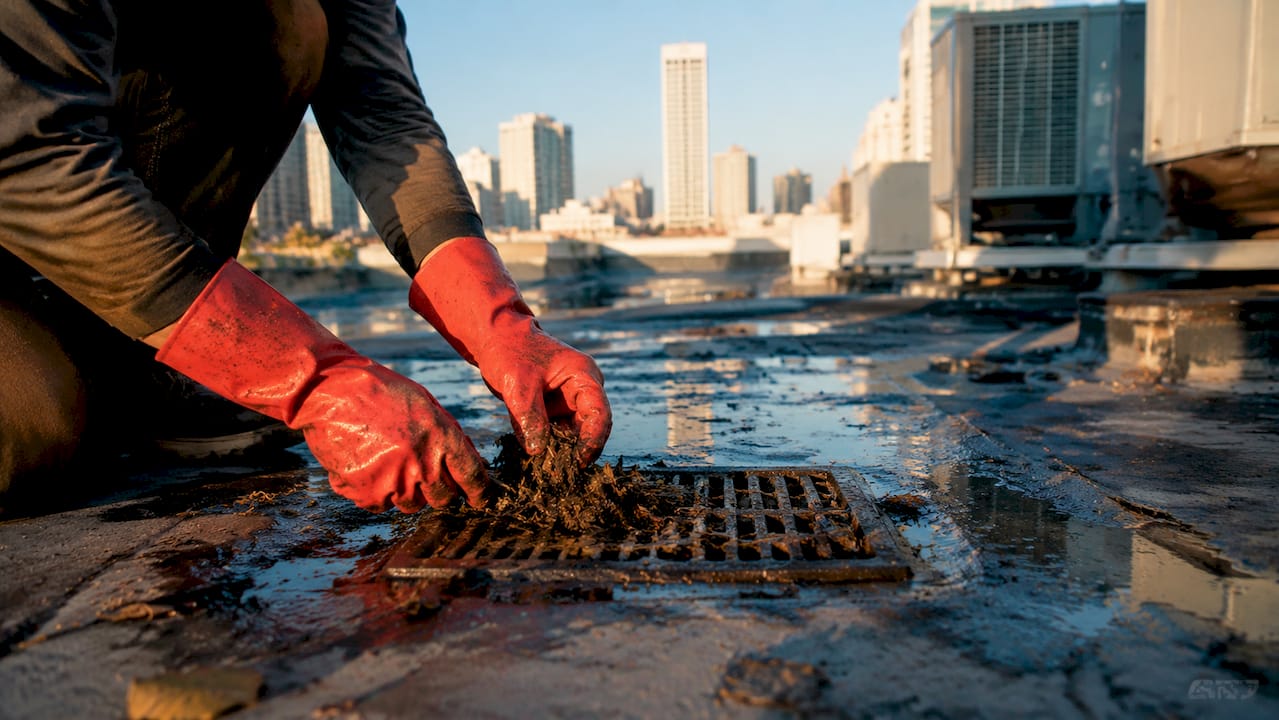
Regular drain cleaning is the single most important maintenance task on any flat commercial roof. Flat roof drains are the weak point of the system. When they clog, water pools, membrane integrity degrades, and structural loads increase. Clearing drains quarterly costs almost nothing. Replacing a membrane damaged by chronic ponding costs tens of thousands of dollars.
When to repair vs. when to replace
Minor repairs cover single-zone leaks, isolated flashing failures, and small membrane punctures. These are appropriate when the roof is under 15 years old and damage is confined to one area. Multiple unrelated leaks in different zones are a strong indicator of systemic failure. Piecemeal patching in that scenario masks the underlying problem and delays an inevitable replacement while adding unnecessary cost.
Use these criteria to guide the repair-versus-replace decision:
- Repair when damage is isolated, the roof is under 15 years old, and the membrane is structurally sound
- Replace when leaks appear in multiple unrelated zones, the insulation is saturated, or the roof has exceeded its design lifespan
- Replace when repair costs exceed 30% of full replacement cost within a two-year window
Pro Tip: Keep every repair invoice, inspection report, and photo in a single dated file. Many insurance companies deny storm damage claims in 2026 without documented inspection history. That file is your proof of due diligence.
Preventative maintenance budgeting follows a straightforward formula. For a 10,000 square foot roof, annual maintenance runs $500–$1,500. Full replacement on the same roof runs $50,000–$120,000. Allocating a consistent annual maintenance budget protects that asset and keeps the roof performing within its rated lifespan. Review the 2026 roofing trends for Texas to understand how material choices affect long-term maintenance costs.
What tools and services support a strong maintenance program?
Professional roofing contractors use thermal imaging cameras and moisture probes to detect water intrusion beneath the membrane surface. These tools identify wet insulation and hidden leaks that a visual inspection cannot catch. Thermal imaging is particularly effective on TPO and EPDM roofs, where moisture migrates laterally before causing visible damage. Scheduling a thermal scan every two to three years adds a layer of detection that routine walkthroughs cannot provide.
DIY checks vs. professional inspections
| Factor | Facility Staff Checks | Professional Inspection |
|---|---|---|
| Cost | Low (labor only) | $200–$500 per visit |
| Frequency | Monthly or quarterly | Twice yearly |
| Detection capability | Surface debris, visible damage | Subsurface moisture, seam integrity, flashing condition |
| Documentation value | Basic log entries | Formal written report with photos |
| Insurance and warranty use | Limited | Accepted by most insurers and manufacturers |
Asset management platforms like OxMaint allow facility teams to schedule inspections, log repairs, and track roof condition over time in a single system. These platforms generate reports that satisfy insurance documentation requirements and support warranty claims. For larger portfolios with multiple buildings, software-based tracking eliminates the risk of missed inspection cycles.
Facility staff should conduct monthly surface checks covering debris removal, drain condition, and visible membrane damage. Licensed roofing contractors handle biannual inspections, sealant renewal, and any repair work. That division of labor keeps costs manageable while maintaining the documentation trail that protects your investment. For flat roof properties in the Houston area, a dedicated flat roof maintenance program covers all of these components in a structured annual plan.
Key takeaways
A structured commercial roof maintenance program is the most cost-effective way to extend roof lifespan, prevent systemic failures, and protect your building’s value over the long term.
| Point | Details |
|---|---|
| Maintenance costs far less than replacement | Annual upkeep runs $0.05–$0.15 per sq ft versus $5–$12 per sq ft for premature replacement. |
| Biannual inspections are non-negotiable | Spring and fall professional inspections catch damage before it escalates into costly repairs. |
| Interior signs appear before exterior damage | Musty odors and ceiling stains signal hidden leaks that are already damaging insulation and decking. |
| Documentation protects your finances | Dated repair logs and inspection reports are required by most insurers for storm damage claims in 2026. |
| Multiple leaks signal replacement, not repair | Leaks in different zones indicate systemic failure; piecemeal patching only delays the inevitable. |
The maintenance mindset most property managers get wrong
Most property managers treat the roof as an emergency-only budget line. That approach costs more money over time, not less. The roof is a mechanical system, the same as your HVAC or elevator. It requires scheduled attention to perform within its rated lifespan. Treating it as a “fix it when it breaks” asset is the fastest way to face a six-figure replacement bill years ahead of schedule.
The most overlooked maintenance task I see on commercial properties is drain clearing. Facility teams walk the roof, note visible damage, and move on. The drains get ignored until water is pooling. By then, the membrane has been under stress for months. Clearing drains takes 20 minutes per quarter. The cost of ignoring them is measured in tens of thousands of dollars.
Documentation is the other gap I see consistently. Property managers spend money on inspections but never build a formal file. When a storm hits and they file an insurance claim, the insurer asks for inspection history. Without it, the claim gets denied or reduced. A simple dated folder with photos and reports from every inspection solves that problem entirely.
My honest recommendation: schedule your biannual inspections now, even if the roof looks fine from the ground. Most commercial roof failures are invisible until they are expensive. The $300 inspection is not a cost. It is a $25,000 risk reduction.
— Misterreroof
Ready to protect your commercial roof investment?
The financial case for professional roof maintenance is clear. A consistent inspection and repair program costs a fraction of what premature replacement demands. Misterreroof provides professional roofing inspections, detailed written reports, and tailored maintenance plans for commercial properties across El Campo and Houston, TX.
Whether your inspection reveals minor repairs or signals that replacement is the smarter financial move, Mister Reroof delivers honest assessments backed by real expertise. If your roof is approaching the end of its service life, review the flat roof replacement options available for Texas commercial properties. Contact Misterreroof today to schedule your inspection and get a free estimate before the next storm season arrives.
FAQ
How often should a commercial roof be inspected?
Commercial roofs require professional inspection twice per year, in spring and fall. Additional inspections should follow any storm event with winds above 60 mph or hail.
What is the cost of commercial roof maintenance per year?
Annual maintenance costs $0.05–$0.15 per square foot, or $500–$1,500 for a 10,000 square foot roof. Full replacement on the same roof runs $50,000–$120,000.
What are the most common signs of commercial roof damage?
The most common signs include ponding water standing more than 48 hours, damaged flashing around penetrations, cracked membrane seams, and interior ceiling stains or musty odors.
When should a commercial roof be repaired vs. replaced?
Repair isolated damage when the roof is under 15 years old and structurally sound. Replace when leaks appear in multiple unrelated zones or repair costs exceed 30% of full replacement cost within two years.
Why does roof maintenance documentation matter for insurance?
Many insurers in 2026 deny storm damage claims without a documented inspection history. Dated reports, photos, and repair logs serve as proof of due diligence and support successful claims.
