
TL;DR:
- A roof replacement reserve is a restricted fund that property owners set aside to cover future roof replacement costs. It helps prevent emergency expenses, ensures lender compliance, and maintains property value by planning ahead. Regular updates, early contributions, and site-specific assessments improve reserve accuracy and long-term financial control.
A roof replacement reserve is defined as a restricted fund that property owners and managers set aside specifically to cover the future cost of replacing a building’s roof. Unlike operating budgets, which fund day-to-day maintenance and repairs, a reserve fund accumulates capital over time for large, non-recurring capital expenditures. Lenders and industry guidelines often require annual contributions between $0.15 and $0.25 per square foot, or at least 10% of an HOA’s annual budget, to maintain adequate reserves. Without a dedicated roofing reserve fund, property owners face emergency capital calls, special assessments, and costly last-minute replacements that strain budgets and disrupt operations.
What is a roof replacement reserve and why does it matter?
A roof replacement reserve is the industry-standard mechanism for planning the largest single capital expenditure most buildings face. The formal term used in reserve studies and lender compliance documents is “replacement reserve” or “capital reserve.” Both terms describe the same concept: money set aside today to pay for a known future expense.
The distinction between operating funds and reserve funds is not just accounting preference. Reserve funds are restricted and cannot be used to cover operating shortfalls without triggering lender penalties and IRS complications. A property that dips into reserves to pay utility bills or staff costs faces real legal and financing consequences.
A reserve study combines a physical inspection of building assets with financial projections to produce annual funding targets. It estimates each component’s useful life, remaining life, and replacement cost, then adjusts for inflation to tell you exactly how much to set aside each year. Most lenders require a current reserve study as a condition of financing.
Property managers who treat the roofing reserve fund as optional discover the cost of that decision during the next hailstorm or membrane failure. Emergency replacements cost tens of thousands more than planned ones and generate tenant damage claims and service interruptions that compound the financial hit.
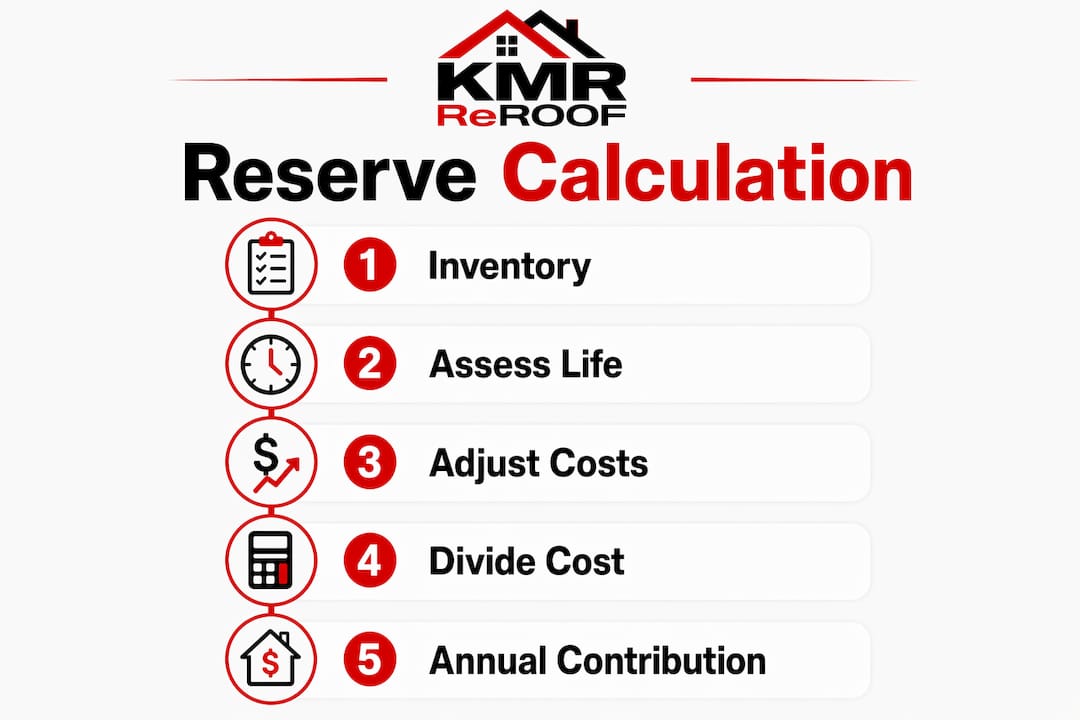
How to calculate your annual reserve contribution
The core formula is straightforward: divide the estimated future replacement cost by the number of years of remaining useful life. That quotient is your baseline annual contribution. Adjust it upward each year to account for inflation, which averages 3–5% annually for labor and materials.
Step 1: Inventory each roof section separately
Most commercial and multi-unit properties have multiple roof sections installed at different times, using different materials, and in different conditions. Each section needs its own reserve line. Common commercial roofing materials carry lifespans of 15–30 years, and replacement costs range from $4 to $16 per square foot depending on material type and site conditions. Treating the entire roof as one number produces a budget that is almost always wrong.

Step 2: Assess remaining useful life, not just age
Roof age is a poor proxy for remaining useful life (RUL). An 8-year-old roof with persistent ponding water may have less life left than a 15-year-old roof that has been properly maintained. RUL factors in drainage performance, membrane condition, flashing integrity, and repair history. Use a qualified roof inspector to assess RUL for each section before setting reserve targets.
Step 3: Adjust for site-specific cost factors
Generic cost-per-square-foot estimates miss a critical variable: access complexity. Complex roof access conditions including rooftop equipment density, building height, and limited staging space can increase replacement costs by 30% or more compared to simple installations. A five-story building with HVAC equipment covering 40% of the roof deck costs far more to replace than a single-story warehouse with clear access.
| Roof type | Typical lifespan | Replacement cost range |
|---|---|---|
| TPO membrane | 15–20 years | $5–$9 per sq ft |
| Modified bitumen | 15–25 years | $4–$8 per sq ft |
| Metal roofing | 40–70 years | $8–$16 per sq ft |
| Asphalt shingles | 20–30 years | $4–$7 per sq ft |
Pro Tip: Starting reserve contributions early in a roof’s life reduces annual funding pressure significantly. Beginning at year 5 rather than year 10 of a 20-year roof can reduce annual contributions from approximately $21,000 to $15,000 on a mid-size commercial property.
Why maintaining a roof reserve fund protects your property long-term
Proactive reserve funding is an investment in property longevity, not a cost center. Emergency replacements cost more, take longer to schedule, and force property owners to accept whatever contractor is available rather than selecting the best one. A funded reserve gives you time to get competitive bids, choose quality materials, and schedule work during off-peak periods.
The financial benefits extend beyond the replacement itself:
- Lender compliance: Most commercial lenders require proof of adequate reserves as a condition of refinancing or new financing. An underfunded reserve can block a deal entirely.
- Insurance underwriting: Insurers assess roof condition and reserve adequacy when pricing property coverage. A well-maintained reserve signals lower risk and can support better premium terms.
- Tenant relations: Unexpected roof failures cause interior damage, business interruptions, and lease disputes. Planned replacements minimize tenant disruption and protect occupancy rates.
- Property value: Well-planned roofing reserves support long-term property value by preventing deferred maintenance from compounding into structural problems.
- Tax treatment: A full roof replacement is depreciated over 39 years for commercial properties, while routine repairs are expensed in the current tax year. Reserves fund capital expenditures, which carry different tax treatment than operating costs.
“Reserves are part of asset management, giving owners control to schedule replacements on their terms rather than contractor-driven timelines during emergencies. Proactive capital planning improves cost control, installation quality, and reduces business interruption.”
Viewing your roofing reserve fund as asset management rather than budgeting changes how you make decisions. You stop reacting to roof failures and start controlling when, how, and at what cost replacements happen.
Best practices for managing roof replacement reserves
The way you hold and manage reserve funds matters as much as how much you contribute. These practices protect the fund and keep it working for you.
- Hold reserves in liquid, low-risk accounts. Money market accounts and short-term CDs are the preferred vehicles. Returns partially offset inflation, but liquidity is the priority. Replacement timelines are predictable, so the fund must be accessible when needed.
- Never commingle reserves with operating funds. Separate accounts prevent accidental misuse and satisfy lender audit requirements. Mixing the two creates tax complications and financing risk.
- Update reserve studies every 3–5 years. Property managers should re-evaluate reserve targets on this cycle to account for labor and material cost inflation, changes in roof condition, and updated replacement cost estimates.
- Prioritize sections by condition, not age. After each condition assessment, rank roof sections by RUL and adjust contribution levels for sections approaching end of life.
- Integrate reserve planning into annual financial reviews. Reserve targets should appear in the annual property budget alongside operating expenses, not as a separate afterthought.
Pro Tip: Schedule roof replacements during late summer or early fall when contractor availability is higher and material lead times are shorter. Planned timing gives you better bid outcomes and avoids the premium pricing that comes with emergency work.
Common mistakes that undermine roof reserve planning
Most reserve shortfalls trace back to a small set of avoidable errors. Recognizing them early prevents the financial gaps that force emergency funding.
- Using age instead of RUL. A roof’s installation date tells you how old it is. Condition tells you how much life it has left. Skipping a professional RUL assessment produces reserve targets that are either too low or too high.
- Applying generic cost estimates without site adjustment. A $6 per square foot estimate from an industry average ignores your building’s specific access complexity, equipment density, and local labor costs. Always get site-specific pricing before finalizing reserve targets.
- Confusing reserve funds with operating funds. This is the most costly mistake. Using reserve funds to cover operating shortfalls triggers lender penalties and IRS complications. The accounts must stay separate.
- Delaying contributions until a problem appears. Waiting until the roof shows visible failure means starting contributions when the replacement timeline is shortest and annual funding requirements are highest.
- Overfunding without reassessment. Tying up excessive capital in reserves when a roof is in excellent condition and has 20 years of life remaining is poor asset management. Update targets regularly to keep contributions proportional to actual risk.
Pro Tip: After any major weather event, commission a condition assessment before your next reserve study update. Texas hail and wind events can shorten RUL by several years, making your current reserve target obsolete overnight. Misterreroof offers free replacement estimates that can anchor your updated cost projections.
Key Takeaways
A funded roof replacement reserve is the single most effective tool property owners have to control replacement costs, maintain lender compliance, and protect long-term property value.
| Point | Details |
|---|---|
| Reserve vs. operating fund | Reserve funds are restricted accounts; mixing them with operating funds creates legal and tax risk. |
| Annual contribution formula | Divide estimated future replacement cost by remaining useful life, then adjust for 3–5% annual inflation. |
| RUL over age | Remaining useful life, not installation date, determines how much to contribute and when to replace. |
| Site-specific cost adjustment | Access complexity can increase replacement costs by 30% or more beyond standard per-square-foot estimates. |
| Early funding advantage | Starting contributions earlier in a roof’s life significantly reduces annual funding requirements. |
Why I think most property owners get this backward
After working closely with property owners across Texas, the pattern is consistent: reserves get funded reactively, not proactively. A roof fails, an emergency assessment goes out, tenants complain, and suddenly everyone wishes they had started a fund five years earlier.
The uncomfortable truth is that a roof replacement reserve is not a financial burden. It is the mechanism that gives you control. When you have a funded reserve, you choose the contractor, the material, and the timing. When you do not, the roof chooses for you, usually at the worst possible moment and at the highest possible cost.
Capital planning for roofing is also simpler than most property owners expect. The math is not complicated. The discipline is. Setting aside a fixed monthly amount into a separate account, updating the target every few years, and commissioning a condition assessment after major weather events covers 90% of what good reserve management requires.
The property owners I have seen manage this well share one trait: they treat the roof as a depreciating asset with a known replacement date, not as a permanent fixture. That mindset shift changes everything about how they budget, plan, and ultimately spend money on their buildings.
— Results
Roof replacement planning support from Misterreroof
Property owners in El Campo and Houston, TX, who are ready to move from reactive repairs to planned replacements have a direct resource in Misterreroof.

Mister Reroof specializes in metal, shingle, flat, and TPO roof replacements, and provides free estimates that give property owners the site-specific cost data they need to set accurate reserve targets. Whether you manage a single commercial building or a portfolio of residential properties, accurate replacement cost figures are the foundation of any reserve plan. Start with the Texas roof replacement guide to understand material options, cost ranges, and what to expect from the replacement process. For Houston-specific budgeting, the Houston replacement cost guide covers the $8,500 to $28,000 cost range with material-by-material breakdowns. Contact Misterreroof today for a free estimate and get the numbers your reserve plan actually needs.
FAQ
What is a roof replacement reserve fund?
A roof replacement reserve fund is a restricted savings account that property owners and managers contribute to annually, specifically to cover the future cost of replacing a building’s roof. It is separate from operating funds and governed by lender and regulatory requirements.
How much should I contribute to a roofing reserve each year?
The annual contribution equals the estimated future replacement cost divided by the remaining useful life of the roof, adjusted upward each year for inflation averaging 3–5%. Industry guidelines suggest contributions between $0.15 and $0.25 per square foot annually as a baseline.
When should I start a roof replacement reserve?
Start as early in the roof’s life as possible. Beginning contributions at year 5 rather than year 10 of a 20-year roof can reduce annual funding requirements by roughly $6,000 per year on a mid-size commercial property, according to capital planning benchmarks.
Can I use reserve funds for routine roof repairs?
No. Reserve funds are restricted to capital expenditures like full roof replacements, not routine maintenance or repairs. Using reserve funds for operating costs triggers lender penalties and creates IRS complications.
How often should I update my roof reserve study?
Update your reserve study every 3–5 years, or immediately after a major weather event that may have shortened the roof’s remaining useful life. Condition changes from hail, wind, or ponding water can make existing reserve targets inaccurate within a single season.
