
TL;DR:
- A roofing scope of work is a detailed written document that defines every task, material, and standard before construction begins. It protects property owners by ensuring clear expectations, preventing disputes, and maintaining warranty compliance. Properly reviewing and managing this scope reduces the risk of costly errors and project misunderstandings.
A roofing scope of work is a detailed written document that defines every task, material, installation standard, and exclusion in a roofing project before a single nail is driven. Known formally in the construction industry as a Statement of Work or SOW, this document is the legal and operational backbone of any roofing contract. Without it, property owners have no reliable way to compare bids, verify quality, or hold a contractor accountable. A well-written roofing project scope protects everyone involved and prevents the disputes that derail projects and drain budgets.
What essential elements must a roofing scope of work include?
A complete roofing scope of work covers far more than a list of materials. Comprehensive scope documents typically run 1–3 pages and include unit pricing for deck repair, precise ice-and-water shield placement, and separate warranties for materials and labor. Every element below must appear in writing before you sign anything.
Core structural and material specifications
The scope must state the roof type, total squares, and pitch. It should name the exact manufacturer, product line, color, and warranty class for every material used. Shingle weight, underlayment type, and starter strip brand all belong here. Vague language like “quality shingles” gives a contractor room to substitute cheaper products without technically violating the contract.

Tear-off and deck preparation details are equally critical. The scope should specify whether the existing roof will be fully removed or overlaid, how many layers are present, and what condition the decking is expected to be in. Roof ventilation requirements and nailing patterns per manufacturer specifications must also appear, because improper fastening can void a material warranty entirely.
Flashing, penetrations, and cleanup
Flashing around chimneys, skylights, vents, and walls is one of the most common sources of post-project leaks. The scope must specify the flashing material, gauge, and installation method for every penetration. Generic language like “flash as needed” is a red flag that signals an incomplete document.
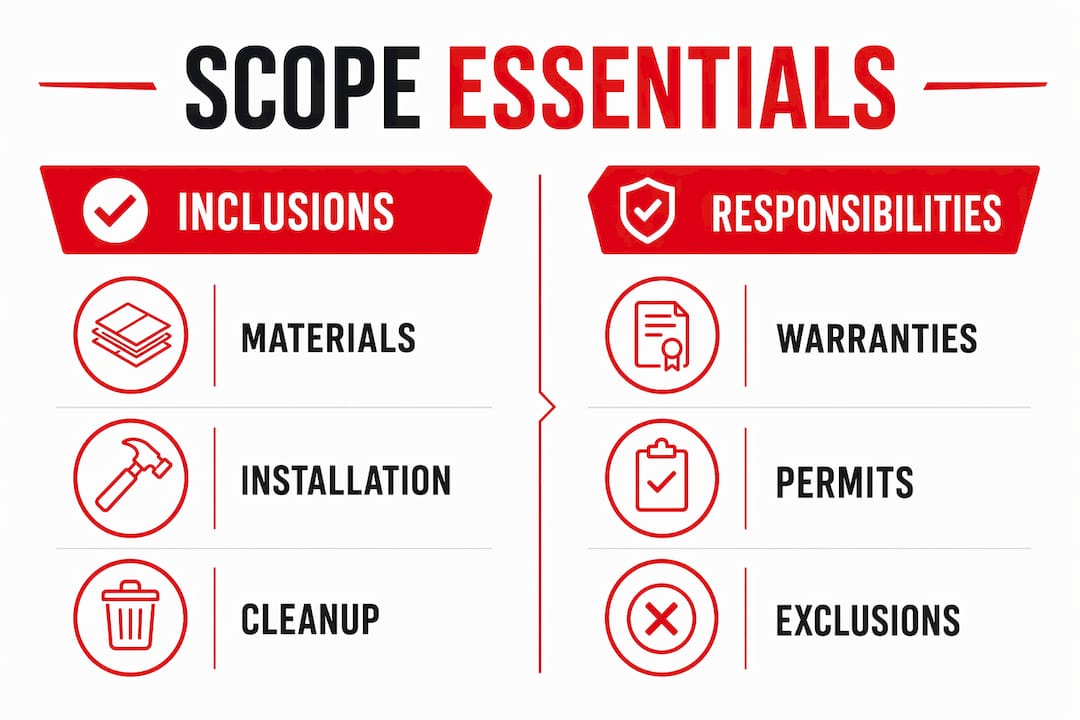
Cleanup procedures belong in the scope too. Clear cleanup expectations include magnetic nail sweeps, debris removal, and protection of landscaping and property. Without this language, disputes over nail damage to tires or dead shrubs become common after the crew leaves.
Pro Tip: Ask your contractor to list the specific manufacturer and product line for every material in the scope. If they resist, that resistance tells you something important about how they operate.
Warranty and permit responsibilities
The scope must separate material warranties from workmanship warranties and state the duration of each. Permit responsibilities and code upgrade obligations must also be documented, including who pulls the permit and who pays for any required upgrades. These details become major contention points when they are left out.
| Scope Element | What to Look For |
|---|---|
| Material specs | Manufacturer name, product line, color, warranty class |
| Tear-off details | Number of layers removed, decking inspection criteria |
| Flashing and penetrations | Material type, gauge, and method for each location |
| Ventilation and nailing | Pattern per manufacturer specs, ridge vent type |
| Cleanup | Magnetic sweep, debris removal, landscaping protection |
| Warranties | Separate terms for materials and labor, duration of each |
| Permits | Who pulls them, who pays for code upgrades |
How does a roofing scope of work differ between residential and commercial projects?
Residential and commercial roofing scopes share the same basic structure, but commercial projects carry significantly more technical weight. A missed detail on a commercial scope can void a warranty worth tens of thousands of dollars or create owner liability for structural failure.
Additional technical requirements for commercial projects
Commercial scopes must address wind uplift fastening patterns, insulation R-values, drainage plans, and interfaces with plumbing, mechanical, and electrical systems. Missing wind uplift specifications and manufacturer pullout values can void NDL (No Dollar Limit) warranty coverage and expose the building owner to direct liability. NDL warranties are the gold standard in commercial roofing because they cover both materials and labor with no cap on the repair cost.
- Wind uplift fastening patterns. The scope must specify the fastener type, spacing, and pullout value required by the manufacturer for each roof zone.
- Insulation R-values. Commercial energy codes set minimum R-values. The scope must confirm the installed insulation meets or exceeds local requirements.
- Drainage and slope. Flat and low-slope commercial roofs require detailed drainage plans. Ponding water is the leading cause of premature membrane failure.
- Trade interfaces. HVAC curbs, plumbing vents, and electrical conduits all penetrate the roof deck. The scope must define who is responsible for each penetration’s waterproofing.
- NDL warranty compliance. Every installation step must align with the manufacturer’s published requirements. Deviations, even minor ones, can trigger warranty voidance.
Residential vs. commercial scope complexity
Residential scopes focus on shingle type, underlayment, flashing, and ventilation. Commercial scopes layer in membrane type, tapered insulation systems, and multi-trade coordination. A property manager overseeing a commercial building should treat the scope as a technical specification sheet, not just a work order. Reviewing it with a roofing consultant before signing is money well spent.
What are common pitfalls and misconceptions in roofing scopes of work?
The single biggest mistake property owners make is treating a vague scope as an inclusive one. Experts consistently warn that unlisted tasks are almost never included, regardless of what a contractor says verbally. Verbal promises carry no legal weight once a dispute reaches arbitration or court.
- Confusing an estimate with a scope. An estimate gives you a price. A scope defines the work. Scopes include line-item pricing for unforeseen conditions like deck replacement, which protects you from surprise change orders mid-project.
- Accepting vague language. Phrases like “flash as needed,” “repair as required,” or “standard installation” are undefined. They give contractors discretion you did not intend to grant.
- Skipping the exclusions list. Exclusions like interior ceiling damage, mold remediation, and solar panel removal must be explicitly listed. If they are not excluded in writing, you may find yourself arguing about who pays for them.
- Ignoring permit and site access terms. Details like driveway clearance and animal containment seem minor until a crew cannot access the roof or a vehicle gets blocked. These details belong in the scope.
- Signing without requesting revisions. If a scope is incomplete, ask for revisions before signing. A contractor who refuses to add specifics is signaling that the vagueness is intentional.
Pro Tip: Read the exclusions section as carefully as the work description. What a scope does not cover is just as important as what it does.
Reviewing common roof replacement mistakes before you sign any contract gives you a concrete checklist of what to watch for. Property owners who skip this step often pay for it twice.
How to use a roofing scope of work to manage your project effectively
A signed scope of work is not a document you file and forget. It is your primary management tool from the first day of work through final inspection. Using it actively separates property owners who get what they paid for from those who spend months in disputes.
- Compare bids on equal terms. A scope functions like a recipe: it specifies every ingredient and step, making it possible to compare two bids for the exact same work. Without a shared scope, you are comparing apples to oranges.
- Document all expectations before work begins. Walk the site with your contractor and confirm that the scope reflects what you discussed. Any verbal agreement made during that walkthrough must be added to the scope in writing before the crew starts.
- Monitor progress against the scope. Check off each line item as work is completed. If the scope calls for a specific underlayment and you see a different product on the pallet, stop the work and ask for clarification immediately.
- Handle changes through written amendments. Any deviation from the original scope, whether requested by you or the contractor, requires a written change order signed by both parties. Verbal approvals for scope changes are the most common source of billing disputes.
- Use the scope for final inspection. Walk the completed roof with the scope in hand. Verify that every specified material was installed, every penetration was flashed per the document, and cleanup was completed as written.
- Understand warranty implications. Roofing warranties in Texas are directly tied to scope adherence. If a contractor skips a step listed in the scope, that deviation can give the manufacturer grounds to deny a warranty claim.
Pro Tip: Take dated photos at each stage of the project. If a dispute arises later, photos showing what was installed under the shingles are far more persuasive than memory.
Understanding what to expect from contractor estimates before the scope is finalized helps you ask better questions and catch gaps early.
Key takeaways
A roofing scope of work is the single most important document in any roofing project, defining every material, task, and exclusion that determines project quality and cost.
| Point | Details |
|---|---|
| Scope vs. estimate | A scope defines the work in detail; an estimate only provides a price. |
| Essential elements | Include material specs, flashing details, ventilation, cleanup, warranties, and permits. |
| Commercial complexity | Commercial scopes must address wind uplift, R-values, and NDL warranty compliance. |
| Vague language is risky | Terms like “flash as needed” give contractors undefined discretion. |
| Active management tool | Use the scope to compare bids, monitor progress, and verify final completion. |
Why I think most roofing disputes are entirely preventable
After years of watching roofing projects go sideways, the pattern is almost always the same. The scope was vague, one party assumed something was included, and the other party assumed it was not. The argument that follows is not really about the roof. It is about a document that should have been clearer from the start.
Property owners tend to underestimate their leverage before signing. A contractor who wants the job will almost always agree to add specifics to a scope if you ask. The ones who push back on adding detail are the ones worth walking away from. A detailed scope is not a sign of distrust. It is a sign of professionalism on both sides.
The blueprint analogy holds up in practice. A builder would never start framing a house from a sketch on a napkin. A roofing project deserves the same discipline. The scope is where that discipline lives. Property managers overseeing multiple buildings have the most to gain here, because a well-written scope becomes a reusable template that sets a consistent standard across every project.
The uncomfortable truth is that most disputes I have seen were not caused by bad contractors. They were caused by incomplete documents that left too much room for interpretation. Fix the document, and you fix most of the problems before they start.
— Results
Misterreroof: clear scopes, quality results
Misterreroof brings the same level of detail to every project in El Campo and Houston, TX. Every estimate comes with a thorough written scope that names specific materials, defines installation standards, and spells out what is and is not included. There are no vague terms and no surprise change orders. Whether you need a shingle, metal, flat, or TPO roof replacement, Mister Reroof documents the work before the crew arrives. Read the Texas roof replacement guide to understand exactly what a professional scope looks like for your property, then contact Misterreroof for a free estimate.
FAQ
What is a roofing scope of work?
A roofing scope of work is a written document that defines every task, material, installation standard, and exclusion in a roofing project. It serves as the legal and operational reference for both the property owner and the contractor throughout the project.
How is a scope of work different from a roofing estimate?
An estimate provides a total price, while a scope of work defines exactly what work will be performed and with which materials. Scopes also include line-item pricing for unforeseen conditions like deck replacement, protecting owners from unexpected change orders.
What should be excluded in a roofing scope of work?
Exclusions like interior ceiling damage, mold remediation, and solar panel removal must be listed explicitly. If these items are not excluded in writing, disputes about who pays for them are common.
Why does a commercial roofing scope need more detail?
Commercial scopes must specify wind uplift fastening patterns, insulation R-values, and trade interfaces to maintain NDL warranty coverage. Omitting these technical details can void the warranty and create direct liability for the building owner.
Can I request changes to a roofing scope before signing?
Yes, and you should. Any incomplete or vague language in the scope should be revised before you sign the contract. A contractor who refuses to add specifics is a contractor worth reconsidering.
